

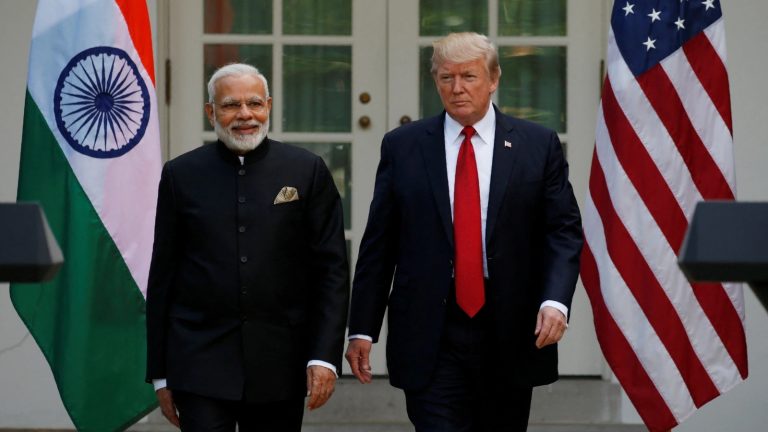
President Donald Trump on Thursday said that trade negotiations with India were progressing positively and hinted at a potential visit to New Delhi in 2026 if invited by Prime Minister Narendra Modi.
The comments, made during a White House press briefing, come as both sides move to mend a relationship strained by tariffs, visa restrictions, and a long-standing dispute over India’s purchases of Russian oil.
Trump described Modi as “a great man” and “a friend,” recalling his last trip to India in 2020, when he was received by a cheering crowd of more than 100,000 at the “Namaste Trump” rally in Ahmedabad.
Register for Tekedia Mini-MBA edition 20 (June 8 – Sept 5, 2026).
Register for Tekedia AI in Business Masterclass.
Join Tekedia Capital Syndicate and co-invest in great global startups.
Register for Tekedia AI Lab.
“India has largely stopped buying oil from Russia,” Trump said, adding that ties between the two nations were “stronger than ever.”
The remarks mark a notable shift in tone following months of friction between Washington and New Delhi. Analysts say Trump’s comments could signal an effort to rebuild trust after a difficult period in which the U.S. imposed steep tariffs on Indian goods and questioned India’s neutrality in the Russia-Ukraine conflict.
Over the past year, U.S.-India relations have faced turbulence due to what many observers described as “missing chemistry” between the two leaders, alongside contentious policy moves from Washington. India currently faces 50% tariffs on its exports to the U.S. — higher than the 47% duties applied to Chinese goods — and an additional $100,000 fee for H1B visa applicants, a change that directly impacts thousands of Indian tech professionals each year.

But perhaps the most contentious issue has been India’s oil trade with Russia.
The oil rift that tested a friendship
When the U.S. and its allies imposed sanctions on Moscow following its invasion of Ukraine, India refused to join the Western embargo and instead ramped up imports of discounted Russian crude. The move was framed by New Delhi as an economic necessity — not a political statement. Indian officials repeatedly emphasized that the country’s energy security could not be compromised, especially given that more than 85% of its oil is imported.

Washington, however, saw India’s position as undercutting the effectiveness of Western sanctions. For months, American officials privately pressed New Delhi to reduce its dependence on Moscow’s crude, warning that continued purchases risked damaging its global standing.
Despite the pressure, India maintained that its engagement with Russia was within the limits of the G7’s price cap framework — which allows the purchase of Russian oil below $60 per barrel — and argued that it was helping stabilize global markets by keeping Russian crude flowing.
However, in recent weeks, New Delhi has quietly reduced its Russian oil purchases, citing U.S. sanctions targeting Russian oil majors Rosneft and Lukoil, which take effect on November 21. As a result, refiners in both India and China have begun to scale back their imports.
A Reuters report on Thursday said Russian oil in Asia is now trading at its steepest discount to Brent crude in a year, a sign that demand from its biggest Asian buyers — India and China — has weakened.
India’s Ministry of Petroleum and Natural Gas did not immediately respond to media requests for comment, but traders familiar with the matter told Reuters that some Indian refiners have switched to Middle Eastern suppliers in anticipation of tighter enforcement of U.S. sanctions.
Still, experts say India’s exit from Russian oil is unlikely to be complete. “Over the long term, completely phasing out Russian oil isn’t realistic for India,” said Prateek Pandey, head of APAC oil and gas research at Rystad Energy. “As Russian crude becomes available at a sharper discount, New Delhi’s ‘economics first’ approach will be tested more than ever.”
A deal in sight
Against that backdrop, Trump’s remarks about “going well” trade talks suggest Washington is ready to ease its tone — and possibly its tariffs. “Negotiations between New Delhi and Washington D.C. are ongoing, and both sides appear optimistic about a trade deal being reached by the end of the year, possibly even in the next few weeks,” said Alexandra Hermann, head of Southeast Asia Research at Oxford Economics.
She noted that the proposed tariff reduction could lower India’s export duties to 20% from the current 50%, aligning the country more closely with regional peers such as Vietnam, Thailand, and the Philippines.
“However, the baseline tariff on India may not fall to Japan and South Korea’s level of 15% due to sticking points around purchases of Russian oil, agricultural imports, and India’s limited scope to commit to sizable investments in the U.S.,” Hermann said.
Trump’s comments come shortly after his meeting with Chinese President Xi Jinping in Korea, where both leaders discussed the global trade slowdown and tariff reform. That meeting, observers say, may have encouraged the White House to recalibrate its trade approach with key Asian economies — particularly India, which Washington sees as a counterweight to Beijing’s regional influence.