

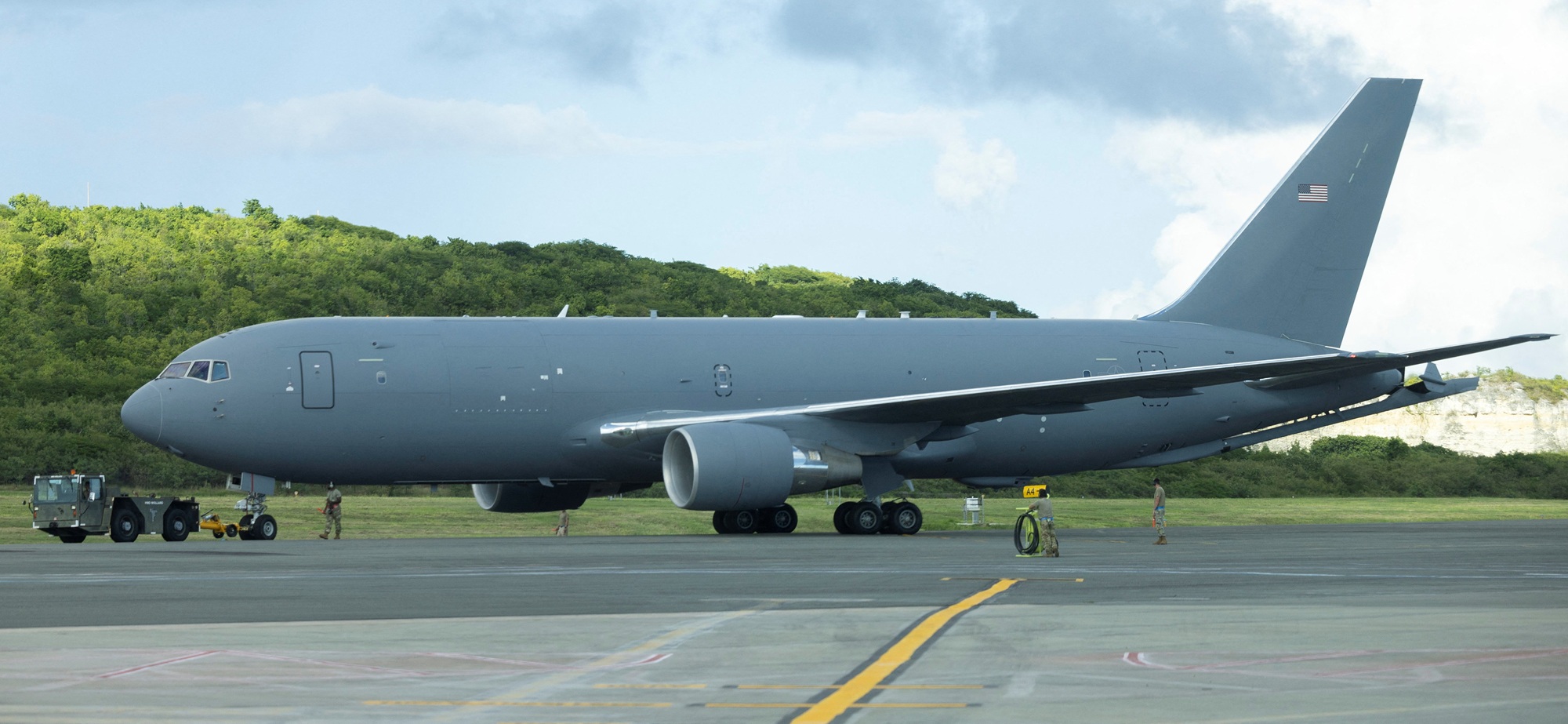
On Tuesday, the U.S. Air Force awarded Boeing a $2.47 billion contract to deliver 15 additional KC-46A Pegasus aerial refueling tankers.
This follows a nearly identical deal in 2024 for the same number of aircraft, then priced at $2.38 billion, signaling steady Pentagon demand even as Boeing grapples with ongoing global headwinds. The KC-46A programme, long criticized for defects ranging from foreign-object debris to supplier-quality issues, has now delivered 98 tankers to the Air Force since 2019, putting Boeing in a stronger position to reclaim confidence from military and international customers alike.
But this contract win reflects only part of a larger story: Boeing’s gradual, and far from complete, decoupling from the economic fallout of the U.S.–China trade war, which once threatened to undermine its global commercial business and exhaust its cash reserves.
Register for Tekedia Mini-MBA edition 20 (June 8 – Sept 5, 2026).
Register for Tekedia AI in Business Masterclass.
Join Tekedia Capital Syndicate and co-invest in great global startups.
Register for Tekedia AI Lab.
Over the past year, Boeing found itself at the center of escalating trade tensions between Washington and Beijing. As U.S. tariffs soared to as much as 145 percent on Chinese imports, China retaliated with steep levies (125 percent) on U.S.-made goods, including commercial aircraft. To protect its airlines from skyrocketing costs, Chinese authorities directed carriers to suspend deliveries of Boeing jets and related parts.
As part of the impact, several jets, including 737 MAX airliners already painted in Chinese-carrier liveries, were flown back to Boeing’s Seattle factories from China’s Zhoushan completion facility.
The shift effectively shut Boeing out of one of the fastest-growing aviation markets in the world at a time when China was projected to account for roughly a fifth of global aircraft demand.

Equally damaging was the effect on Boeing’s supply chain. Building modern commercial aircraft depends on a vast network of global suppliers, many of them outside the United States. With trade barriers raised, Boeing faced doubled costs on parts and increased difficulty sourcing components — a blow to both margins and production timelines.
As orders collapsed and aircraft slated for Chinese carriers piled up unsold, Boeing’s finances creaked. Deferred deliveries translated into inventory carrying costs, stalled revenue recognition (since buyers pay only on delivery), and increased pressure on cash flow.
Some analysts estimated that losses tied to delayed or cancelled China deliveries could reach a billion-plus dollars in 2025 alone.

For a company that relied for decades on China as a key growth engine, sometimes delivering a quarter of its commercial jets there, the disruption threatened not just a temporary revenue drop, but a structural setback.
Faced with shrinking demand from China and elevated costs, Boeing adopted a deliberate pivot — expanding its reliance on international customers outside China, focusing on military contracts, and working hard to stabilize operations and cash flow.
CEO Kelly Ortberg recently said that Boeing is “not going to continue to build airplanes for customers who will not take them.”
Instead, the company has directed much of its 2025 production capacity — especially 737 MAX jets — toward other global buyers rather than waiting for China’s market to reopen fully.
This reallocation appears to be paying off. In Q1 2025, Boeing reported a much narrower loss than feared, $31 million compared with the prior year’s much larger deficit, alongside revenue of $19.5 billion, boosted by strong delivery numbers. Its cash burn, once a key concern, also reportedly shrank significantly.
Moreover, orders and deliveries for military aircraft — which are less sensitive to trade politics and airlines’ cost pressures — have become more prominent in Boeing’s mix. The new KC-46A tanker order is one of several recent defense deals that help offset losses from stalled commercial deliveries.
In effect, Boeing is trying to reshape itself from a company tethered to cyclical airline demand in a few markets into a more balanced aerospace exporter with both commercial and defense streams — better insulated from trade-war shocks.
Why the KC-46A Deal Matters — Symbolism and Strategy
The $2.47 billion contract for 15 KC-46A Pegasus tankers doesn’t just represent revenue. It is a signal that Boeing remains a trusted partner for the U.S. military even as it navigates one of the most turbulent commercial periods in its history. The fact that the new contract comes at a similar price point to last year’s underlines stability in U.S. defense procurement even as global geopolitical and trade pressures swirl.
This provides a dual benefit for Boeing. First, it brings in predictable, high-margin revenue at a time when commercial market demand remains uncertain. Second, it reinforces Boeing’s standing in Washington and among allied nations — a critical asset if the company hopes to leverage future international defense sales or offset commercial volatility with long-term defense contracts.
Seen against the backdrop of China’s delivery freeze and supply-chain disruption, the tanker deal underscores how Boeing is leaning on its diversification strategy — balancing commercial uncertainty with defense demand.
Still a Long Road With Risks
But while Boeing’s recent performance offers hope, challenges linger. The trade war with China is not definitively resolved; tariffs remain high, and Beijing’s airlines may continue to favor European or domestic manufacturers over American ones.
Global supply-chain costs remain elevated, particularly for aircraft such as the 787 Dreamliner that rely heavily on imported components.
For the commercial business to fully rebound, Boeing must not only offload planes originally destined for China, but also win new orders in other regions — a task complicated by reputational issues, competition (especially from Airbus), and rising global economic uncertainty.
Still, the KC-46A contract — and Boeing’s broader pivot — suggests the company is no longer relying on China alone. That shift may prove essential if Boeing hopes to emerge from the trade-war disruption not just stable, but structurally more resilient.