

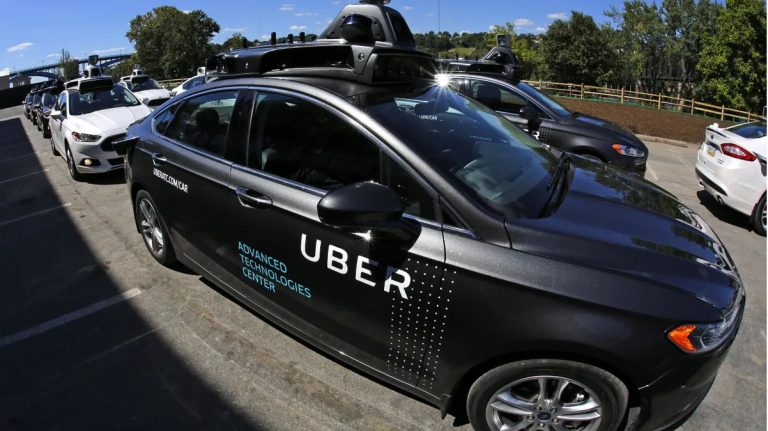
Uber CEO Dara Khosrowshahi has been blunt about what autonomous vehicles could mean for the millions of people who have built livelihoods on ride-hailing platforms.
Speaking at an All-In podcast summit, Khosrowshahi said human drivers will remain a major part of Uber’s network for the next five to seven years, but warned that “10 to 15 years from now, this is going to be a real issue,” adding that he has no “neat answer” for the social dislocation that could follow.
The company is already experimenting with autonomous options through partnerships such as its work with Waymo, but Khosrowshahi did not shy away from the human and political complexities ahead.
Register for Tekedia Mini-MBA edition 20 (June 8 – Sept 5, 2026).
Register for Tekedia AI in Business Masterclass.
Join Tekedia Capital Syndicate and co-invest in great global startups.
Register for Tekedia AI Lab.
“For the next five to seven years, we’re going to have more human drivers and delivery people, just because we’re going so quickly,” he said. “But, I think, 10 to 15 years from now, this is going to be a real issue.”
He highlighted Uber’s efforts to create alternative on-demand work—labeling and other tasks to help train AI—as one way the company is trying to soften disruption, but acknowledged those roles require different skills than driving.
The Robotaxi Race: Who’s Launching, Who’s Partnering, and How They’re Trying to Scale
The industry is no longer hypothetical. Multiple firms are moving from labs and piloting to paying customers and app integration—often through deals with incumbent ride-hail apps—that aim to accelerate adoption while lowering unit economics.

Waymo, Alphabet’s autonomous-driving unit, is perhaps the farthest along in mainstream deployment. It now operates paid robotaxi services in several U.S. cities and has broadened coverage and product offerings aimed at business users, including a corporate bookings product that plugs Waymo into company travel programs. Waymo is expanding its footprint—now serving cities such as San Francisco, Phoenix, Los Angeles, Austin, and Atlanta—and completes more than a million autonomous rides per month, positioning itself as the most mature commercial robotaxi operator.
Rather than always building its own consumer brand, some AV developers are striking partnerships with large ride-hail platforms to gain immediate network scale. Waymo’s multi-city agreement to run its Waymo One fleet within the Uber app in selected markets is a clear example: Uber handles dispatching and payment while Waymo provides the fully driverless vehicles. That integration model lets robotaxi operators reach riders without having to build a consumer business from scratch.
Legacy automakers and start-ups have also formed alliances. Motional has run a long-standing commercial robotaxi service with Lyft, notably in Las Vegas, and maintains partnerships aimed at wider rollouts. The Motional–Lyft relationship exemplifies how AV companies are relying on incumbent ride-hail networks to reach real riders at scale.

New commercial tie-ups continue to surface. This month, a Lucid–Nuro–Uber arrangement took a visible step forward with the first delivery of a Lucid Gravity vehicle to be retrofitted for autonomous use, a milestone in plans to deploy thousands of robotaxis in the coming years under collaborations that involve vehicle makers, autonomy software firms, and ride-hail platforms. These industrial partnerships aim to solve manufacturing, retrofitting, and fleet economics in parallel.
Tesla remains a wild card. CEO Elon Musk has long promised a “robotaxi” future driven by Tesla’s Full Self-Driving (FSD) software. Tesla’s approach differs: instead of selling a standalone robotaxi fleet, Tesla plans a distributed model where consumer vehicles with FSD capabilities can be pooled as on-demand robotaxis. That model has sparked regulatory scrutiny and public confusion about what “robotaxi” means in Tesla’s terms—because many of Tesla’s public statements conflate supervised FSD features with fully driverless service.
Regulators have warned that supervised systems are not the same as true Level-4 robotaxis.
Risk, Regulation, and the Crash Test for Commercialization
Ambition runs headlong into regulatory reality. Cruise’s early charge into multiple cities and a rapid launch trajectory became a cautionary tale after safety incidents triggered permit suspensions and intense regulatory review. That episode showed how quickly public confidence and approvals can be jeopardized—forcing some operators to pause, re-test, and re-engage with regulators to restore trust and permissions.
Cities and state regulators are wrestling with how to certify and oversee robotaxis. Approvals vary widely across jurisdictions, and companies must navigate local requirements for testing, insurance, safety reporting, and human-supervision fallback strategies. That patchwork creates friction for scaling nationally and incentivizes partnership strategies—teaming with a local dispatch brand or proving reliability in a small set of cities first.
Even where regulators have green-lit services, city geography and user behavior shape the economics. Operators are focusing first on concentrated corridors—airport links, downtown commutes, and business travel—where predictable demand can be monetized while the systems accumulate safety data and learning. Waymo’s focus on airport connectivity and business accounts, for example, is a deliberate effort to capture high-value trips and predictable usage patterns.
Pilot data from commercial services suggest robotaxis can exceed many human drivers on efficiency metrics and utilization, but they still struggle with edge-case scenarios that human drivers manage easily—bad weather, unusual construction, and chaotic urban interactions. Some drivers told Business Insider they are skeptical that robotaxis can handle potholes and messy street conditions today; that skepticism helps explain why human drivers are not panicking yet. But efficiency gains from driverless fleets—if sustained—represent a structural pressure on labor economics for ride-hail platforms. (This dynamic was one of Khosrowshahi’s central points.)
What This Means for Uber and Drivers
For Uber, the short-term playbooks are straightforward: keep human drivers productive and pay them for demand that still requires human judgment; integrate robotaxi supply where regulators and partners allow; and expand alternative income streams on the platform (labeling, data work) to soften displacement.
“We’re expanding into other kinds of on-demand work as well to be able to adjust the kind of work available to people who want to earn on our own platform,” he said.
However, Khosrowshahi warned that there is no simple fix for the long run.
“This is a big, big societal question that we’re going to have to struggle with, and lots of others are going to struggle with too,” Khosrowshahi said.
In practice, that means Uber will run hybrid networks for years: human drivers handling most trips while robotaxis serve targeted corridors and scale gradually through partnerships (e.g., with Waymo) and vehicle supply deals. If robotaxis reach the scale their backers promise, the labor question moves from operational to societal—requiring public policy, reskilling programs, or new social supports to mitigate displacement.