

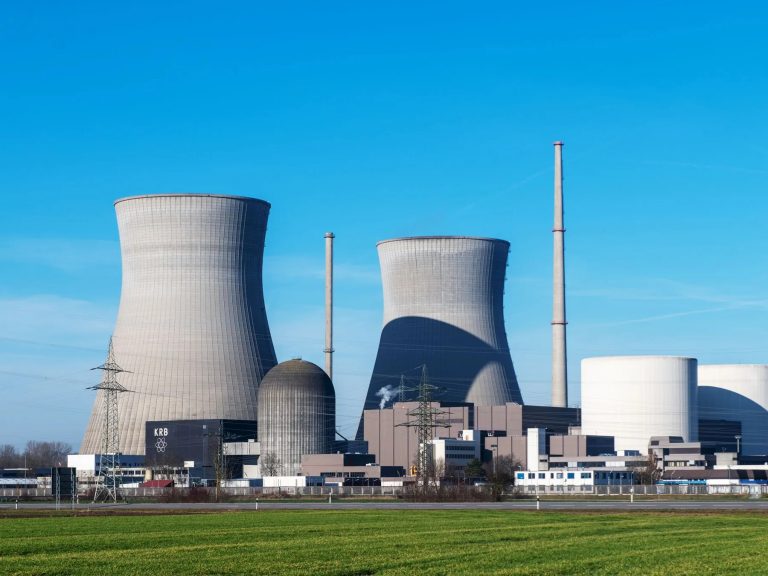
The United States is set for one of its most significant nuclear energy expansions in decades, as three companies — Westinghouse Electric, Cameco, and Brookfield Asset Management — announced a sweeping $80 billion plan to build a new fleet of nuclear reactors across the country in partnership with the U.S. government.
The initiative marks a bold step under President Donald Trump’s “energy dominance” agenda, which emphasizes a renewed focus on oil, gas, coal, and nuclear energy.
The plan comes amid surging electricity demand in the United States, the first such sustained increase in two decades, driven largely by the explosion of artificial intelligence data centers that require massive, constant power supplies to sustain machine learning and cloud computing operations. Officials and some business leaders believe nuclear energy, long neglected and controversial, could play a vital role in powering the next wave of AI-driven digital infrastructure while maintaining low-carbon output.
Register for Tekedia Mini-MBA edition 20 (June 8 – Sept 5, 2026).
Register for Tekedia AI in Business Masterclass.
Join Tekedia Capital Syndicate and co-invest in great global startups.
Register for Tekedia AI Lab.
Under the agreement, the U.S. government will help finance the construction of reactors using Westinghouse’s advanced nuclear technology and will also assist with permits and regulatory clearances. In return, Washington will obtain a participation interest that allows it to collect 20 percent of any cash distributions exceeding $17.5 billion once the projects are operational. However, the government’s equity interest will only take effect after a final investment decision and completion of key construction milestones.
While this partnership represents a major policy shift toward atomic power, it also revives long-standing concerns about the economics of new nuclear projects. The industry’s recent record has been marred by delays and massive cost overruns. The Vogtle nuclear expansion in Georgia, completed between 2023 and 2024, took seven years longer than expected and cost roughly $35 billion — more than double its initial $14 billion estimate. No other large-scale nuclear reactor is currently under construction in the United States, underscoring the financial and logistical hurdles the new initiative faces.
Critics have also renewed concerns about nuclear waste management, a persistent issue that remains unresolved. The U.S. still lacks a permanent repository for radioactive waste, forcing plant operators to store spent fuel on-site in cooling pools before transferring it into hardened casks. Environmental groups have noted that without a clear disposal plan, expanding the nation’s reactor fleet could pose long-term safety and storage challenges.

However, optimism is returning to the nuclear sector, largely fueled by the technological needs of the AI and cloud computing industries. Major technology companies, including Google, Microsoft, and Amazon, have begun securing long-term power contracts generated by next-generation nuclear systems, such as small modular reactors and even fusion-based facilities. These energy partnerships are seen as essential to maintaining consistent, carbon-free power for hyperscale data centers that operate around the clock.
Just this week, NextEra Energy and Google reached an agreement to restart an idle nuclear plant in Iowa, marking a symbolic shift toward nuclear’s reemergence as a cornerstone of digital-era energy planning. Similarly, Microsoft has partnered with Constellation Energy to revive one unit of the Three Mile Island nuclear station in Pennsylvania, which will directly power the company’s data centers.
The deal between Westinghouse, Cameco, and Brookfield also includes a clause that could see Westinghouse go public in the coming years. If the U.S. government’s participation interest vests and the company’s valuation exceeds $30 billion by January 2029, Westinghouse would be required to make a public share offering — a move that could reshape the global nuclear supply chain and attract institutional investors into the sector.

Cameco and Brookfield Renewable Partners acquired Westinghouse in 2023 for $7.9 billion, including debt, from Brookfield Business Partners, which had rescued the company from Toshiba’s bankruptcy in 2018 for $4.6 billion. Following Tuesday’s announcement, Cameco’s shares surged more than 15% in premarket trading, indicating strong investor confidence in the renewed U.S. nuclear drive.
The plan also aligns with President Trump’s May executive order promoting nuclear energy, which targets an additional 5 gigawatts of reactor capacity by 2030 — part of a broader push to secure energy independence and sustain industrial competitiveness amid growing AI-related power consumption.