

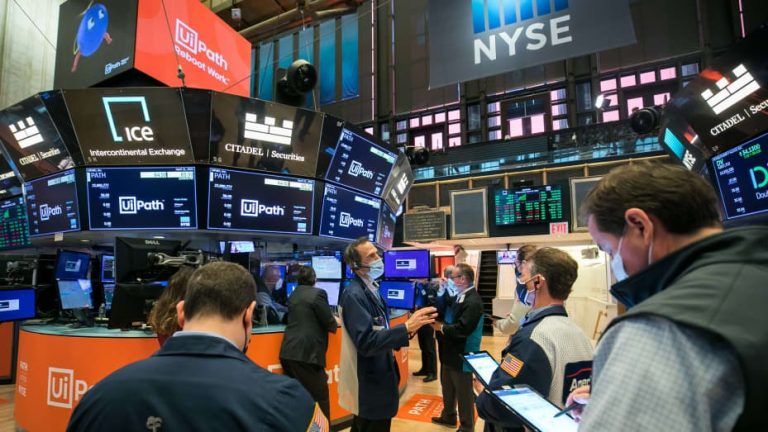
U.S. stock futures are pointing lower in premarket trading aligning with the observation of equities falling around 0.5%.
This comes amid renewed uncertainty over U.S. trade policy following President Donald Trump’s announcement of a new 15% global tariff after the Supreme Court struck down his prior broader “reciprocal” tariffs late last week.
Key futures levels (approximate, based on early morning reports): S&P 500 futures: Down ~0.3% to 0.5%; declines of 0.43% in some updates, or around -0.31% to -0.4%. Dow Jones futures: Down ~0.4% to 0.5% (e.g., -0.39% to -0.48%, with point drops around 200–239). Nasdaq 100 futures: Down ~0.5% to 0.6%.
The pullback reflects risk-off sentiment as investors weigh potential impacts from tariffs on growth, inflation, and corporate earnings—despite some positive reactions last week to the initial court ruling. Meanwhile, precious metals are gaining as safe-haven assets.
Register for Tekedia Mini-MBA edition 20 (June 8 – Sept 5, 2026).
Register for Tekedia AI in Business Masterclass.
Join Tekedia Capital Syndicate and co-invest in great global startups.
Register for Tekedia AI Lab.
Gold is up strongly, with futures climbing ~1% to 1.7% around $5,150–$5,170 per ounce, from a Friday close near $5,080–$5,100. Spot prices hovered near $5,150–$5,160. Silver: Showing even sharper gains, up ~2% to 5–6% around $86–$87 per ounce, with some reports of surges toward $87+.
This divergence is classic in periods of trade and geopolitical uncertainty: equities especially growth and tech-heavy face pressure from potential economic headwinds, while gold and silver benefit from flight-to-safety flows and a weaker dollar tone. Other notable premarket highlights include: Big moves in individual stocks; Novo Nordisk down sharply on trial data, Eli Lilly up; some miners higher alongside metals.
The new 15% global tariff introduces a temporary but broad cost shock to U.S. importers, with net effects on corporate earnings that are modestly negative in the short term—primarily through higher input costs, margin pressure, and heightened uncertainty—while the Supreme Court’s February 20 ruling striking down broader IEEPA-based tariffs provided some near-term relief.
Flat 15% on most imports raised from an initial 10% announcement. Exemptions include Section 232 goods; USMCA-compliant Canada and Mexico goods, and key categories like pharmaceuticals, electronics, critical minerals, energy products, specific agricultural items (beef, tomatoes, fertilizers), aerospace, and others.

Heaviest exposure falls on metals, electrical equipment, motor vehicles/parts, and (if extended) apparel. Temporary (150 days, ~July 2026 expiration unless Congress extends or new authorities are used). This limits full-year 2026 impact but creates front-loaded pressure in Q1–Q2.
With new 15% Section 122: Rises to ~12.2–13.7% depending on behavioral adjustments and exemptions. Net for many firms: Partial relief vs. prior regime (refunds possible on struck-down duties, estimated >$175B at risk), but new blanket adds costs where exemptions don’t apply. Remaining Section 232 tariffs keep baseline elevated ~4.5% effective long-run per some models.
Tariffs function as a tax on imports ~$3T+ annual U.S. goods imports. Affected companies face: COGS inflation: Up to 15% on the imported share of inputs and inventory. Import-reliant sectors see the biggest hit. Historical data shows 55–80% passed to consumers via price hikes; the rest absorbed via lower margins or cost cuts.

Goldman Sachs and Yale estimates suggest consumers bear ~55–70%, businesses ~22%+. Firms may accelerate imports pre-Feb 24 or draw down stockpiles, muting Q1 impact—but Q2 could see sharper pressure. Supply-chain shifts (nearshoring/reshoring) add one-time costs.
Importers of struck-down IEEPA tariffs could reclaim duties; litigation ongoing; process messy but positive for cash flow/earnings in 2026. Yale models show short-run price level +0.6%, equivalent to ~$600–800 average household hit—translating to softer demand and ~0.1–0.2% long-run GDP reduction ($30B annual). If extended, effects roughly double.
Unemployment +0.3pp by end-2026. This modest macro drag typically flows through to corporate profits (S&P 500 earnings are highly cyclical). S&P 500 EPS haircut is widely published yet (tariff is <48 hours old; analysts will update in coming weeks, especially post-Nvidia earnings). Analogous past episodes triggered 1–3% downward EPS revisions before partial recovery as rates/delays eased.
Expect similar modest trimming here—concentrated in Q1–Q2 guidance—offset partially by the SCOTUS relief and any domestic manufacturing boost. Retail and consumer discretionary (imported apparel, electronics, toys—e.g., Walmart, Target, consumer electronics), autos (parts), industrials with heavy import content.
P&G, McCormick, Levi Strauss cited repeated tariff-driven margin squeezes. Tech like electronics often exempted; but China and Taiwan supply chains still vulnerable; pharma (exempted). Pure domestic manufacturers (steel, autos, durables—output +2% in models), energy, sectors shielded by exemptions. Exporters face retaliation risk (hurting Boeing, Caterpillar, ag firms).
Economists from EY-Parthenon and Oxford Economics highlight planning paralysis—“impossible to plan,” hurting hiring, capex, and investment decisions. Volatility (10% ? 15% overnight) exacerbates this; even temporary, it delays earnings visibility.
Markets largely shrugged off the announcement; Friday stocks rose on SCOTUS relief; premarket dip today reflects broader risk-off + this. Fiscal stimulus elsewhere: Tax cuts, deregulation, and potential extensions could cushion.
Major partners (EU, UK, China, Brazil) face shifts—some lower (China/Brazil see average rate drops), others higher—raising escalation risk and hurting U.S. multinationals’ foreign earnings. +0.6% prices could prompt Fed caution, but small enough that 2026 consensus S&P EPS growth ~12–14% in recent outlooks likely holds with only minor downward tweaks.
Expect a modest 1–2% drag on full-year 2026 S&P 500 earnings growth from the tariff layer; more in import-heavy names, less aggregate due to temporariness and exemptions, plus wider dispersion and guidance caution. The bigger risk is prolonged uncertainty or extension into permanent policy, which would amplify GDP/earnings hits.
Companies with strong pricing power, domestic production, or low import exposure are best positioned; watch Q1 earnings calls for updated guidance. This remains fluid—further legal, bilateral, or Congressional moves could shift the outlook rapidly. Markets remain volatile with key events ahead this week potential State of the Union, Nvidia earnings, PPI data.