

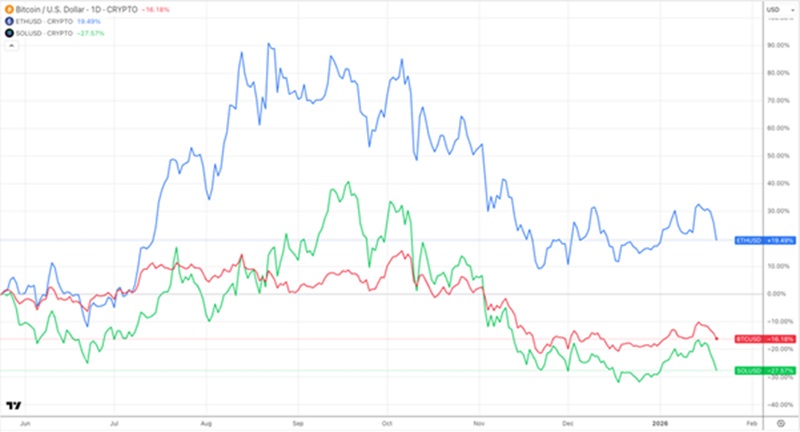
The sharp drop in cryptocurrencies has become part of a broader wave of investor withdrawal from risky assets following U.S. President Donald Trump’s statements about his intention to impose new trade duties on eight European countries. In the Asian session, Bitcoin dropped below $92,000, while the Ethereum price fell by more than 5% and Solana by 9%. The total capitalization of the crypto market decreased by about $100 billion over the course of the morning, and the liquidation of long positions approached $790 million.
This is a characteristic sign of a sudden transition in markets to risk-off mode. This impulse turned out to be closely related not so much to the internal problems of the cryptocurrency market, but to the general deterioration of the global investment environment. Trump’s statements about 10% duties, followed by an increase to 25% in the absence of an agreement, caused a decline in futures on American stock indices and a simultaneous increase in safe-haven assets — gold and silver, with the gold price reaching a new all-time high. In such circumstances, digital assets, despite the increasingly active participation of institutional investors, remain a high-risk segment and are the first to respond to spikes in geopolitical and trade uncertainty.
It is noteworthy that, back in mid-January, Bitcoin was approaching $98,000 amid an influx of funds into American ETFs, which the market perceived as an attempt at a sustained recovery after the weak end of 2025. However, a new wave of tariff threats quickly shifted market participants’ focus. As a result, safe-haven assets are setting new record highs, while cryptocurrencies are once again under pressure. According to analysts, what is happening looks more like a general reduction in portfolio risk than an event specific to digital assets.
At the same time, the strengthening of US trade protectionism goes far beyond the European trend and increasingly affects strategic industries, including semiconductors. The American authorities have already made it clear that they are ready to apply import duties of up to 100% to products from chip and memory manufacturers if they do not localize production in the United States. In fact, we are talking about a tough industrial policy designed to force the largest players, from Taiwan’s TSMC to South Korea’s Samsung Electronics and SK Hynix, to invest in American facilities.
This line increases long-term uncertainty for global supply chains and increases costs in the technology sector, which is already a key source of volatility for stock indices. For cryptocurrencies, this means maintaining high sensitivity to macroeconomic and political signals. After all, while trade wars and tariff threats are pushing investors toward safe assets, digital currencies remain vulnerable, despite the growth of institutional demand and the development of regulated investment instruments.
As a result, the current decline in the crypto market does not look like an isolated episode, but a reflection of a larger shift in investor sentiment, where US trade policy is becoming one of the key factors shaping the balance between risk and capital protection.