

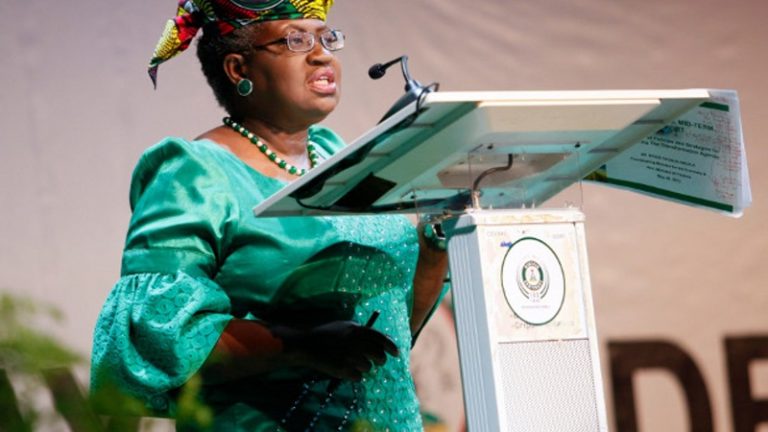
The Director-General of the World Trade Organization (WTO), Dr. Ngozi Okonjo-Iweala, on Thursday, met behind closed doors with President Bola Tinubu at the Presidential Villa, commending his administration for the economic reforms she said were restoring stability to Nigeria’s economy.
Okonjo-Iweala, who described the meeting as “very good,” said the President was “gracious” to receive her shortly after she joined First Lady, Senator Oluremi Tinubu, to launch a new Women Exporters Fund. The fund, jointly managed by the WTO and the International Trade Centre (ITC) in Geneva, is designed to help Nigerian women entrepreneurs expand their businesses, create jobs, and boost household incomes, especially in the growing digital economy.
She revealed that Nigeria competed and emerged as one of only four countries selected globally for the programme. Out of a staggering 67,000 Nigerian women who applied, 146 were chosen as beneficiaries. Sixteen of these winners, under the “Booster Track,” already operate businesses that will now be scaled up with 18 months of technical and business support from the WTO, ITC, the Federal Ministry of Industry, Trade and Investment, and the Nigerian Export Promotion Council. Another 100 will each receive $5,000 in direct funding alongside a year of business development support, while the remainder will gain tailored assistance to strengthen their enterprises.
Register for Tekedia Mini-MBA edition 20 (June 8 – Sept 5, 2026).
Register for Tekedia AI in Business Masterclass.
Join Tekedia Capital Syndicate and co-invest in great global startups.
Register for Tekedia AI Lab.
“This is just the beginning,” Okonjo-Iweala said, stressing the programme’s potential to diversify Nigeria’s economic base while empowering women. She explained that such initiatives not only stimulate entrepreneurship but also act as an informal safety net, enabling women to better withstand economic shocks.
On Nigeria’s economy, Okonjo-Iweala—who served as Minister of Finance and Coordinating Minister of the Economy under former President Goodluck Jonathan—credited the Tinubu administration with achieving a level of stability she described as a necessary foundation for growth.
“You cannot really improve an economy unless it’s stable,” she noted. “The President and his team have worked hard to stabilize the economy. The reforms have been in the right direction. The next step is growth, and alongside that, building social safety nets so those feeling the pinch of reforms can get support.”

She specifically commended the government’s key policy moves, including the removal of the petrol subsidy and the unification of Nigeria’s multiple foreign exchange windows—measures she acknowledged were difficult but essential for restoring macroeconomic balance. However, she cautioned that while reforms were crucial, they also came with short-term pain, particularly for the most vulnerable Nigerians.
To this end, she urged the Federal Government to prioritize targeted social safety nets to cushion the impact of rising living costs on poor households.
“Growth, job creation, and income expansion must go hand-in-hand with measures to protect those at risk of being left behind,” she said, adding that neglecting such interventions could weaken public support for necessary reforms.

The meeting between Tinubu and Okonjo-Iweala comes just two weeks before the expiration of her first term as WTO Director-General on August 31, 2025, and the commencement of her second term on September 1, 2025. Her historic appointment in 2021 made her the first African and first woman to lead the 164-member global trade body.
Accompanied by Trade Minister Jumoke Oduwole, Okonjo-Iweala also briefed the President on the operational framework of the Women’s Exporters Fund for the digital economy.
She emphasized that the initiative is not just about business growth but also about empowering women to “weather the storms of the economy and create jobs for themselves.”
“This is part of the thinking behind social safety nets and what we can do to support Nigerian women to contribute more to the economy and to themselves,” she said. “Sixteen of them have won what we call the Booster Track—those who already have businesses but whose operations will be scaled up with our support. Another 100 will each get $5,000 to start or strengthen their businesses with 12-month development support.”