

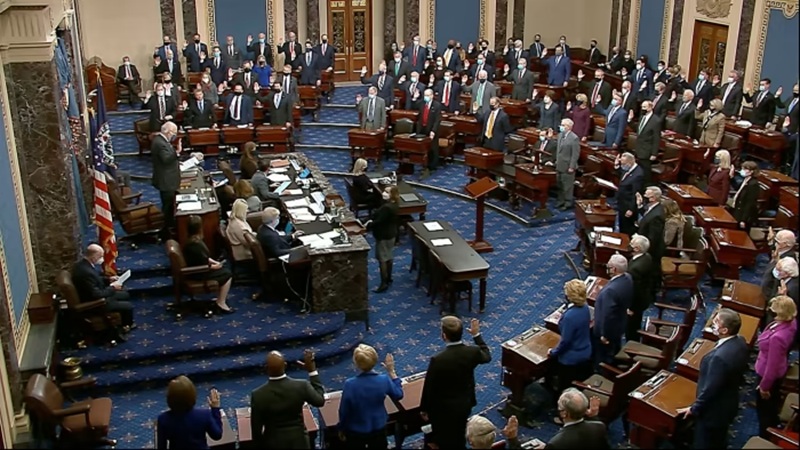
A group of 12 Senate Democrats, including Sens. Ruben Gallego (D-AZ), Mark Warner (D-VA), Kirsten Gillibrand (D-NY), Cory Booker (D-NJ), Catherine Cortez Masto (D-NV), Ben Ray Luján (D-NM), John Hickenlooper (D-CO), Raphael Warnock (D-GA), Adam Schiff (D-CA), Andy Kim (D-NJ), Lisa Blunt Rochester (D-DE), and Angela Alsobrooks (D-MD), released a comprehensive six-page framework for digital asset market structure legislation.
This move ends months of relative public silence from Democrats on the issue and signals their intent to engage in bipartisan negotiations with Republicans, who have been pushing their own versions of similar bills.
The framework emphasizes that the nearly $4 trillion global crypto market is too significant to leave unregulated, highlighting the need for rules that foster innovation while prioritizing consumer protection, financial stability, and preventing illicit activities.
Register for Tekedia Mini-MBA edition 20 (June 8 – Sept 5, 2026).
Register for Tekedia AI in Business Masterclass.
Join Tekedia Capital Syndicate and co-invest in great global startups.
Register for Tekedia AI Lab.
The senators stated: “Digital asset technology has the potential to unlock new businesses and spur American innovation. But questions about digital assets’ place in the U.S. regulatory framework have hobbled both innovation and consumer protection.” They stressed that achieving a “strong, bipartisan outcome will require time and cannot be rushed,” contrasting with Republican calls for faster passage, such as Sen. Cynthia Lummis’s (R-WY) push to deliver legislation to President Trump’s desk by Thanksgiving.
Key Elements of the Seven-Pillar Framework
The proposal outlines seven core pillars to guide future legislation, focusing on regulatory clarity, enforcement, and ethics.
Closing the Gap in the Spot Market for Non-Security Digital Assets | Assign exclusive jurisdiction to the Commodity Futures Trading Commission (CFTC) over non-security tokens in spot markets, addressing current regulatory voids where no agency has clear authority. |
Clarifying the Legal Status of Digital Assets and Regulator Jurisdiction | Provide clear token classification guidelines, distinguishing securities (under SEC oversight) from commodities, and require regulators to issue guidance on how existing securities laws apply to digital assets.

Bringing Issuers into a Regulatory Framework, Mandate disclosures for token issuers, including details on project risks, tokenomics, and compliance with anti-money laundering (AML) rules, while integrating stablecoin issuers (building on the recently passed GENIUS Act) without allowing them to offer interest-bearing products.
Bringing Other Platforms into a Regulatory Framework | Require decentralized finance (DeFi) platforms, decentralized exchanges, and other digital asset trading venues to register with the Financial Crimes Enforcement Network (FinCEN) and comply with AML/KYC standards; incorporate existing platforms into SEC frameworks where applicable.
Blocking Illicit Finance | Strengthen tools to combat money laundering and terrorism financing in crypto, including enhanced reporting, international cooperation, and mechanisms to isolate non-compliant platforms while aiming to protect user financial privacy.

Preventing Corruption and Abuse | Impose restrictions on elected officials and their families from issuing, endorsing, or profiting from crypto projects while in office; require full disclosure of holdings. This pillar explicitly targets potential conflicts, such as those linked to President Trump and his family’s crypto ventures.
Ensuring Fair, Effective Regulation | Boost funding and staffing for the SEC, CFTC, and Treasury; mandate bipartisan rulemaking processes to avoid partisan dominance; streamline hiring for enforcement roles.
This framework overlaps with Republican proposals, like the Senate Banking Committee’s updated discussion draft from September 5, 2025, and the House-passed CLARITY Act (which advanced in July 2025 with 294-134 support), in areas like token classification and dual SEC/CFTC roles.
However, it diverges on stricter DeFi oversight, ethics provisions, and a deliberate pace, which could complicate negotiations. Critics like Sen. Elizabeth Warren (D-MA) have opposed lighter-touch Republican bills, arguing they enable corruption, but the 12 signatories (most of whom supported the bipartisan GENIUS Act for stablecoins) represent a more crypto-friendly Democratic bloc.
Implications for Crypto Regulation
This release marks a pivotal shift, as Democrats had largely ceded the conversation to Republicans in 2025. It paves the way for intensified talks in the Senate Banking Committee, potentially leading to a comprehensive bill by year’s end—though partisan divides on enforcement and timelines remain.
Industry observers, including Paradigm’s Justin Slaughter, see it as a “strong” foundation for bipartisan passage, especially after crypto groups like Fairshake spent $195 million influencing 2024 elections.
On X (formerly Twitter), reactions ranged from optimism about regulatory clarity to concerns over privacy impacts from anti-illicit finance measures. Overall, it underscores growing congressional consensus that the U.S. needs a unified framework to compete globally while safeguarding markets.
Kazakhstan Outlined Plans of Integrating Digital Assets into the Country’s Financial Framework
Meanwhile, on September 8, 2025, during his annual State of the Nation address in Astana, Kazakhstan’s President Kassym-Jomart Tokayev outlined ambitious plans to integrate digital assets into the country’s financial framework.
A key highlight was the proposal to establish a State Fund of Digital Assets (also referred to as the National Digital Asset Fund), which would serve as a strategic cryptocurrency reserve. This move positions Kazakhstan as a proactive player in the global crypto landscape, building on its established role as a major Bitcoin mining hub.
The fund will be created under the Investment Corporation of the National Bank of Kazakhstan. It aims to accumulate “promising assets” in the digital financial system, including high-potential cryptocurrencies like Bitcoin. The reserve will help diversify national holdings, hedge against economic volatility, and support long-term financial returns.
Initial funding could come from seized digital assets from criminal investigations, revenues from state-regulated mining operations, and potentially allocations from the National Fund (Kazakhstan’s sovereign wealth fund, valued at around $60 billion, primarily from oil revenues).
Tokayev directed the Agency for Regulation and Development of the Financial Market to draft comprehensive digital asset legislation by the end of 2025, with full implementation targeted for 2026. This new law will liberalize crypto markets, promote fintech innovation, integrate tokenized assets, and attract new participants while maintaining regulatory oversight.
It builds on existing efforts, such as the launch of the digital tenge in pilot mode in 2023, which is already used for National Fund project financing and will expand to budgets at national, local, and state-owned enterprise levels. The president proposed up to $1 billion in joint government and central bank investments to fuel high-tech and fintech sectors.
This includes channeling bank liquidity into productive economic areas, addressing criticisms that domestic banks favor low-risk investments over real-economy lending. The broader goal is to modernize the financial system, boost competitiveness, and reduce reliance on traditional commodities like oil and gas.
The “CryptoCity” Initiative
In tandem with the fund, Tokayev confirmed plans for CryptoCity in Alatau (a town in southeastern Kazakhstan near Almaty). This will be Central Asia’s first fully digitalized smart city, where residents and businesses can use cryptocurrencies for everyday payments—such as groceries, services, and utilities.
The project emphasizes advanced technology, favorable living conditions, and blockchain integration to showcase digital finance in action. It aligns with a pilot zone announced in May 2025 allowing crypto payments for goods and services, and it could attract IT specialists, developers, and investors to drive economic growth.
Kazakhstan currently holds about 13-14% of global Bitcoin mining hashrate (down from a 2021 peak of 27.3% after China’s ban), generating millions in tax revenue despite challenges like unlicensed operations straining the power grid. Crypto ownership among citizens has doubled in the last two years, reflecting growing adoption.
This announcement follows global trends, with countries like the United States (under President Trump’s executive order for a crypto reserve), Brazil, Indonesia, El Salvador, and Bhutan exploring similar sovereign digital asset strategies.
Kazakhstan’s International Financial Center (AIFC) in Astana already hosts crypto-friendly regulations, including the region’s first spot Bitcoin ETF launched in August 2024 and acceptance of stablecoins for regulatory fees.
However, nationwide crypto payments remain prohibited outside controlled environments to balance innovation with risk management, including warnings about rising online fraud and cybersecurity threats. Tokayev’s vision also includes establishing a dedicated Ministry for AI Development and a “Digital Code” to integrate AI, big data, and the platform economy.
These steps could solidify Kazakhstan’s role as a regional digital finance hub, potentially increasing global attention to its ecosystem while fostering economic diversification. The reaction on X (formerly Twitter) has been positive, with crypto influencers and news outlets highlighting the “snowball effect” of institutional adoption.