DD
MM
YYYY

PAGES

DD
MM
YYYY

spot_img

PAGES

Home Blog

Jupiter Integrates Polymarket into its Aggregator

0

The Solana-based decentralized exchange aggregator Jupiter has integrated Polymarket, bringing the popular prediction market platform natively to the Solana blockchain for the first time.

This allows users to trade event-based prediction contracts such as outcomes on sports, politics, or other events directly within the Jupiter app, without needing to bridge assets or switch platforms. Jupiter positions this as a major step toward becoming the leading on-chain prediction market hub on Solana, adding a dedicated “Prediction” tab alongside its core swap and DeFi features.

Jupiter reportedly secured a $35 million strategic investment from ParaFi Capital in its JUP token, with an extended lockup period.  Separately, a Nevada state court (Judge Jason D. Woodbury) has granted a temporary restraining order (TRO) against Blockratize Inc. (the operator behind Polymarket), effective for two weeks (14 days).

This prohibits Polymarket from offering event-based contracts—including sports and other events—to Nevada residents.The ruling stems from a civil enforcement action filed by the Nevada Gaming Control Board (NGCB) in mid-January 2026.

The state argues that Polymarket’s contracts constitute unlicensed wagering under Nevada gaming laws (e.g., NRS 463.0193), requiring a state gaming license. The court found that these activities likely violate state law and are not exclusively regulated by the federal Commodity Futures Trading Commission (CFTC) under the Commodity Exchange Act.

The judge noted potential “direct, irreparable” harm from bypassing Nevada’s regulated betting system (e.g., risks like match-fixing or underage access). Polymarket appears to have already begun complying by restricting access in Nevada.

A hearing on a potential preliminary injunction is scheduled for February 11, 2026, which could extend or modify the restrictions. These developments highlight the ongoing tension between decentralized prediction markets often framed as derivatives and state-level gambling regulations, especially in gaming-heavy jurisdictions like Nevada—timed notably close to major events like the Super Bowl.

The Jupiter integration focuses on on-chain accessibility for Solana users globally, while the Nevada order is a localized enforcement action against U.S. users in that state.

The recent developments involving Jupiter’s integration of Polymarket and the Nevada court’s temporary restraining order (TRO) on Polymarket’s sports and event contracts carry several key implications across regulatory, market, ecosystem, and user perspectives.

This marks the first time Polymarket operates natively on Solana via Jupiter, Solana’s top decentralized exchange (DEX) aggregator and “superapp.” Users can now trade event-based contracts directly in the Jupiter app, with a new “Prediction” tab—no bridging, no platform switching, and leveraging Solana’s high speed and low fees.

For Solana Ecosystem 

It boosts on-chain activity, liquidity, and real-world utility. Prediction markets could drive significant trading volume to Solana, challenging Ethereum’s historical dominance in this niche.

Analysts see this as a liquidity catalyst, potentially injecting fresh flows into Solana dApps and increasing overall network engagement. Enhances Jupiter’s positioning as a comprehensive on-chain hub (swaps + predictions).

It adds utility layers, potentially sustaining user growth and on-chain metrics. Reports note $JUP price momentum tied to this, plus a separate $35M strategic investment from ParaFi Capital with token lockups, signaling strong institutional confidence.

Expands reach of Polymarket to Solana’s large, active user base, enabling multi-chain growth and access to faster/cheaper trading. This could help capture more global volume, especially as prediction markets gain traction for event-driven speculation.

Reinforces Solana’s appeal for consumer-facing apps needing low-cost, high-throughput infrastructure. It aligns with patterns where platforms like Kalshi have also explored Solana integrations for tokenized contracts.

This is bullish for decentralized, on-chain prediction markets, positioning Solana as a competitive hub and potentially increasing adoption among retail and power users.

Regulatory and Risk Implications from Nevada TROA

Nevada state court (Judge Jason Woodbury) granted a 14-day TRO against Polymarket’s operator (Blockratize Inc.), prohibiting it from offering event-based contracts—including sports—to Nevada residents. This stems from a civil enforcement action by the Nevada Gaming Control Board (NGCB), arguing these contracts qualify as unlicensed wagering under state gaming laws.

The court found likely merit in the claims and ruled that federal oversight via the Commodity Futures Trading Commission (CFTC) under the Commodity Exchange Act does not provide exclusive preemption—meaning states can still regulate.

Polymarket has complied by geo-restricting Nevada access. The TRO expires after 14 days, with a preliminary injunction hearing set for February 11, 2026, which could extend restrictions, impose fines, or lead to a permanent ban in the state.

A localized setback but part of escalating U.S. state-level pressure similar actions against Kalshi, others in states like Tennessee. Sports markets often dominate volume, so restrictions could dent U.S. user growth and revenue if replicated elsewhere.

The ruling underscores that prediction markets aren’t fully shielded by federal derivatives classification. States with strong gaming interests may push for licensure or bans, creating a patchwork of U.S. regulations. This contrasts with Polymarket’s recent federal progress but highlights “nuanced and evolving” federal-state tensions.

Increases compliance costs and risks for platforms operating in the U.S. It may accelerate geo-blocking in regulated states, limit sports/event focus, or spur lobbying for clearer rules. Globally, it adds to scrutiny amid bans in some jurisdictions.

Jupiter’s integration expands global/on-chain access just as Nevada enforces localized restrictions (timed near major events like the Super Bowl). This creates a bifurcated landscape—strong growth outside heavy U.S. regulation, but headwinds domestically.

Decentralized platforms can thrive internationally or via non-U.S. users, with Solana gaining as a prediction market leader. If Nevada’s stance prevails or spreads, it could chill U.S. adoption, force structural changes, or impact volumes tied to high-profile events.

Bullish for Solana/Jupiter innovation; cautious for Polymarket’s U.S. exposure. Prediction markets remain innovative but face persistent regulatory friction in gambling-centric regions. These events reflect the classic crypto tension: rapid innovation versus evolving oversight. The February 11 hearing will be key for short-term clarity on the Nevada case.


BitMine is Currently Facing Over $6B Unrealized Losses on its Ethereum Investment

0

BitMine Immersion Technologies (ticker: BMNR), a publicly traded company chaired by Fundstrat’s Tom Lee and often compared to a “MicroStrategy for Ethereum,” is currently facing massive unrealized losses on its Ethereum (ETH) holdings amid a sharp crypto market downturn.

Recent reports indicate that BitMine’s unrealized losses on its ETH stockpile have reached approximately $6.6 billion with some sources citing figures around $6B to $6.95B or nearing $7B. This positions it as one of the largest paper losses in crypto treasury strategies if realized.

BitMine holds around 4.24 million ETH roughly 3.5% of Ethereum’s circulating supply, with recent additions including over 40,000 ETH in the past week despite falling prices. The treasury is valued at about $9.6 billion based on ETH trading near $2,300–$2,400, down from peaks around $13.9B–$14B in late 2025.

Average acquisition cost: Estimated around $3,600–$3,883 per ETH, leading to the deep drawdown as ETH has slid toward multi-month lows near $2,200–$2,300 in recent trading. The losses stem from aggressive accumulation during higher prices, followed by a broader market sell-off that erased hundreds of billions in crypto value, with thin liquidity and leveraged positions amplifying the drop.

These are unrealized (paper) losses, meaning they only become actual if BitMine sells at current levels. The company has continued buying during the dip, with Tom Lee remaining bullish on ETH’s long-term potential previously targeting higher prices like $7,500+.

However, this has drawn scrutiny over concentration risk, as the firm’s balance sheet is heavily tied to ETH performance. BitMine’s stock (BMNR) has reacted negatively, dropping significantly in recent sessions ~12% in one premarket period, and the situation highlights risks in corporate crypto treasury plays—especially compared to more diversified peers.

This mirrors broader market stress, with similar pressures on other ETH-focused treasuries. If ETH recovers, these losses could shrink dramatically; if not, it could test investor patience and lead to a “pruning” among such firms in 2026.

The $6.6 billion (or figures ranging $6B–$6.95B+) in unrealized losses on BitMine Immersion Technologies’ (BMNR) Ethereum holdings represents one of the largest paper losses in corporate crypto treasury strategies to date.

This stems from holding ~4.24 million ETH about 3.5% of circulating supply, acquired at an average cost of roughly $3,600–$3,883 per ETH, while ETH trades near $2,200–$2,400 amid a broader market sell-off involving liquidations, thin liquidity, and deleveraging.

These losses remain unrealized—they only crystallize if BitMine sells at current levels. The company, chaired by Tom Lee, has continued aggressive accumulation like adding >40,000 ETH recently and staking over 2 million ETH staked, generating yield, signaling long-term conviction in Ethereum’s fundamentals despite short-term pain.

The treasury is heavily tied to ETH performance, making the balance sheet and stock price a near-direct proxy for ETH volatility. Losses have pushed the firm’s market NAV close to or below 1x in some estimates, complicating equity raises via share issuance.

BMNR shares dropped sharply ~10–12% in premarket/early trading on February 2, 2026, reflecting investor concerns over the drawdown and governance. The stock trades with high volatility, often at a discount or premium to NAV depending on sentiment.

Continued buying/staking could amplify recovery if ETH rebounds (Tom Lee remains bullish on long-term upside, e.g., prior high targets). However, prolonged weakness risks further dilution, forced adjustments, or “pruning” among weaker treasury plays, as predicted by some analysts.

No signs of margin calls or forced liquidation yet, but leverage in the broader ecosystem adds tail risk. A hypothetical forced sale of BitMine’s holdings could cause significant slippage potentially 20–40% further downside in extreme scenarios, exacerbating sell-offs due to thin order books. This highlights risks in large concentrated positions during deleveraging events.

The headline loss (one of the biggest documented in crypto treasuries) fuels bearish narratives, contributing to ETH’s slide toward multi-month lows and cascading liquidations > $485M in ETH longs recently. It underscores how corporate strategies can magnify volatility.

Some whales have bought the dip, and staking locks up supply reducing sell pressure long-term. If ETH recovers via adoption, yield narratives, or macro shifts, losses could reverse dramatically—similar to past cycles. Aggressive accumulation works in bull markets but exposes firms to brutal drawdowns when leverage unwinds or liquidity dries up.

Compared to peers (e.g., diversified miners or Bitcoin-focused treasuries), pure ETH plays show higher risk from altcoin volatility. 2026 could see a shakeout: Well-capitalized players survive and consolidate, while over-leveraged or concentrated ones struggle—potentially leading to M&A, pivots, or exits.

This is a high-stakes test of conviction in Ethereum’s long-term story versus near-term market stress. Tom Lee and BitMine appear committed to holding/accumulating through the dip, betting on recovery and staking yields to offset losses. If ETH stabilizes or rebounds, the position could become a massive win; otherwise, it risks becoming a cautionary tale for corporate crypto bets.

Is the Metaverse Still Going to Happen?

0

When Mark Zuckerberg announced the metaverse in 2021, there was a huge amount of hype around the concept. The founder and CEO of Meta himself had grand plans for it and initially stated that he believed one billion people would be using it by 2030.

In the years since the announcement, however, talk of this virtual reality world has died down, and it seems now that Meta is pivoting away from its original idea. The metaverse may still happen, but it could be further in the future than originally anticipated.

Meta Seems to Have Pivoted Away from the Metaverse

Meta has invested heavily in Reality Labs in the last few years, as it believes that immersive virtual worlds are the future of social interaction. VR has long been predicted as a disruptive technology and one that could be set to take the world by storm at some point, but artificial intelligence has stolen the limelight since its adoption rapidly accelerated in 2023.

Meta has shifted towards AI and practical creator technologies, and a lot of this has been to do with commercial pressure. With many of its main rivals also putting increased resources into AI development, Meta has had to do the same. Metaverse development requires long timelines and expensive hardware adoption, which is something that’s often difficult to justify to shareholders who want near-term returns.

When the metaverse was first conceived, there may have been plans to go all-in on the project. But because of developments in other technology, it may now be a case of building it gradually. Immersive elements will most likely seep into everyday use, rather than appear all at once. The metaverse could still be on the horizon, but it may be much longer until it becomes fully realised.

Current Entertainment Industry May Be Too Strong to Disrupt

Another problem for an idea as drastically innovative as the metaverse is that the current entertainment industry is incredibly strong as it is. People often don’t want change if the things that they can currently get are sufficient.

Major providers like Netflix are doing everything they can to keep people interested in the existing model, by constantly adding new ways to enjoy their platforms. The original streaming service has added games to its offerings, along with various live events that have generated a lot of hype. For instance, Skyscraper Live was the latest event, with millions of people watching Alex Honnold climb Taipei 101 in real time.

The same can be seen in the online casino industry, where new inventions are regularly added to keep interest high. The casino online UK market is now packed full of slots with new features, and even includes multiplayer games now such as 4 Cash Planes. Players are familiar with the format, and can easily find the games they want to play.

If the metaverse were to come along and shake everything up, there would be a new learning curve for people. They would need to master new ways to find the content they want to watch or play, which could lead to frustration.

The metaverse could still be on the way, but its introduction may be different to what was originally planned. It makes more sense for elements of the metaverse to be introduced steadily over time, rather than in one fell swoop. That’s the approach that Meta seems to be taking now.

India Slashes Tariffs on Critical Inputs to Cut China Dependence and Shield Exporters From Trump-Era Trade Pressures

0

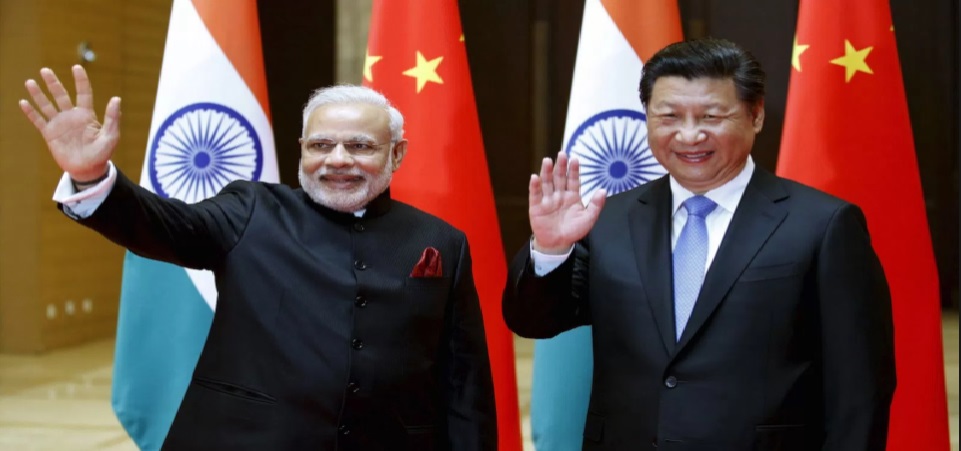
India has moved to recalibrate its trade and industrial policy at a moment of rising global fragmentation, cutting tariffs on a wide range of capital goods and raw materials in a bid to reduce dependence on China, support its energy transition, and blunt the impact of U.S. trade actions on exporters.

The measures, announced in the annual budget on Sunday, underline how New Delhi is increasingly using customs policy as a strategic lever rather than a narrow revenue tool, as geopolitical tensions and protectionism reshape global supply chains.

Finance Minister Nirmala Sitharaman said the government would lower duties on capital goods required to process critical minerals and manufacture lithium-ion battery cells, a step aimed at strengthening domestic manufacturing capabilities essential for clean energy and electric vehicles. Tariffs were also eliminated on sodium antimonate, used in solar glass production, and on monazite, a key source of rare earth elements used in permanent magnets for EVs and other clean-energy technologies.

The rare earth decision carries particular weight. China controls more than 90% of global processing capacity for rare earth magnets and imposed export curbs last year, disrupting electric vehicle production plans in India and elsewhere. By cutting duties on monazite and related inputs, New Delhi is signaling a long-term push to build local processing capacity and reduce vulnerability to Chinese supply dominance, even though analysts caution that developing a full rare earth ecosystem will take years and significant investment.

Beyond energy transition materials, the budget included tariff concessions for raw materials used by export-oriented sectors such as marine products, leather, and textiles. These industries have faced growing pressure from U.S. tariffs imposed under President Donald Trump, who has adopted an aggressive trade stance toward partners, including India. Sitharaman framed the cuts as a way to lower input costs and preserve competitiveness for exporters navigating a more hostile global trade environment.

India also moved to support strategic and high-value manufacturing. Duties were cut on inputs used to produce aircraft parts for maintenance and repair in the defense sector, and on components for the electronics industry. Both areas are central to India’s effort to attract global manufacturers seeking to diversify away from China amid geopolitical risk and supply chain disruptions.

Analysts say the tariff reductions are closely tied to India’s ambition to reach $1 trillion in goods exports. Lower input costs could help Indian firms integrate more deeply into global value chains, improve margins, and attract foreign investment. Customs duty reforms, they argue, are a necessary—though not sufficient—condition for India to emerge as a credible alternative manufacturing hub.

At the same time, the changes reflect continuity rather than a radical departure in trade policy. Experts describe the approach as incremental and tactical, aligning India’s tariff structure with new trade deals and shifting geopolitical realities while avoiding sweeping liberalization. This caution reflects the broader uncertainty created by rising protectionism, conflicts between major powers, and the disruption of long-standing multilateral trade norms.

The budget also made a one-time concession for special economic zones, traditionally export-only enclaves, allowing them to sell into the domestic market. The move is intended to address underutilized capacity in SEZs, which have struggled amid global trade disruptions and weaker external demand. While welcomed by the industry, analysts view it as a stopgap rather than a structural fix.

However, the tariff cuts highlight how India is repositioning itself in a rapidly changing global economy. While these calibrated steps are enough to deliver a sustained manufacturing take-off, they underscore New Delhi’s growing reliance on trade policy as a strategic instrument.

Top 3 Millionaire-Making Cryptos: Ozak AI, Dogecoin, and SHIB Show Surging Interest

0

Crypto markets are heating up as investors position early for tokens capable of delivering the next wave of millionaire-making gains. Analysts highlight Ozak AI, Dogecoin, and Shiba Inu as the three assets attracting the strongest attention heading into the new cycle.

DOGE and SHIB continue to dominate the meme-driven landscape with explosive volatility potential, yet Ozak AI stands out as the clear leader due to its exponential intelligence-based growth model. With AI emerging as crypto’s fastest-moving narrative, the Ozak AI trajectory is already pulling ahead of meme assets that rely on sentiment cycles.

Ozak AI’s Intelligence Edge

Ozak AI leads millionaire-maker projections because its value increases through nonstop computation rather than hype. The system is powered by HIVE’s ultra-fast 30 ms market-signal engine, which reads liquidity movements, volatility shifts, and cross-chain patterns far faster than manual tools. Its SINT-driven autonomous agents monitor multiple blockchains simultaneously and adjust instantly as new data flows in.

Perceptron Network’s 700K+ distributed nodes feed continuous cross-chain intelligence into the system, making Ozak AI more accurate with every hour of operation. This creates a compounding loop that strengthens regardless of market mood. Analysts note that with the Ozak AI Presale surpassing $6.1 million, demand is accelerating sharply and mirrors early-stage patterns seen in some of the strongest long-term winners of past cycles.

Dogecoin (DOGE)

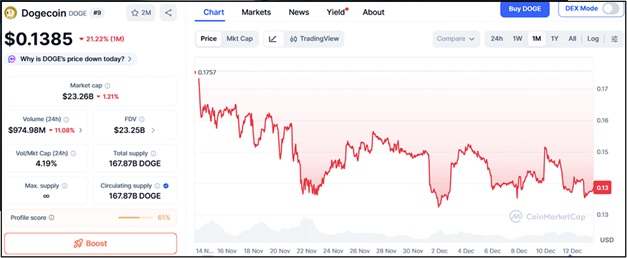
Dogecoin trades near $0.1385 and continues to show solid accumulation as traders rotate back into high-volatility meme assets. Strong support appears at $0.130, $0.124, and $0.118, levels that repeatedly attract buyers during pullbacks. On the upside, DOGE faces resistance at $0.149, $0.164, and $0.179, all zones that typically ignite momentum surges once broken.

Analysts believe DOGE could produce powerful multi-x gains during a full meme rotation thanks to its massive community and historical performance during euphoric phases. Yet they also point out that its growth resets between cycles because DOGE relies heavily on sentiment instead of evolving technology.

Shiba Inu (SHIB)

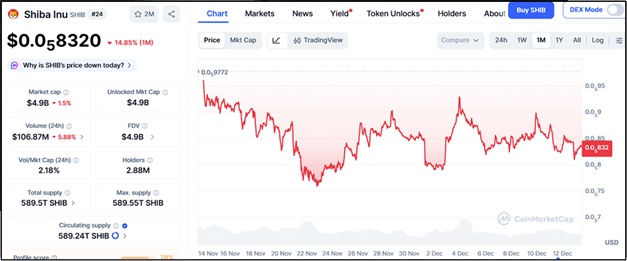
Shiba Inu remains one of the strongest meme-ecosystem tokens as Shibarium activity grows and long-term holders accumulate. Trading around $0.000008320, SHIB maintains solid support at $0.00000810, $0.00000785, and $0.00000760. Resistance sits at $0.00000858, $0.00000894, and $0.00000921, areas traders watch closely for breakout signals. SHIB has a proven history of delivering massive gains during strong market peaks.

Its upside remains significant thanks to a large global community and expanding ecosystem, but analysts note that SHIB’s performance is still tied to sentiment spikes and ecosystem milestones rather than a compounding technological foundation.

Why Ozak AI Leads Millionaire-Maker Rankings

Dogecoin and Shiba Inu remain top meme contenders with strong explosive potential, but their growth is cyclical. Ozak AI grows continuously. Every signal processed through HIVE, every autonomous decision executed by SINT, and every data stream supplied by Perceptron makes Ozak AI smarter and more powerful. This creates an exponential trajectory that meme tokens cannot match. Analysts consistently rank Ozak AI as the strongest millionaire-making crypto heading into the next cycle, with the potential to outpace both DOGE and SHIB by a wide margin as the AI narrative accelerates.

 About Ozak AI

Ozak AI is a blockchain-based crypto project that provides a technology platform that specializes in predictive AI and advanced data analytics for financial markets. Through machine learning algorithms and decentralized network technologies, Ozak AI enables real-time, accurate, and actionable insights to help crypto enthusiasts and businesses make the correct decisions.


For more, visit:

Website: https://ozak.ai/

Telegram: https://t.me/OzakAGI

Twitter: https://x.com/ozakagi