DD
MM
YYYY

PAGES

DD
MM
YYYY

spot_img

PAGES

Home Blog

India Slashes Tariffs on Critical Inputs to Cut China Dependence and Shield Exporters From Trump-Era Trade Pressures

0

India has moved to recalibrate its trade and industrial policy at a moment of rising global fragmentation, cutting tariffs on a wide range of capital goods and raw materials in a bid to reduce dependence on China, support its energy transition, and blunt the impact of U.S. trade actions on exporters.

The measures, announced in the annual budget on Sunday, underline how New Delhi is increasingly using customs policy as a strategic lever rather than a narrow revenue tool, as geopolitical tensions and protectionism reshape global supply chains.

Finance Minister Nirmala Sitharaman said the government would lower duties on capital goods required to process critical minerals and manufacture lithium-ion battery cells, a step aimed at strengthening domestic manufacturing capabilities essential for clean energy and electric vehicles. Tariffs were also eliminated on sodium antimonate, used in solar glass production, and on monazite, a key source of rare earth elements used in permanent magnets for EVs and other clean-energy technologies.

The rare earth decision carries particular weight. China controls more than 90% of global processing capacity for rare earth magnets and imposed export curbs last year, disrupting electric vehicle production plans in India and elsewhere. By cutting duties on monazite and related inputs, New Delhi is signaling a long-term push to build local processing capacity and reduce vulnerability to Chinese supply dominance, even though analysts caution that developing a full rare earth ecosystem will take years and significant investment.

Beyond energy transition materials, the budget included tariff concessions for raw materials used by export-oriented sectors such as marine products, leather, and textiles. These industries have faced growing pressure from U.S. tariffs imposed under President Donald Trump, who has adopted an aggressive trade stance toward partners, including India. Sitharaman framed the cuts as a way to lower input costs and preserve competitiveness for exporters navigating a more hostile global trade environment.

India also moved to support strategic and high-value manufacturing. Duties were cut on inputs used to produce aircraft parts for maintenance and repair in the defense sector, and on components for the electronics industry. Both areas are central to India’s effort to attract global manufacturers seeking to diversify away from China amid geopolitical risk and supply chain disruptions.

Analysts say the tariff reductions are closely tied to India’s ambition to reach $1 trillion in goods exports. Lower input costs could help Indian firms integrate more deeply into global value chains, improve margins, and attract foreign investment. Customs duty reforms, they argue, are a necessary—though not sufficient—condition for India to emerge as a credible alternative manufacturing hub.

At the same time, the changes reflect continuity rather than a radical departure in trade policy. Experts describe the approach as incremental and tactical, aligning India’s tariff structure with new trade deals and shifting geopolitical realities while avoiding sweeping liberalization. This caution reflects the broader uncertainty created by rising protectionism, conflicts between major powers, and the disruption of long-standing multilateral trade norms.

The budget also made a one-time concession for special economic zones, traditionally export-only enclaves, allowing them to sell into the domestic market. The move is intended to address underutilized capacity in SEZs, which have struggled amid global trade disruptions and weaker external demand. While welcomed by the industry, analysts view it as a stopgap rather than a structural fix.

However, the tariff cuts highlight how India is repositioning itself in a rapidly changing global economy. While these calibrated steps are enough to deliver a sustained manufacturing take-off, they underscore New Delhi’s growing reliance on trade policy as a strategic instrument.

Top 3 Millionaire-Making Cryptos: Ozak AI, Dogecoin, and SHIB Show Surging Interest

0

Crypto markets are heating up as investors position early for tokens capable of delivering the next wave of millionaire-making gains. Analysts highlight Ozak AI, Dogecoin, and Shiba Inu as the three assets attracting the strongest attention heading into the new cycle.

DOGE and SHIB continue to dominate the meme-driven landscape with explosive volatility potential, yet Ozak AI stands out as the clear leader due to its exponential intelligence-based growth model. With AI emerging as crypto’s fastest-moving narrative, the Ozak AI trajectory is already pulling ahead of meme assets that rely on sentiment cycles.

Ozak AI’s Intelligence Edge

Ozak AI leads millionaire-maker projections because its value increases through nonstop computation rather than hype. The system is powered by HIVE’s ultra-fast 30 ms market-signal engine, which reads liquidity movements, volatility shifts, and cross-chain patterns far faster than manual tools. Its SINT-driven autonomous agents monitor multiple blockchains simultaneously and adjust instantly as new data flows in.

Perceptron Network’s 700K+ distributed nodes feed continuous cross-chain intelligence into the system, making Ozak AI more accurate with every hour of operation. This creates a compounding loop that strengthens regardless of market mood. Analysts note that with the Ozak AI Presale surpassing $6.1 million, demand is accelerating sharply and mirrors early-stage patterns seen in some of the strongest long-term winners of past cycles.

Dogecoin (DOGE)

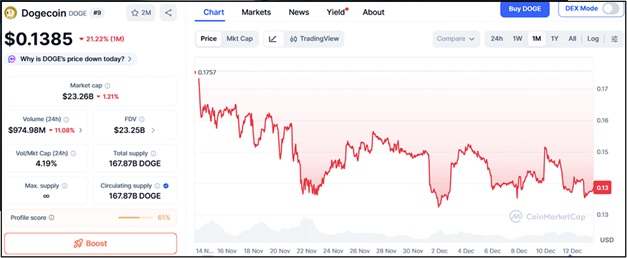
Dogecoin trades near $0.1385 and continues to show solid accumulation as traders rotate back into high-volatility meme assets. Strong support appears at $0.130, $0.124, and $0.118, levels that repeatedly attract buyers during pullbacks. On the upside, DOGE faces resistance at $0.149, $0.164, and $0.179, all zones that typically ignite momentum surges once broken.

Analysts believe DOGE could produce powerful multi-x gains during a full meme rotation thanks to its massive community and historical performance during euphoric phases. Yet they also point out that its growth resets between cycles because DOGE relies heavily on sentiment instead of evolving technology.

Shiba Inu (SHIB)

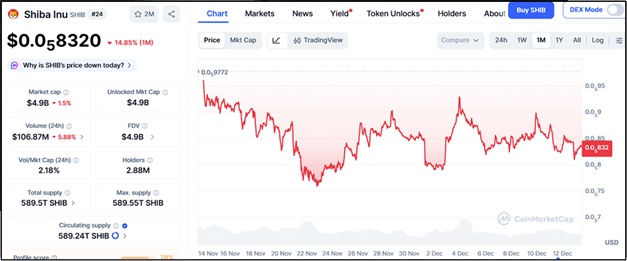
Shiba Inu remains one of the strongest meme-ecosystem tokens as Shibarium activity grows and long-term holders accumulate. Trading around $0.000008320, SHIB maintains solid support at $0.00000810, $0.00000785, and $0.00000760. Resistance sits at $0.00000858, $0.00000894, and $0.00000921, areas traders watch closely for breakout signals. SHIB has a proven history of delivering massive gains during strong market peaks.

Its upside remains significant thanks to a large global community and expanding ecosystem, but analysts note that SHIB’s performance is still tied to sentiment spikes and ecosystem milestones rather than a compounding technological foundation.

Why Ozak AI Leads Millionaire-Maker Rankings

Dogecoin and Shiba Inu remain top meme contenders with strong explosive potential, but their growth is cyclical. Ozak AI grows continuously. Every signal processed through HIVE, every autonomous decision executed by SINT, and every data stream supplied by Perceptron makes Ozak AI smarter and more powerful. This creates an exponential trajectory that meme tokens cannot match. Analysts consistently rank Ozak AI as the strongest millionaire-making crypto heading into the next cycle, with the potential to outpace both DOGE and SHIB by a wide margin as the AI narrative accelerates.

 About Ozak AI

Ozak AI is a blockchain-based crypto project that provides a technology platform that specializes in predictive AI and advanced data analytics for financial markets. Through machine learning algorithms and decentralized network technologies, Ozak AI enables real-time, accurate, and actionable insights to help crypto enthusiasts and businesses make the correct decisions.


For more, visit:

Website: https://ozak.ai/

Telegram: https://t.me/OzakAGI

Twitter: https://x.com/ozakagi


Impacts of Trump’s Critical Minerals Stockpile Launch

0

President Donald Trump is set to launch a $12 billion strategic critical-minerals stockpile, according to reports from Bloomberg.

The initiative, internally referred to as Project Vault, aims to reduce U.S. dependence on China for rare earth elements and other critical minerals essential to manufacturing, defense, and technology sectors. It combines approximately $1.67 billion in private capital with a $10 billion loan from the U.S. Export-Import Bank (Ex-Im Bank).

The Ex-Im Bank’s board was reportedly scheduled to vote on the loan. The stockpile would procure and store minerals like gallium, cobalt, rare earths, and others used in products such as iPhones, electric vehicle batteries, jet engines, semiconductors, and defense systems.

It functions similarly to the U.S. Strategic Petroleum Reserve but for critical minerals, protecting manufacturers from supply disruptions, price volatility, and potential export restrictions from China which dominates global production and processing of many of these materials.

Major U.S. companies, including automakers (e.g., GM), tech firms (e.g., Google), aerospace (e.g., Boeing), and others, would access the shared inventory through long-term commitments. Commodity traders like Traxys and Mercuria may handle procurement and storage.

This builds on Trump’s ongoing efforts to bolster domestic supply chains, including prior investments in U.S. rare earth companies, bilateral deals with Australia, and trade measures like Section 232 investigations into imports of processed critical minerals.

The announcement has sparked immediate market reactions, with shares of U.S.-focused rare earth and critical minerals companies surging in premarket or early trading. This move reflects escalating U.S.-China tensions over strategic resources, with the administration emphasizing national security and economic resilience in high-tech and defense industries.

The plan has not been formally announced by the White House yet, based on available reporting, but details emerged from senior administration officials. Rare earth elements (REEs) are a group of 17 chemically similar metallic elements in the periodic table.

Despite their name, they are not particularly rare in the Earth’s crust—the “rare” part refers to the difficulty in finding them in concentrated, economically mineable deposits and the complex, costly process required to separate and purify them. They include: The 15 lanthanides (atomic numbers 57–71): Lanthanum (La), Cerium (Ce), Praseodymium (Pr), Neodymium (Nd), Promethium (Pm), Samarium (Sm), Europium (Eu), Gadolinium (Gd), Terbium (Tb), Dysprosium (Dy), Holmium (Ho), Erbium (Er), Thulium (Tm), Ytterbium (Yb), and Lutetium (Lu).

Plus scandium (Sc) and yttrium (Y), which share similar chemical properties and often occur in the same mineral deposits. They were initially thought to be scarce when discovered in the 18th–19th centuries, and they are often found dispersed in low concentrations within minerals like bastnäsite, monazite, and xenotime.

Extraction typically involves mining, chemical processing, and separation—making supply chains vulnerable to disruption. REEs have unique magnetic, luminescent (phosphorescent), catalytic, and electrical properties due to their electron configurations especially the partially filled 4f orbitals in lanthanides.

These make them irreplaceable in many high-tech applications. REEs are essential for modern technology, clean energy, and defense. The largest demand comes from permanent magnets around 45% of global use in recent years.

Common applications include: Permanent magnets (e.g., NdFeB or “neodymium” magnets): Neodymium, praseodymium, dysprosium, terbium ? Used in electric vehicle motors, wind turbines, hard drives, headphones, MRI machines, and electric motors. Cerium, lanthanum ? In petroleum refining, automotive catalytic converters, and chemical reactions.

Phosphors and lighting: Europium, yttrium, terbium ? In LED lights, flat-screen displays, fluorescent lamps, and TV screens. Batteries and electronics: Various REEs ? In rechargeable batteries, smartphones, laptops, and fiber optics (e.g., erbium for amplifiers).

Defense and aerospace: Samarium, gadolinium, yttrium ? In precision-guided munitions, radar, sonar, lasers, jet engines, and electronic warfare systems. REEs are considered critical minerals because of their vital role in green technologies (e.g., EVs, renewables), electronics, and national security.

China dominates global production and processing often over 80–90% for many REEs, leading to supply chain concerns and initiatives like the U.S. strategic stockpile efforts to build resilience. In short, rare earth elements may not be geologically rare, but their specialized properties and concentrated supply make them indispensable—and geopolitically significant—in the modern world.

Michael Saylor’s Strategy Acquires More Bitcoin Amid Steep Market Decline

0

In a move that has become almost routine, Strategy (formerly MicroStrategy) has  added more Bitcoin to its holdings amid a sharp market decline.

This announcement was made by the company’s executive chairman Michael Saylor signaling, continued confidence in the crypto asset despite heightened volatility and investor caution.

Saylor in a post on X with the caption “More Orange” disclosed Strategy latest Bitcoin acquisition of 2,932 BTC for $264 million, bringing the company’s total holdings to 271,264 BTC valued at $55.8 billion as of February 1, 2026.

The accompanying chart from StrategyTracker illustrates the firm’s 96 purchase events since 2020, with an average cost of $67,383 per BTC, well below the current price near $78,000 highlighting their dollar-cost averaging approach amid market volatility.

This move aligns with MicroStrategy’s aggressive treasury strategy, using convertible debt and stock sales to accumulate Bitcoin, which has boosted MSTR shares but exposed them to crypto price swings, as seen in a recent 6% stock dip.

The announcement sparked a mix of reactions on as some lauded the company’s relentless stacking, amid BTC’s downward price trajectory. However, skeptics pointed out the timing, with some noting that Strategy often buys near local highs, and others joking that “whenever Saylor buys we go 5% down next week.”

Others highlighted the contrast between Strategy’s long-term conviction and short-term trader frustration.

The purchase also arrives just ahead of Strategy’s Q4 earnings report, adding another layer of attention to the company’s financials and its Bitcoin-centric balance sheet.

A Consistent Strategy in A Volatile Market

The latest purchase marks Strategy’s 96th reported Bitcoin acquisition since it began its now-famous treasury strategy in 2020. The company has consistently used proceeds from equity offerings, convertible debt, and preferred stock sales (including the high-yield Series A Perpetual Stretch Preferred Stock — STRC) to fund its Bitcoin buys even during periods of price weakness.

This particular buy comes at a challenging moment for Bitcoin, after the crypto asset experienced a sharp pullback from a $98,000 high in January, before briefly dipping below $75,000 on February 1, 2026. Reports reveal that Bitcoin has continued to face market headwinds, extending its decline by more than 12% over the past seven days.

Bitcoin’s recent sell-off has exposed a growing tension in crypto markets, pitting seasoned “buy-the-dip” investors against mounting evidence of structural vulnerabilities. The weakness in Bitcoin is also part of a broader cross-asset correction.

Macro strategists at Bull Theory described the decline as a sequential chain reaction, beginning with small-cap equities and the US dollar, cascading through stocks and precious metals, and finally spilling into highly leveraged crypto markets.

At current prices, Strategy’s Bitcoin treasury reflects unrealized paper losses of approximately $150 million. When Bitcoin dipped to $74,544 earlier in the session, those losses briefly expanded to nearly $1 billion.

The losses are not limited to Strategy. Data from BitcoinTreasuries showed that several other corporate Bitcoin holders are also sitting on significant unrealized losses.

Despite the pressure, Saylor and Strategy show no signs of slowing down. The “More Orange” post a recurring phrase the executive uses to telegraph new purchases was widely interpreted by the crypto community as confirmation of continued accumulation.

The Bigger Picture

Strategy’s Bitcoin treasury is now valued at roughly $62–63 billion (depending on intraday BTC price), making it by far the largest corporate holder of the asset. This model has transformed the company from a traditional business intelligence software provider into one of the most prominent leveraged proxies for Bitcoin exposure in public markets.

Critics argue the approach is highly speculative and exposes shareholders to extreme volatility. Supporters view it as a bold, forward-thinking hedge against fiat inflation and a long-term bet on Bitcoin’s adoption as a superior store of value.

With this latest “orange” addition, one thing remains clear: Michael Saylor and Strategy are not pausing regardless of short-term price action. As Saylor has repeatedly signaled through his posts over the years, the plan appears to be simple and unwavering, more purchases, always.

India Extends Tax Holiday to 2047 for Foreign Cloud Firms, Deepening Push to Become a Global Data Centre Hub

0

India has taken a decisive step to cement its position in the global cloud and data infrastructure race, announcing that foreign companies using data centers located in the country to serve customers worldwide will not be taxed on their global income for more than two decades.

The policy, unveiled as part of the 2026–27 federal budget, is designed to remove a major source of regulatory uncertainty that had quietly worried multinational technology firms, even as they invested billions of dollars in India’s fast-growing digital infrastructure.

Finance Minister Nirmala Sitharaman used her budget speech to deliver the assurance, saying India would “provide a tax holiday till 2047 to any foreign companies that provide cloud services to their customers globally, by using data center services from India.” The move effectively guarantees that merely hosting or routing global cloud services through Indian data centers will not create future tax liabilities on overseas income.

The announcement addresses a long-standing concern among foreign firms that New Delhi could, at some point, interpret tax rules in a way that treats the use of Indian-based data centers as establishing a taxable presence. Such fears had persisted despite India’s push to attract global technology capital and despite repeated assurances that the country wants to be seen as a stable, predictable destination for long-term digital infrastructure investment.

Vaibhav Gupta, a partner at tax advisory firm Dhruva Advisors, said the measure provides clarity and long-term stability. According to him, foreign companies no longer need to worry that their global revenues could be brought into India’s tax net simply because they rely on data center capacity in the country. By extending the assurance until 2047, the government is offering a time horizon that aligns with the lifespan of large-scale data center investments, which typically span decades.

India’s data center sector has expanded rapidly in recent years, driven by rising domestic demand for digital services and by global companies seeking alternative hubs outside China and traditional markets such as Singapore. Dozens of hyperscale and colocation data centers have been built or are under construction across states, including Maharashtra, Tamil Nadu, Telangana, and Andhra Pradesh, supported by improving power availability, expanding fiber-optic networks, and state-level incentive packages.

Global technology giants have already made major commitments. Google said in October it would invest $15 billion in an artificial intelligence-focused data center project in Andhra Pradesh. Microsoft and Amazon have poured billions of dollars into expanding their cloud and data infrastructure footprint in India, while domestic conglomerates such as Reliance Industries and the Adani Group have also stepped up investments, betting on long-term growth in cloud computing, AI, fintech, and streaming services.

Yet despite this momentum, lawyers told Reuters that uncertainty around future tax treatment had remained a quiet but persistent concern, particularly for companies using Indian facilities to serve customers entirely outside the country. The new tax holiday is intended to eliminate that risk and make India more competitive against rival data center hubs in Southeast Asia, the Middle East, and Europe.

Information Technology Minister Ashwini Vaishnav framed the policy as part of a broader national strategy.

“Data centers will be a major strength for India through which we can provide new services to the world,” he told reporters, signaling that the government views digital infrastructure as an export platform, not just a domestic enabler.

The move comes as global demand for data center capacity is surging as artificial intelligence, cloud computing, and data-intensive applications expand at a rapid pace. At the same time, companies are grappling with rising costs, power constraints, and regulatory bottlenecks in traditional data center locations. India is seeking to position itself as a cost-effective alternative, with a large talent pool, growing renewable energy capacity, and now, long-term tax certainty.

By extending the tax holiday to 2047, the centenary of India’s independence, the government is also making a symbolic statement about policy continuity. Analysts say the assurance reduces regulatory risk and could accelerate the next wave of investments, particularly in AI and high-performance computing, where firms require predictable operating conditions over long periods.

While Google, Microsoft, and Amazon did not immediately comment on the announcement, industry watchers say the policy could tilt future investment decisions in India’s favor, especially as companies reassess where to locate energy-hungry computing infrastructure. The move also complements India’s broader efforts to promote green data centers, with several states offering incentives for renewable-powered facilities as scrutiny grows over the carbon footprint of global computing.

In effect, New Delhi is trading potential future tax revenue for deeper integration into the global digital economy. By anchoring cloud infrastructure and data processing within its borders, India hopes to capture spillover benefits in jobs, skills, innovation, and exports. If the strategy succeeds, data centers could emerge as a core pillar of India’s growth story in the digital age, much as manufacturing was for earlier generations of emerging economies.