

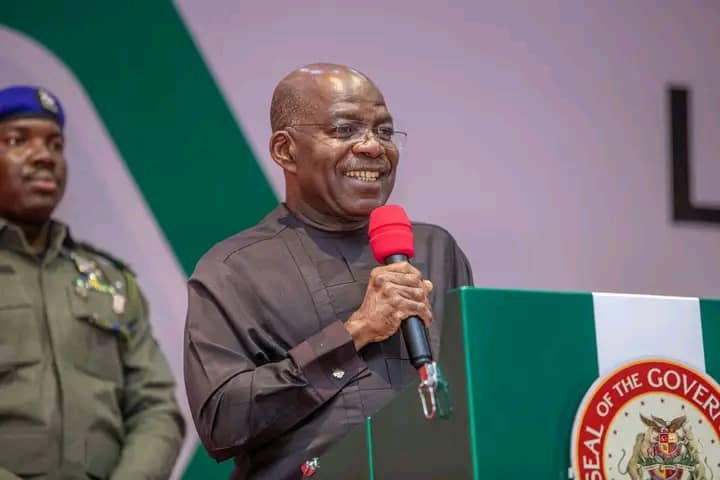
For the first time in the budget history of Nigeria’s South-East, a state has crossed the trillion-naira threshold. Abia achieved that milestone on Tuesday as Governor Alex Otti presented a N1.016 trillion budget proposal for 2026 to the State House of Assembly, drawing both admiration and scrutiny in equal measure.
Tagged “Budget of Acceleration and New Possibilities,” the plan marks a dramatic leap in the state’s financial ambition. It is a development many observers see as a pointed signal of how far Abia has travelled under Otti’s stewardship since 2023. The rise to a trillion-naira estimate, they argue, mirrors a growing administrative confidence backed by an economy that has become more active and more attractive to investors over the past two years.
Otti told lawmakers that the 2026 plan is designed to deepen infrastructure, strengthen social services, and lock in the gains of ongoing reforms. The size of the estimate represents a 13 percent rise from the 2025 budget.
Register for Tekedia Mini-MBA edition 20 (June 8 – Sept 5, 2026).
Register for Tekedia AI in Business Masterclass.
Join Tekedia Capital Syndicate and co-invest in great global startups.
Register for Tekedia AI Lab.
A striking feature of the proposal is its aggressive capital allocation. Abia intends to channel N811.8 billion — or 80 percent — into capital projects, while recurrent spending is capped at N204.4 billion, or 20 percent. Otti explained that the state is targeting a point where internally generated revenue, now rising sharply, fully covers recurrent expenditure.
Abia expects a combined internal and external revenue inflow of N607.2 billion in 2026, leaving a N409 billion deficit — roughly 40 percent of the entire plan. The size of the gap has raised questions about full implementation, yet analysts familiar with the state’s recent trajectory say Abia is now better placed to borrow and close the financing hole.
The reasoning is that the state’s economic profile has shifted. Investments in infrastructure, security, and digital revenue systems have helped broaden economic activity and improve investor sentiment. Otti reminded lawmakers that Abia’s IGR, once stuck near N20 billion a few years ago, is projected to hit N100 billion in 2025 and potentially climb to N223.4 billion in 2026. The state, in other words, is now seen as bankable.

Where the Money Will Go
Otti laid out an expansive list of spending priorities. Education takes N203.2 billion, or 20 percent of the entire proposal. The plan covers salaries for approximately 15,000 teachers, new model schools, three technical colleges, and ICT labs for more than 100 public schools, along with investments in ABSU, Ogbonnaya Onu Polytechnic, and the Abia State College of Education (Technical) in Arochukwu.
Healthcare receives N149.7 billion. The state intends to supply new equipment to ABSUTH and 23 other public facilities, upgrade seven general hospitals, and expand infrastructure for training more medical professionals.
Roads and transport together consume one of the largest slices. Abia is planning to spend N169.3 billion on road construction and rehabilitation, from the Umuahia–Ikot Ekpene axis to Ahiaeke–Okwuta–Bende and several community-impact routes. Another N11.1 billion is set aside for the transport sector, including N6 billion for 80 more electric buses, after the arrival of the first batch of 20.

The proposal also includes support programmes for entrepreneurs, farmers, youths, women, and vulnerable households, alongside more than N229 billion for housing, urban renewal, environmental cleanup, and cultural development.
Anambra’s Push: A N757 Billion Plan to Keep Momentum
Across the Niger Bridge, Anambra is charting a different path but with equal determination.
Governor Chukwuma Soludo has submitted a N757 billion proposal to the State House of Assembly for 2026. The figure rises 24.1 percent above the state’s 2025 estimate, which stood at N606.99 billion.
Soludo’s proposal allocates N595.3 billion for capital expenditure — about 79 percent of the budget — while N161.6 billion is dedicated to recurrent spending. He told lawmakers that the administration recorded more than 60 percent budget performance in 2025, even in an election year.
The plan, titled “Changing Gears 3.0: Solution Continues,” aims to consolidate the administration’s push toward a more digital and economically diversified Anambra. The budget carries a deficit of N225.7 billion, which the government hopes to finance through a blend of public–private partnerships, concessions, improved internal revenue, and support from financial institutions.
Commissioner for Budget and Economic Planning, Chiamaka Nnake, later told reporters that the state’s 2025 budget had already hit 61 percent performance as of October, and could close the year around 75 percent.
Ebonyi’s “Actualization and Hope” Budget Hits N884.8 Billion
In Ebonyi, Governor Francis Nwifuru is pursuing his own ambitious vision with a N884.868 billion proposal for 2026. His plan — “Budget of Actualization and Hope” — is said to be anchored on the administration’s “People’s Charter of Needs,” a framework built around infrastructure expansion, human capital improvement, and social-sector consolidation.
The estimate includes N749.49 billion for capital expenditure, representing 84.7 percent of the total. Recurrent expenditure is pegged at N135.37 billion. Nwifuru credited the State Assembly for its cooperation, saying the administration had restored stability across key institutions.
“We are building not just roads and schools, but resilient people empowered to be globally competitive,” he said.
A Region Entering a New Fiscal Cycle
Taken together, the 2026 proposals tabled by Abia, Anambra, and Ebonyi show a South-East in transition. All three states are leaning heavily on capital spending, infrastructure upgrades, and rising internal revenue as they attempt to push their economies into a new phase.
Yet Abia stands out this year. Breaking through the N1 trillion ceiling has positioned the state at the center of attention — partly because of its milestone significance, partly because it reinforces a narrative about renewed administrative direction and growing investor confidence.
The N409 billion deficit still looms, and full execution will depend on Abia’s ability to secure concessionary financing and sustain its rising revenue curve. But after two years of steady reforms and visible capital work, the state is no longer seen as a risk-heavy territory. This perception, many argue, is the biggest factor that could help Abia bridge the gap and keep its trillion-naira plan alive.