

In many places across the world, the consensus is that artificial intelligence will displace workers, especially those at the entry levels of industries. The narrative is that AI will trigger disintermediation, eliminating jobs in massive numbers. But let me share a perspective: Africa will not be severely affected in this disruption. In fact, the continent may benefit in unique ways.
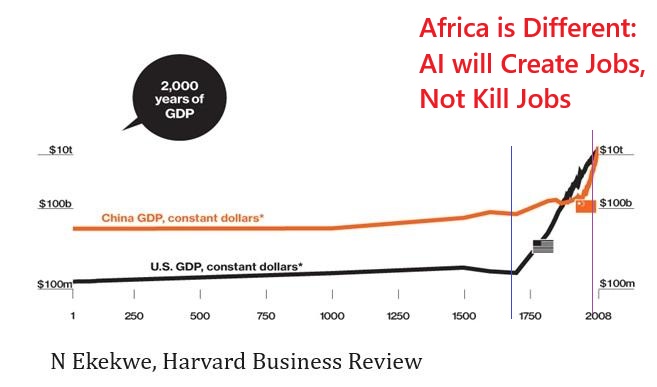
Years ago, I had divided modern civilization into three eras: the invention society, the innovation society, and the accelerated society. Those who have studied with us in Tekedia Mini-MBA know that framework well. In the invention era, brilliant minds created the pillars of modern knowledge in physics, chemistry, mathematics, and biology. But they did not commercialize those ideas into products and services.
The innovation society did what the inventors did not: they transformed those discoveries into products that shaped modern commerce and life. From the understanding of compounds, vaccines emerged; from electromagnetism, industries were born. Then came the accelerated society—our present moment—where technologies, powered by automation and AI, are compounding at breakneck speed. We are experiencing a Cambrian explosion of possibilities, and markets are being reshaped in unprecedented ways.
Register for Tekedia Mini-MBA edition 20 (June 8 – Sept 5, 2026).
Register for Tekedia AI in Business Masterclass.
Join Tekedia Capital Syndicate and co-invest in great global startups.
Register for Tekedia AI Lab.
But these epochs have not been universal. They largely describe the realities of a few regions: Western Europe, the United States, China, and a handful of others. Sub-Saharan Africa has not fully crossed from invention to innovation. We remain largely in the era where ideas abound, but the systematic conversion into scalable products and services lags. And since AI can only disrupt jobs when innovation has created industries and employment structures to disrupt, Africa is shielded. The foundations required for AI-driven mass job losses are still thin across the continent.
Of course, this does not mean AI will have no impact in Africa. In banking, insurance, and telecoms, AI will certainly play roles. But let us be factual: how many people are employed in those sectors compared to agriculture, trade, and informal economies? The vast majority of Africans work in spaces where AI is not immediately applicable.
So, while the world panics about job losses, Africa must think differently: this is our window to leapfrog, to harness AI not as a destroyer of work but as a catalyst for creating new categories of industries, jobs, and opportunities for our people.

---
Connect via my
LinkedIn |
Facebook |
X |
TikTok |
Instagram |
YouTube