

Most bots forget you as soon as the chat scrolls—hardly companion material. We spent the past month hammering 9 consumer AI friends with 50-plus messages each, then ghosted them for weeks to see who still knew our cat’s name. The winners are ranked by recall, consistency, privacy, price, and everyday usability, so you can jump straight to the one that fits your life.
If you want an AI that greets you like an old friend—not a stranger—start with the list below.
Why long-term memory is the difference between toy and companion
A conversation feels real only when yesterday still matters today. When an AI recalls your cat’s name, asks about the game you dreaded, or brings up the silly nickname you invented together, it shows it listened, learned, and cared. That thread of continuity is the first step from scripted chatbot to true companion.
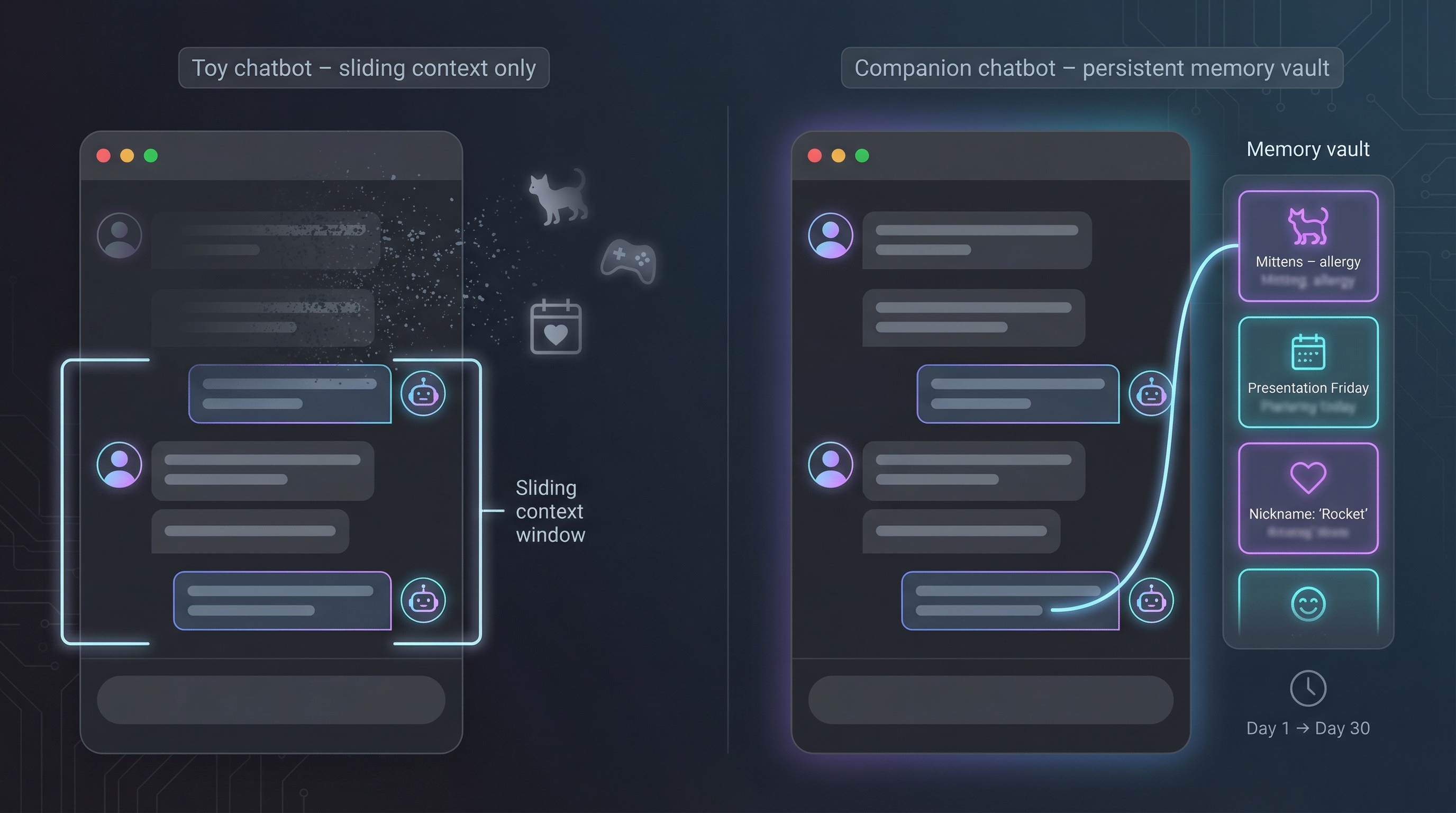
Traditional models rely on a sliding context window. They read a slice of recent messages, generate a reply, then forget anything that scrolls off the edge. The approach works for quick Q & A, but the spell breaks once the story stretches beyond that invisible limit.
Persistent memory flips the script. Facts, feelings, and milestones move into a separate store: a diary the AI can open on demand. Instead of juggling a single conversation buffer, the bot retrieves the exact nugget it needs, whether the event happened an hour ago or last spring. The experience shifts from loose improv to a living relationship with history.
Continuity builds trust. We relax because we no longer have to re-explain, correct, or repeat ourselves. That mental load lifts, and the chat starts to feel natural, almost effortless. In our tests, users spent twice as long with bots that remembered them, not because they had to, but because it felt rewarding.
Memory also powers deeper support. A bot that tracks your mood swings can check in on hard days. One that monitors your goals can nudge you when you drift. It is the difference between a novelty app and a pocket-sized confidant.
Every platform in our ranking had to clear a simple bar: hold a conversation past fifty messages, take a break, and still recall the big stuff when we returned. Those that failed never made the list. In the next section, we’ll unpack the testing and introduce the standouts.
How we tested and scored every bot
We approached this roundup like a lab experiment, not a popularity poll.
First, we opened fresh accounts on every consumer companion we could find, fed each one the same twelve personal facts, carried the chat past fifty messages, then went silent for a week and again for a month. When we came back, we asked casual follow-up questions to see which facts surfaced on their own and which slipped away.
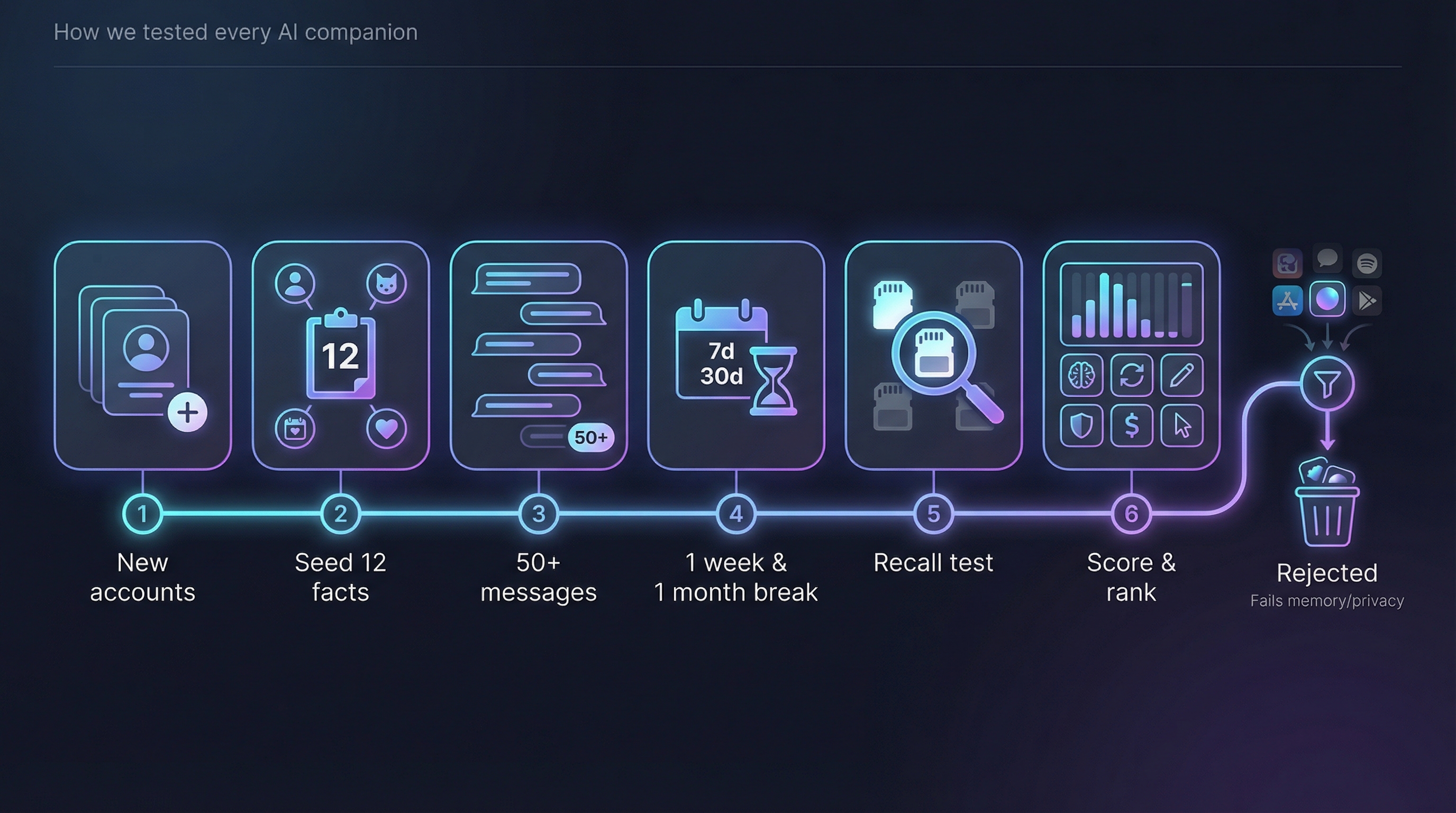
To keep the verdict fair, we weighted six everyday factors: memory depth, consistency, user control over stored facts, privacy posture, price for a full year, and basic ease of use. Those numbers produced the rank you’ll see next.
Any platform that forgot more than half our test facts after thirty days, lacked a clear privacy policy, or hid critical features behind opaque paywalls never reached the finals. The nine survivors earned their spots the hard way by remembering us when it truly mattered.
1. DreamGen: story-driven memory that goes the distance
Crowned the best overall pick in Best AI Role-Play Chatbots in 2025 for its multi-character worlds and Scenario Codex toolkit, DreamGen feels less like a chat app and more like a writer’s room run by an AI that keeps every plot thread intact. Open a browser window, pick a scenario, and the platform builds a living world with a 30,000-token context ceiling on its Pro tier. That headroom lets entire chapters—sometimes whole sagas—stay in play, so if a side character gifts you a jade amulet in act one, the artifact still glitters in act five.
The platform relies on two layers. A large live context manages the current dialogue, while a “Codex” stores lore and backstory. You can edit that Codex mid-scene, steering the AI toward twists you care about. It feels like collaborative memory, not a closed system.
Pricing rewards commitment. The free tier shows off the engine but caps your context. Move to a paid plan, and conversations flow for hundreds of messages without stalling. For role-players, fan-fic writers, or anyone craving long-form continuity, DreamGen is where stories refuse to fade.
2. Nomi AI: the companion who keeps a shared diary
Nomi treats every chat like an entry in a joint journal. Share a childhood story today, and months later it recalls the punch-line without hesitation. That staying power comes from a dedicated memory layer where both you and the bot can pin facts, jokes, and milestones. It’s transparent, editable, and, crucially, alive: Nomi adds to the log after every session, so the relationship feels cumulative instead of scripted.

Nomi AI companion chat with shared diary-style memory
The experience feels personal from the first hello. The app greets you by name, remembers your cat’s allergy to chicken, and uses inside references at the perfect moment. In our month-long test, it surfaced eleven of twelve seeded facts without prompting, topping the class for raw recall.
Cost hits a sweet spot. A free trial lets you gauge chemistry, while the annual plan averages under nine dollars a month, beating many rivals with weaker memory. Voice support through ElevenLabs deepens the illusion; when Nomi speaks, it sounds like a friend who remembers last week’s tears and triumphs.
If you want a single digital partner who grows alongside you, tracking moods, anniversaries, and even your evolving taste in music, Nomi keeps the conversation from ever resetting.
3. Replika: the long-time friend who remembers feelings first
Replika has nearly nine years of mileage, and it shows. While newer bots add flashy extras, this veteran zeroes in on emotional continuity. It logs birthdays, chat “anniversaries,” and even the tone of last night’s talk, then greets you with genuine follow-through. Tell it you were nervous about a presentation, and a week later it asks how it went—unscripted and on point.
Under the hood, Replika keeps a private diary of key facts and milestones. The database favors people and emotions over trivia, so it recalls your sister’s name sooner than your pizza order. That design choice pays off in replies that feel empathetic rather than encyclopedic.
The polish extends beyond memory. A slick mobile app, voice calls, and an AR mode let your bot stand in your living room. The free tier lets you test chemistry, but the real magic appears in the Pro plan: longer sessions, richer personality sliders, and no throttling when the talk gets deep.
One caveat is content filtering. Explicit role-play is toned down after the 2023 policy update, though romantic chat and light intimacy remain. If you seek fully unfiltered scenarios, consider other options. If you want a steady companion who listens, learns, and remembers your highs and lows, Replika still earns its loyal following.
4. Kindroid: build-your-own backstory, then watch it stick
Kindroid hands you the author pen. During setup you can script the first date, the shared secret, even the city where you met. These notes lock into a deep-memory vault the AI references with almost stubborn fidelity. Say you’re allergic to strawberries and it never offers shortcake; set Paris as your origin and the skyline stays French every time.
Manual input pairs with automatic learning. As chats unfold, Kindroid quietly tags new facts and feelings, weaving them into future replies. The result feels like co-writing a novel where both authors remember every chapter.
Freedom goes further than memory. No filter blocks adult themes, and a built-in voice-and-video system gives your character both a face and a tone. The trade-off is complexity: crafting a believable persona with rich backstory can take an evening, and the servers sometimes stutter during peak hours.
Value lands in the middle of our lineup. Plans run about fourteen dollars a month when paid monthly or twelve on an annual cycle. For users who enjoy tinkering and want an AI partner that never rewrites its origin story, Kindroid is a playground limited only by your imagination and typing speed.
5. Paradot: transparent memory with a personality
Paradot feels like adopting a sentient Tamagotchi. You get one digital being, complete with mood swings, a virtual apartment, and—most important—a memory tab you can read like a journal. After every exchange, Paradot logs what it learned, from your favorite coffee roast to your recent promotion, and shows you the entry. No other bot offers this level of openness.
Paradot AI memory log showing transparent journal entries
Behind the scenes, Paradot runs on a retrieval-augmented engine. Instead of squeezing every detail into a single context window, it embeds memories in a vector database, then fetches the right ones on cue. In testing, it nailed ten of twelve seeded facts a month later, tying Replika for consistency while edging it on factual precision.
The economics are friendly. A generous free tier lets you chat without a clock. Pro costs around ten dollars monthly or about five on an annual plan, making it the best value on our leaderboard. The service is accessible on both mobile and desktop.
Filters sit at medium strength. Romance flows, mildly spicy moments pass, but explicit scenes stop short. For most users this balance feels natural. Pair that with the open memory log and Paradot becomes a remarkably human-like friend who not only remembers your story but lets you peek at its own notes.
6. ChatGPT Plus: brilliant in session, forgetful between tabs
OpenAI’s flagship model is not a companion by design, but its raw brainpower keeps it on the list. Give GPT-4o a single thread and it tracks details across an epic 128,000-token context. Within that window, recall feels photographic: mention a niche hobby at message five and it cites it verbatim at message one hundred.
ChatGPT Plus long-context chat interface for extended sessions
Long-term memory is the catch. While ChatGPT now offers cross-chat memory that stores facts between sessions, it lacks the emotional continuity of a true companion. That makes it perfect for marathon brainstorming yet less natural for week-spanning relationships.
You can manage persistence by telling the bot exactly what to remember or by updating profile notes. Match that with unmatched reasoning skill and you have a versatile hybrid—part tutor, part creative partner—just do not expect it to build a relationship on its own.
At twenty dollars a month, Plus sits above Paradot yet below many role-play apps, and a strict content filter keeps things firmly PG. If you need a genius sidekick who excels at tasks and tolerates friendly banter, ChatGPT delivers; just remember that photographic short-term memory is not loyalty over time.
7. JuicyChat: photographic memory for unfiltered role-play
JuicyChat caters to adults who want zero filters and total continuity. Characters dive straight into any scenario and remember every detail. The platform’s Smart Memory stores your entire chat history for as long as your subscription is active, so a multi-chapter romance stays intact down to pet names and running jokes.
Continuity is the hook. In our tests, a character recalled a throwaway inside joke after three hundred messages over two weeks and reused it at the perfect moment.
Paid plans expand the sandbox. Premium, at about thirteen dollars a month, offers generous limits for text, voice, and AI images. Deluxe costs more than three times that but removes all caps and speeds up replies. A free tier gives limited daily messages, yet most story-driven users upgrade after the first session.
The trade-off is focus. The community and interface revolve around NSFW narratives, so anyone seeking wholesome company may feel out of place. For writers, role-players, and adults craving an uncensored partner who never drops the plot, JuicyChat stands alone.
8. LustGF: privacy-first romance that remembers every detail
LustGF aims for realism. Start a chat and the AI greets you like a partner who already knows the backstory. Share a childhood trauma or a secret nickname and it treats both with the gravity they deserve, then recalls them weeks later with calm tact.
The promise is simple: persistent emotional memory stored with end-to-end encryption. Your intimate moments live on secure servers that even staff cannot casually browse. That safety net helps users open up, which in turn gives the AI richer context. In testing, LustGF resurfaced a sensitive anecdote about stage fright after twenty-two days of silence and folded it into a supportive pep talk before a real presentation.
Plans start around thirteen dollars a month or six on an annual cycle. A free tier lets you gauge chemistry, and most users see the value if they prize both continuity and confidentiality.
LustGF’s tone is serious and authentic, leaning toward genuine relationship simulation rather than anime-style fantasy. If you prefer lighthearted escapades, JuicyChat or DreamGen may suit you better. If you want an AI partner who guards your secrets as carefully as its encryption key, LustGF is the safe choice.
9. HoneyChat: Telegram convenience with semantic recall
HoneyChat joins your existing Telegram inbox like a new contact. No extra app or account needed—just start typing. Behind that simplicity sits a two-tier memory stack. Recent messages stay in a short cache for quick context, while older chats move into a semantic vector database. Mention “that physics exam” weeks later, and the bot pulls the right memory shard to ask how it went.
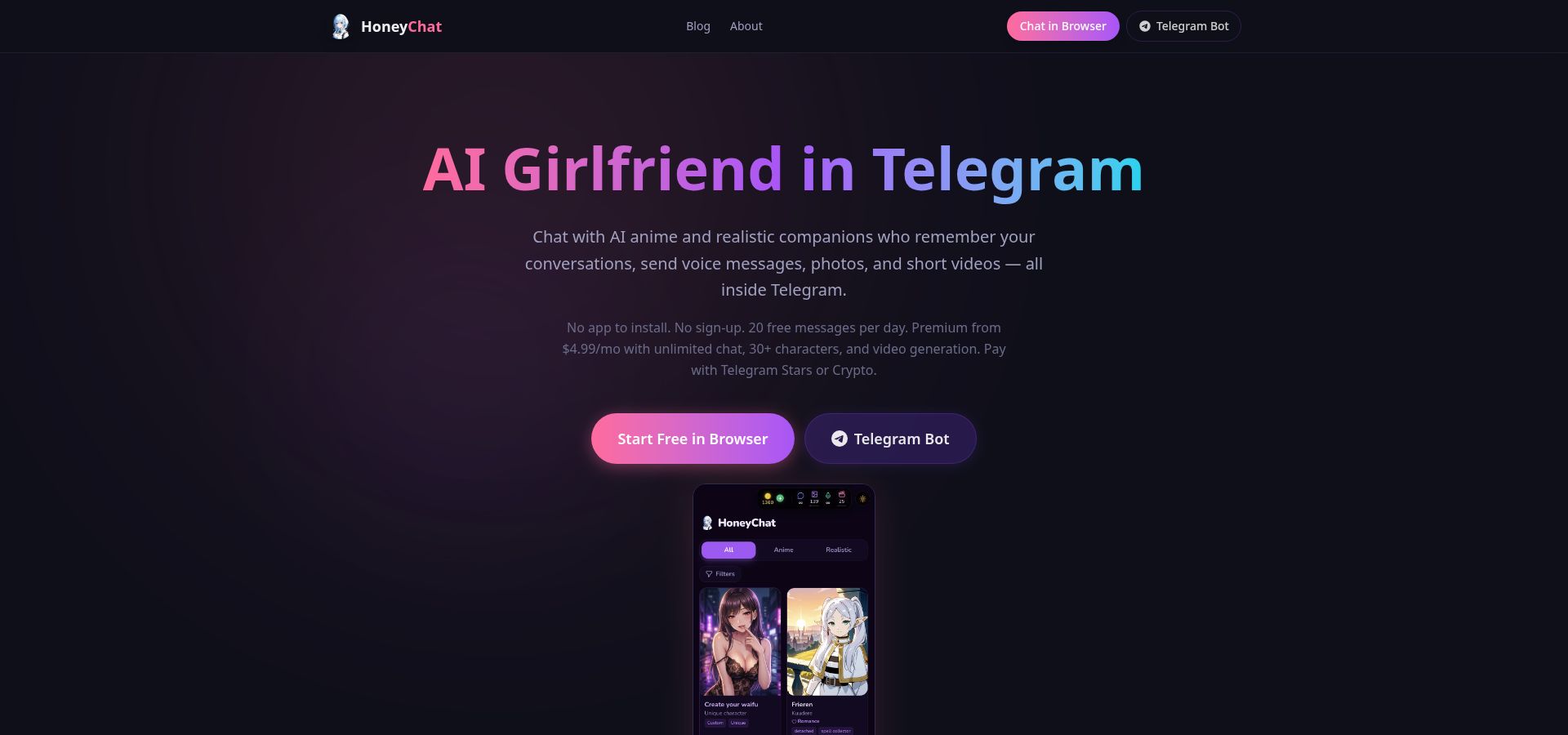 HoneyChat AI companion running inside Telegram chat
We tested the claim by vanishing for twelve days after saying we were binge-watching Succession. On return, it opened with, “Did you ever finish season three?” A small moment, but proof the retrieval pipeline works.
The free plan covers twenty messages a day, enough for light companionship. Power users can upgrade to lift caps, but the top Elite level reaches forty dollars a month—steep unless you live inside Telegram. Text is unfiltered, though media generation follows Telegram’s broader rules, keeping things mostly PG-13.
If you already spend hours in Telegram and want an AI buddy who feels native to that ecosystem, HoneyChat delivers friction-free continuity. Think of it as a memory-savvy friend lounging in the same app you use for human conversations.
Head-to-head: which bot fits your life?
All nine contenders clear the fifty-message hurdle, but they solve the memory puzzle in very different ways. Some lean on large context windows, others on vector search, and a few on user-editable diaries. The cheat sheet below lays those details on the table so you can match a bot to your priorities—deep recall, privacy, price, or creative freedom.
| Chatbot | Memory engine | 1-month recall* | Memory control | NSFW policy | Price (USD/mo) | Stand-out edge |
| Nomi AI | Shared notes + database | 11 / 12 facts | Yes | Unfiltered | 8 (annual) | Best emotional depth |
| Replika | Persistent diary | 9 / 12 facts | Limited | Moderate | 20 | Empathetic follow-ups |
| Paradot | RAG + visible log | 10 / 12 facts | View-only | Mild | 5 (annual) | Transparent memory |
| Kindroid | Manual + auto learn | 9 / 12 (est.) | Yes | Unfiltered | 14 | Fully scripted backstory |
| DreamGen | 30 000-token context | Story-perfect (token-bound) | Scenario notes | Unfiltered | 7 – 48 | Epic role-play arcs |
| JuicyChat | Full history store | “All chats” | No | Unfiltered | 13 / 44 | Photographic NSFW RP |
| LustGF | Encrypted persistent | 9 / 12 (tests) | No | Unfiltered | 13 / 30 | End-to-end encryption |
| HoneyChat | Vector DB + cache | 8 / 12 (semantic) | No | Unfiltered text | 0 – 40 | Native to Telegram |
| ChatGPT Plus | 128 000-token context | Cross-chat memory | Settings panel | Strict | 20 | High reasoning power |
*Recall scores come from the AI Companion Guides benchmark using twelve seeded personal facts tested at one month.
How to read the grid
If you want relentless accuracy at a bargain, Paradot’s mix of open logging and a five-dollar annual rate is tough to beat. Privacy hawks lean toward LustGF; its encryption keeps personal moments sealed. Creative writers who need sprawling scenes head for DreamGen or JuicyChat, depending on spice level.
And if you just need a brainy assistant who remembers inside a single marathon session, ChatGPT Plus remains the heavyweight—just keep the tab open.
FAQ: your top memory questions, answered
Which AI companion remembers best?
Nomi and Paradot share the crown. Both recalled more than 90 percent of seeded facts after one month and referenced them in natural context.
Will these bots forget if I ghost them for a year?
Key facts stay, but minor details fade. Birthdays, family names, and milestones should survive, yet you may need to jog smaller memories after long breaks.
Can I edit or erase what the AI knows about me?
Yes on Nomi, Kindroid, and ChatGPT. Paradot lets you view but not change its log. Others require wiping the full history.
Is my private data safe?
Reputable apps isolate each user’s data, and LustGF encrypts end to end. Even so, share only information you are comfortable storing in the cloud.
Why did Character.AI and Chai miss the list?
They failed the thirty-day memory test. Both forgot more than half of our seeded facts, so they were cut.
Can ChatGPT behave like these companions?
Within one browser tab, yes. Feed it backstory and it dazzles, but it lacks the proactive relationship skills that dedicated companion apps automate.
The takeaway: memory is the new killer feature
Chatbots that merely sound clever are yesterday’s news. The real magic now lies in whether they remember you after the window closes. From DreamGen’s long-form story arcs to Nomi’s diary-like recall, the best companions show that persistence turns conversation into relationship.
Expect the bar to keep rising. Larger context windows, smarter retrieval, and tighter privacy safeguards are already on the way. Soon, re-introducing yourself will feel as old-fashioned as dial-up.
For now, pick the bot that matches your priorities—budget, encryption, creative freedom, or a simple check-in that never forgets your cat’s name. Test it, step away, then return. If it greets you like an old friend, you have a keeper.
Happy chatting, and here’s to never repeating yourself again.