

Short-form video has entered a strange new phase: the hardest part is no longer editing. It’s deciding what kind of performance you want, and how much risk you’re willing to take to get it.
In the last wave of AI adoption, text and images were the headline. Now video is the battleground—especially “performance video”: dance clips, skits, talking avatars, and remixes that look like a real shoot, but are generated or re-performed by models. The hottest use cases aren’t cinematic films. They’re the everyday formats that drive attention: Reels, TikTok, Shorts, and the endless loop of reactions.
For founders and creators—especially in fast-growing markets—this shift matters because it compresses the cost curve. When performance becomes cheap, distribution becomes expensive. And when distribution is expensive, trust becomes the premium.
Why AI dance is trending (and why it’s not just a meme)
AI dance content is popular for a simple reason: it packages “movement + personality” into something instantly watchable. A dance clip has a built-in structure (setup ? motion ? payoff), and it performs well even without dialogue. That makes it ideal for global audiences, multilingual feeds, and low-attention scroll behavior.
But there’s a deeper point: AI dance is a gateway to synthetic performance. Once you can generate clean motion from a single photo, you can produce:
- Product promo loops (a model “showing” outfits without a shoot)
- Brand mascots that move consistently across campaigns
- Character-led content for games, comics, and IP pages
- Creator “formats” that can be remixed weekly without re-recording
Tools like free AI dance are getting attention because they reduce production friction: you can test ideas quickly, then keep the winning formats and discard the rest.
Face swaps are the growth hack—and the governance problem
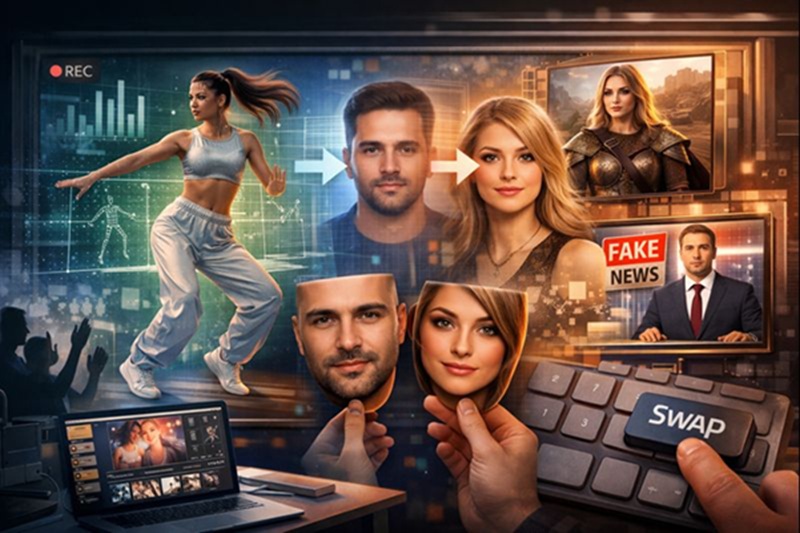
Face swaps sit on the other side of the same coin. AI dance generates performance; face swap personalizes performance.
This is why face swaps are everywhere in marketing experiments: the same clip can be re-targeted across audiences, creators, or “characters” with minimal rework. The conversion logic is obvious: people stop scrolling when they recognize a face or feel like the content is “about them.”
But face swaps also trigger the hardest questions in AI media: consent, impersonation, and fraud. That’s why any serious use of a face swap video workflow must be paired with clear internal rules—especially if a brand is involved.
A practical way to think about it is: the more realistic the output, the higher the compliance burden. If it looks real, viewers assume it is real.
A founder’s framework: content cost collapses ? trust becomes the moat
When content creation becomes cheap, competition moves up the stack:
- Taste and creative direction (knowing what works for your audience)
- Distribution (channels, partnerships, community, creator networks)
- Trust and provenance (permission, labeling, and accountability)
In many African and emerging-market contexts, this is a big deal. SMEs and solo creators can suddenly produce “big brand” content without big brand budgets. That is an advantage. But it also means scams get cheaper too. So the winners will be the teams that can scale content and signal legitimacy.
Here’s a simple operating table you can use inside a team:
| Use case | Why it works | Main risk | Basic safeguard |
| AI dance for social growth | Fast output, high watchability | Low (if fictional/clearly stylized) | Avoid using real private individuals |
| Brand mascot performance | Consistent identity across campaigns | Medium (misleading realism) | Label as AI/virtual character where appropriate |
| Face swap for creator collabs | Personalization boosts engagement | High (consent/impersonation) | Written permission + clear usage scope |
| Political / news-adjacent edits | High virality | Extreme (disinformation) | Don’t do it—too costly to defend |
How to use synthetic performance responsibly: practical rules
You don’t need a legal team to be sensible, but you do need discipline. If you’re running marketing experiments, adopt rules that are easy to explain to anyone on the team:
- Consent first: if a real person’s identity is involved, get permission. No exceptions.
- No “confusion design”: don’t intentionally make viewers think a fake clip is real.
- Keep receipts: save original assets and a short note on the intent and source.
- Separate internal tools from public output: what you can generate privately is not what you should publish publicly.
- If it touches finance, health, politics, or reputation—avoid. The downside dominates.
This is not only ethics; it’s strategy. The moment your brand is associated with impersonation, you lose the trust premium—and your customer acquisition cost rises.
The opportunity most people miss: synthetic performance as a production system
The smartest teams won’t treat AI dance and face swaps as “viral tricks.” They will treat them as a content production system:
- Build a small library of repeatable formats (3–5 winners)
- Turn each format into a weekly “template”
- Run A/B tests on hooks, pacing, and visual identity
- Keep the same character consistency so audiences remember you
- Track performance like product metrics, not like art
In that world, the competitive edge is not the tool. The edge is the workflow—and the willingness to iterate like an operator.
Bottom line
AI dance is exploding because it’s a low-friction way to manufacture watchable motion. Face swaps are exploding because they let you personalize that motion at scale. Together, they define the next creator economy phase: synthetic performance.
If you’re building in this space, don’t obsess over the novelty. Obsess over the operating model: speed, repeatability, and trust. When everyone can create, the teams that win are the ones people believe.