

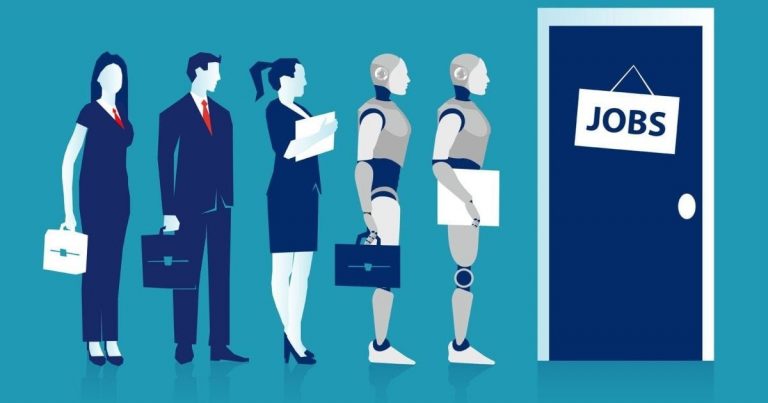
Artificial Intelligence (AI) is no longer just reshaping how work is done, it is now reshaping who gets to keep their jobs.
In 2025, the rapid adoption of AI across U.S. industries was responsible for almost 50,000 layoffs, according to data from consulting firm Challenger, Gray & Christmas.
These figures highlight a growing shift as companies automate roles, streamline operations, and replace human labor with AI-driven systems in a bid to cut costs and boost efficiency. Per Challenger, overall job cuts topped 1 million in 2025, the highest level since the Covid-19 pandemic in 2020.
Register for Tekedia Mini-MBA edition 20 (June 8 – Sept 5, 2026).
Register for Tekedia AI in Business Masterclass.
Join Tekedia Capital Syndicate and co-invest in great global startups.
Register for Tekedia AI Lab.
Major firms such as Meta, Salesforce, Microsoft, IBM, amongst others, announced significant job cuts this year, citing AI as a factor. Amazon in October, announced the largest ever round of layoffs in its history, slashing 14,000 corporate roles, as it looks to invest in its biggest bets which include AI.
CEO Andy Jassy warned of the cuts earlier this year, telling employees that AI will shrink the company’s workforce and that the tech giant will need “fewer people doing some of the jobs that are being done today, and more people doing other types of jobs.”
Also, Tech giant Microsoft has cut a total of around 15,000 jobs through 2025, and its most recent announcement in July saw 9,000 roles on the chopping block.

CEO Satya Nadella wrote in a memo to employees that the company needed to “reimagine” its “mission for a new era,” and went on to tout the significance of AI to the company.
Salesforce CEO Marc Benioff confirmed in September that 4,000 customer support workers had been cut at the firm with the help of AI.
He said on a podcast, “I’ve reduced it from 9,000 heads to about 5,000, because I need less heads”.

Artificial intelligence is no longer a distant disruption in the U.S. labor market, it is already reshaping how people work and what skills are valued. As AI systems become more capable of automating routine, repetitive, and rules-based tasks, U.S. citizens are increasingly being pushed to upskill and adapt in order to remain relevant in a fast-changing economy.
According to a recent report from the McKinsey Global Institute, AI and AI-powered robots are now capable of performing more than half of all work hours in the United States. The report found that although the vast majority of human skills will remain relevant in an era of large-scale automation, the way people use those skills is expected to change dramatically.
At current levels of capability, AI agents could perform tasks that occupy 44 percent of U.S. work hours today, and robots could account for 13 percent, the report said. Recent U.S. government projections underline this shift. Employment growth is expected to remain flat or even decline in several tech-exposed fields, particularly administrative support roles, paralegals and legal assistants, and computer programmers.
These occupations have traditionally relied on structured tasks such as data entry, document preparation, basic legal research, and writing or debugging standard code areas where AI tools now perform faster and at lower cost.
The Bureau of Labor Statistics (BLS) has explicitly pointed to technology, including AI, as a major factor behind these projections. In administrative roles, for example, AI-powered software can now schedule meetings, manage emails, generate reports, and process invoices with minimal human input. This reduces demand for entry-level and mid-level clerical workers while increasing demand for professionals who can supervise systems, interpret outputs, or manage more complex workflows.
Even in programming once seen as a future-proof career AI is changing the landscape. Tools that can generate code, fix bugs, or translate natural language into software instructions are reducing demand for basic coding tasks.
The BLS suggests that while advanced software engineering, systems design, and AI-related roles will grow, traditional programming jobs focused on routine development may stagnate or decline. This is forcing programmers to upskill into areas like AI engineering, cybersecurity, cloud architecture, and product-focused development.
Overall, AI is not just replacing jobs, it is redefining them. Workers who rely solely on routine technical or administrative skills face higher risk, while those who invest in continuous learning especially in analytical thinking, creativity, system oversight, and human-centered skill are better positioned to thrive.
As AI adoption accelerates across industries, the U.S. workforce is being nudged toward higher-value roles that complement machines rather than compete with them. The future of work, as the BLS projections suggest, will belong to those who can adapt alongside AI, not those who ignore its impact.