

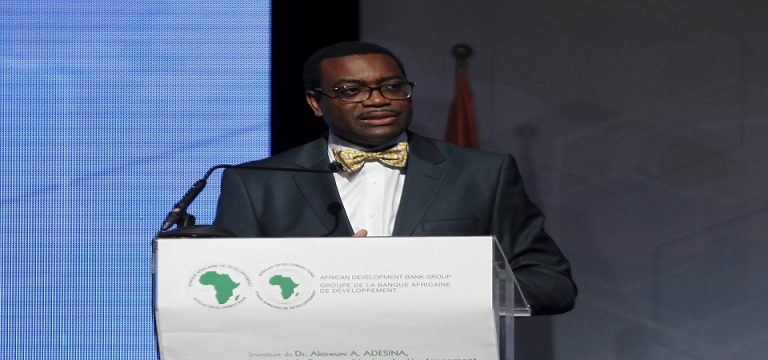
President of the African Development Bank (AfDB), Dr. Akinwumi Adesina, has issued a renewed warning to African governments, urging them to end the continuous export of raw materials if the continent intends to break free from poverty and long-term economic underdevelopment.
In a post shared on Thursday via his official X handle, Adesina was blunt in his message.
“Africa must end the exports of its raw materials. The export of raw materials is the door to poverty. The export of value-added products is the highway to wealth. And Africa is tired of being poor,” he said.
Register for Tekedia Mini-MBA edition 20 (June 8 – Sept 5, 2026).
Register for Tekedia AI in Business Masterclass.
Join Tekedia Capital Syndicate and co-invest in great global startups.
Register for Tekedia AI Lab.
The Cost of Exporting Wealth and Importing Poverty
Though not new, Adesina’s call strikes at the heart of a deeply entrenched economic model that has defined Africa’s position in the global market for over a century: a supplier of cheap raw materials and a consumer of expensive, imported finished goods.
Despite possessing a vast array of natural resources—from gold, crude oil, lithium, and cobalt, to cocoa, coffee, and cotton—Africa remains one of the least industrialized regions in the world. According to figures from the Office of the United States Trade Representative and other multilateral institutions, the continent accounts for less than 2% of global manufacturing and under 3% of global trade.
The result has been a long history of missed opportunities for value retention. While resource-rich African countries export raw materials to industrialized nations, those same materials are processed into finished products abroad and then sold back to Africa at significantly higher prices. This dynamic not only results in economic loss but also perpetuates joblessness, low wages, weak technological capacity, and poor industrial growth across the continent.

Adesina Not Alone in His Call
Adesina’s remarks join a growing chorus of African voices calling for a break from the extractive economic legacy inherited from colonial rule. Among them is the Director-General of the World Trade Organization (WTO), Dr. Ngozi Okonjo-Iweala, who has also urged African nations to stop exporting critical raw materials such as lithium, cobalt, and other rare earth minerals without first processing them.
In February, Okonjo-Iweala said Africa must harness its resources to create value at home, warning that the continent really needs to change its mindset about access to aid.
“We need to develop our processing industries to create jobs, boost intra-continental trade, and ensure we stop exporting raw materials without value addition,” she stated.

The WTO chief, who is also a former Nigerian finance minister, has repeatedly emphasized that the continent must position itself not just as a participant in global trade, but as a strategic actor with value-added capacity and negotiating leverage.
A Legacy of Exploitation
For many pan-African scholars, economists, and grassroots activists, this shift is long overdue. The current model, where Africa’s mineral and agricultural resources are shipped abroad with little to no local processing, has been widely criticized as a continuation of a colonial extractive framework, one that sees the continent as little more than a mineral and agricultural basin for industrialized nations.
Activists such as P.L.O. Lumumba, Kemi Seba, and others have consistently decried what they describe as a systemic design that ensures Africa remains dependent. According to them, the global trade system has been structured in a way that discourages industrialization on the continent, while rewarding Western and Asian countries that profit from African resources.
This sentiment has also been echoed by think tanks across the continent. Reports by the African Center for Economic Transformation (ACET) and the United Nations Economic Commission for Africa (UNECA) have emphasized the need for an industrial policy that prioritizes domestic manufacturing, regional trade integration, and the development of strategic industries such as agro-processing, textiles, automobile assembly, and battery production.
AfCFTA and the Push for Regional Industrialization
Efforts to reverse the trend have picked up pace in recent years, with the African Continental Free Trade Area (AfCFTA) at the center of that push. Designed to create the world’s largest single market, the AfCFTA is expected to boost intra-African trade, expand industrial capacity, and encourage the development of local value chains.
Adesina has been one of the most vocal proponents of leveraging AfCFTA to unlock the continent’s potential. He has consistently argued that regional integration, agro-industrialization, energy expansion, and improved infrastructure must form the bedrock of any long-term plan to lift Africa out of poverty.
Under his leadership, the bank has invested heavily in energy and transport infrastructure projects, with the goal of bridging the infrastructure gap that continues to frustrate industrial growth.
IMF SDR Allocation and Financial Inequities
Beyond industrialization, Adesina has also taken aim at global financial structures that marginalize Africa. Last week, he criticized the International Monetary Fund’s (IMF) disproportionate allocation of Special Drawing Rights (SDRs), pointing out that Africa received only $33 billion—just 4.5% of the $650 billion issued globally in response to the COVID-19 pandemic.
According to Adesina, this allocation failed to reflect the urgency of Africa’s economic challenges, especially given that the continent experienced some of the deepest pandemic-induced shocks and had the least fiscal space to implement recovery plans.
In response, the AfDB, in partnership with the African Union, has spearheaded efforts to rechannel unused SDRs from wealthier nations to African economies. The bank, alongside the Inter-American Development Bank (IDB), co-developed a new framework to enable the reallocation of SDRs, which has now been approved by the IMF Board. The plan hinges on leveraging the AfDB’s AAA credit rating to raise additional funding for Africa’s development needs.
Pushing for A Better Future
The message from Adesina and other leaders is consistent: Africa cannot develop if it remains an exporter of raw materials and an importer of value. The economic logic is that processing and manufacturing drive higher incomes, job creation, technological innovation, and greater economic resilience. In contrast, raw material exports offer short-term revenue but little in the way of long-term transformation.
From cocoa in West Africa to rare earth minerals in the Democratic Republic of Congo, and from cotton in Burkina Faso to oil in Angola, the story has been the same—resources leave the continent unprocessed, only to return as overpriced finished goods. This extractive cycle keeps Africa on the margins of global prosperity, even as it sits atop immense natural wealth.
This has created an economic underdevelopment that has kept many in multidimensional poverty, fueling the call for a redesign that will see Africa utilize its mineral resources for its development. While it is clear that as Adesina said, “Africa is tired of being poor,” the question remains whether its leaders are ready to act accordingly.