

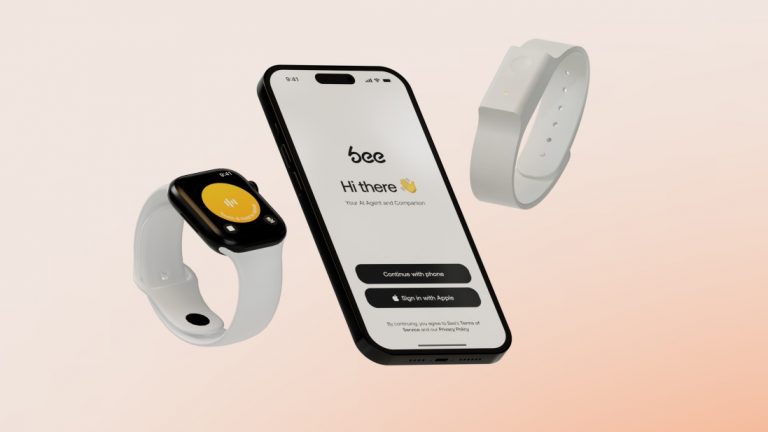
Amazon has acquired AI wearables startup Bee, a move that analysts view as a significant shift in the tech giant’s ambition to bring artificial intelligence closer to consumers in more personal and persistent ways.
The deal, first disclosed in a LinkedIn post by Bee co-founder Maria de Lourdes Zollo and confirmed by Amazon to TechCrunch, is not yet finalized. Still, the acquisition underlines Amazon’s growing interest in wearable AI products beyond its existing Echo smart speaker line and Alexa voice assistant.
Bee, which raised $7 million in funding last year, has developed a Fitbit-like wristband priced at $49.99 (with a $ 19 monthly subscription) as well as an Apple Watch app. The device’s key feature is its always-on listening capability, which records ambient conversations unless manually muted. Bee’s AI uses these inputs to generate to-do lists, reminders, and other productivity prompts, functioning as what the startup describes as “a personal, ambient intelligence.”
Register for Tekedia Mini-MBA edition 20 (June 8 – Sept 5, 2026).
Register for Tekedia AI in Business Masterclass.
Join Tekedia Capital Syndicate and co-invest in great global startups.
Register for Tekedia AI Lab.
In past interviews, Zollo said Bee ultimately aims to build a “cloud phone” — a virtual mirror of a user’s smartphone that grants access to notifications, accounts, and communication features, but in a less obtrusive and more fluid form. On its website, Bee describes its mission as creating an AI assistant that is “less like a tool and more like a trusted companion.”
Amazon did not disclose how much it paid for Bee, but it confirmed that Bee’s employees received offers to join the company. It is also unclear whether Amazon will retain Bee’s brand or fold the technology into its own devices.
Competing in a Crowded, Cautious Market
The acquisition puts Amazon in competition with other tech firms that are exploring AI-powered wearables. Meta is integrating its generative AI into smart glasses, Apple is rumored to be working on AI-enhanced smart eyewear, and OpenAI is reportedly developing its own AI hardware with backing from former Apple design legend Jony Ive.

But unlike Humane AI and Rabbit, which launched expensive, experimental gadgets to tepid consumer interest — Humane’s AI Pin costs a steep $499 — Bee has positioned itself as a budget-friendly alternative. Its lower $50 price tag could make it attractive to early adopters without requiring a major financial gamble.
Surveillance Fears Linger
However, the always-on nature of Bee’s product raises serious privacy concerns. While the company claims it doesn’t store or train AI on recorded audio, it does retain learned behavioral data to function as a personal assistant. Bee has also said it would only record voices with verbal consent, and that it is developing tools for users to set boundaries — for instance, pausing recording in sensitive locations or on specific topics.
It also plans to move toward on-device processing, which would keep sensitive data off the cloud — a more secure approach favored by privacy advocates.

But whether Amazon will preserve these privacy safeguards is uncertain. The company’s past conduct raises red flags: Amazon has been widely criticized for allowing law enforcement access to Ring camera footage without user permission or court orders. The company settled with the U.S. Federal Trade Commission in 2023, after it was found that employees and contractors had unfettered access to users’ video recordings.
Given that Amazon’s Alexa ecosystem already collects significant voice data and has faced repeated scrutiny over how it handles user privacy, critics argue that integrating Bee’s technology could intensify surveillance risks unless carefully managed and independently audited.
A Strategic Bet on AI’s Next Form
Still, for Amazon, the acquisition is a calculated bet on the future of personal computing — one that moves beyond screens and keyboards toward wearable, ambient AI. The success of this pivot could determine whether Amazon can retain its dominance in consumer AI as competition from OpenAI, Apple, and Meta heats up.
The deal also reinforces Amazon’s belief that voice-first, passive interaction models could be the key to unlocking the next major platform shift, especially as consumers tire of constantly engaging with smartphones and apps.
For now, Bee remains an independent startup pending the close of the deal — but its future under Amazon could shape how, and how closely, artificial intelligence will follow users throughout their day.