

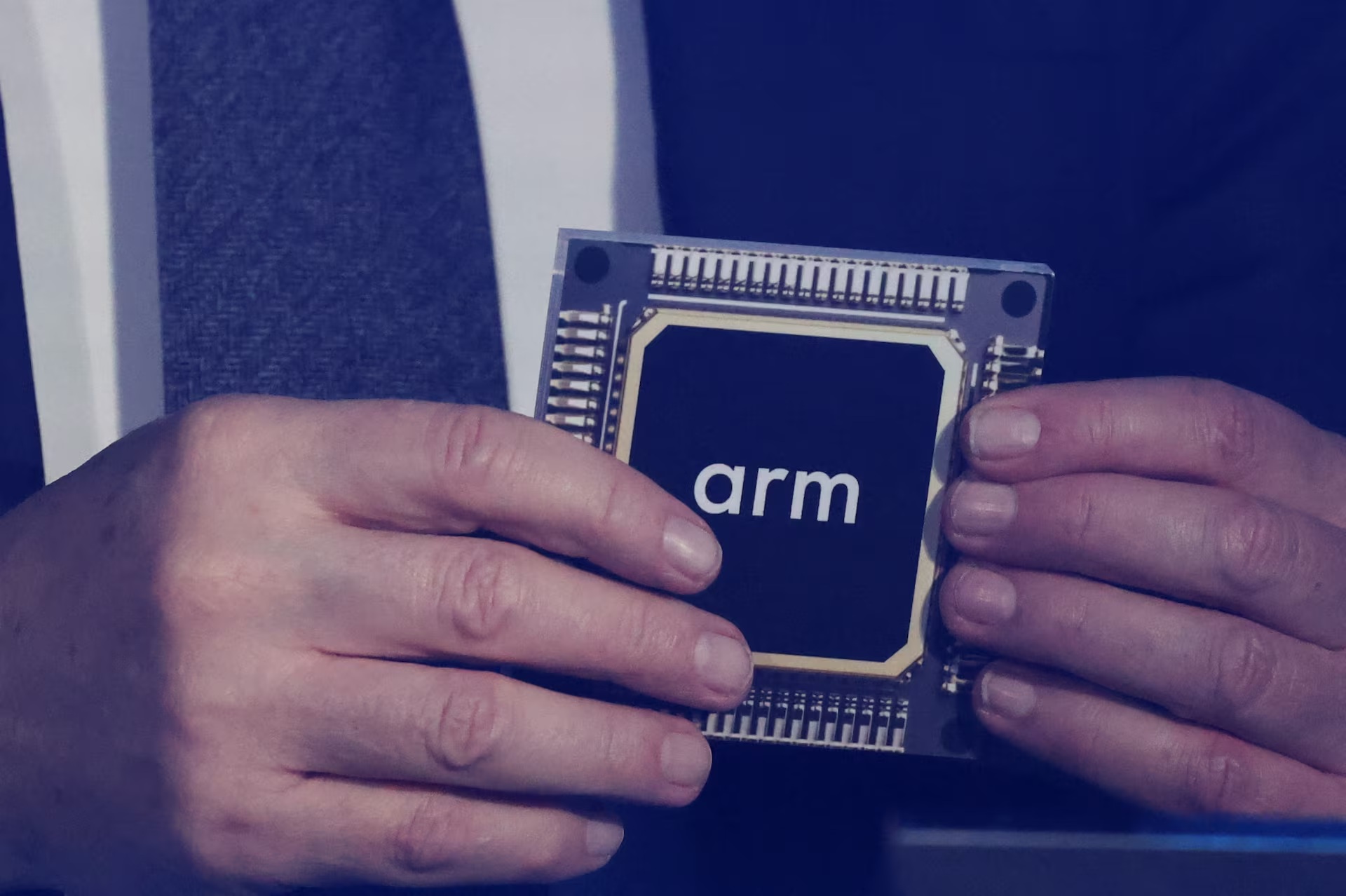
Arm Holdings has laid out its boldest transformation in decades, pairing an aggressive long-term financial forecast with a decisive move into manufacturing its own chips, a strategy that could redraw competitive lines across the semiconductor industry.
The British chip designer said it expects annual revenue to reach $25 billion by 2031, a more than sixfold increase from the roughly $4 billion it generated in 2025. At the center of that projection is a newly unveiled processor, the Arm AGI CPU, expected to contribute about $15 billion in yearly sales within the same period.
The announcement, delivered by chief executive Rene Haas at an event in San Francisco, marks a turning point for a company long defined by its neutral role in the global chip ecosystem. For 35 years, Arm has supplied the underlying architecture for processors used by partners, earning licensing fees and royalties while avoiding direct competition. That model is now being recalibrated.
Register for Tekedia Mini-MBA edition 20 (June 8 – Sept 5, 2026).
Register for Tekedia AI in Business Masterclass.
Join Tekedia Capital Syndicate and co-invest in great global startups.
Register for Tekedia AI Lab.
The AGI CPU is designed specifically for artificial intelligence inference, the stage where trained models are deployed in real-world environments. It is an area gaining commercial importance as companies shift from building AI systems to running them at scale. Meta Platforms has been named as the initial customer, signaling early validation from one of the largest buyers of data center compute.
Arm’s decision to produce its own silicon reflects a broader shift in how value is being captured in the AI era. While the company’s architecture already underpins a growing share of data center processors, much of the economic upside has historically accrued to its customers. By moving into finished chips, Arm is seeking to claim a larger portion of that value chain.
The timing aligns with a structural change in computing demand. The emergence of agentic AI, systems capable of carrying out tasks with limited human input, is driving renewed interest in central processing units. Unlike earlier AI workloads that leaned heavily on specialized accelerators, these systems require a balance of flexibility and performance that CPUs are well-positioned to provide.

Haas said demand for CPUs linked to such workloads could increase fourfold, adding that even that estimate may prove conservative.
“We may be under-calling that number,” Haas said Tuesday. “I think the demand is higher than we think it is.”
The implication is a sustained expansion in one of the industry’s most competitive segments, where Arm is now positioning itself not just as an enabler, but as a direct participant.

Financially, the shift could be transformative. Chief financial officer Jason Child said the company expects gross margins of around 50% on the new chip, significantly higher than the effective margins derived from licensing alone.
“It expands our market to include customers that were not interested in an IP model, gives our current customers choice, and for Arm it creates a much larger profit opportunity,” Child said at the event on Tuesday.
The move also opens access to customers who have historically bypassed Arm’s IP model in favor of off-the-shelf processors or fully in-house designs.
Yet the strategy carries clear risks. Arm’s customer base includes some of the world’s largest technology companies, many of which design their own chips using Arm architecture. By entering the market with its own products, the company risks unsettling those relationships, even as executives insist participation in the new model will remain optional.
“We’re not going to force any of our existing customers to migrate,” Child said, seeking to reassure partners wary of a shifting competitive dynamic.
The company’s push into higher-performance computing has been building for years. Since the introduction of its Neoverse platform in 2018, Arm has steadily gained ground in data centers, an arena historically dominated by x86 processors from Intel and AMD. Adoption accelerated when Amazon launched its Graviton chips, followed by similar efforts from Google and Microsoft.
What distinguishes the current move is the level of vertical integration. Arm is no longer content to sit at the architectural layer; it is moving into product design and, by extension, deeper into the commercial realities of pricing, supply chains, and customer support.
Analysts say the market is still adjusting to what that means. Ben Bajarin of Creative Strategies noted that the shift effectively creates a new business line that investors must evaluate alongside Arm’s legacy licensing operations.
“Arm has typically been modeled purely on their licensing and royalty business and now they have given investors a new market opportunity and business to wrap their head around and model, so it isn’t a surprise it will take some time for folks to wrap their head around the valuation and new revenue targets,” he told CNBC.
The scale of the revenue targets suggests management believes the addressable market for AI-focused processors is expanding rapidly, particularly as inference workloads begin to dominate computing demand.
There is also a broader industry context. As AI deployment accelerates, hyperscale companies are increasingly building or commissioning custom chips to control costs and optimize performance. Arm’s new offering could appeal to a tier of customers that lack the resources to develop in-house silicon but still require high-performance solutions tailored to AI workloads.
The early market response reflects cautious optimism. Shares rose about 6% in after-hours trading following the announcement, even after closing slightly lower during the regular session, indicating that investors are weighing both the scale of the opportunity and the complexity of execution.
Arm’s bet is that the economics of artificial intelligence will favor those who can deliver integrated, high-performance computing solutions at scale. The company has spent decades enabling others to build that future. With the AGI CPU, it is now attempting to build a larger share of it itself.