

ASML raised its full-year guidance for the second time this year after posting stronger-than-expected second-quarter results, as the artificial intelligence investment boom continues to drive unprecedented demand for advanced semiconductor manufacturing equipment despite investors’ concern about the sustainability of industry spending.
The Dutch semiconductor equipment maker, the world’s sole supplier of extreme ultraviolet (EUV) lithography systems used to manufacture the most advanced chips, said customers are accelerating capacity expansion plans to meet surging AI-related demand. The stronger outlook reinforces the view that AI infrastructure spending remains robust across the semiconductor supply chain, from chip designers such as Nvidia to foundries like Taiwan Semiconductor Manufacturing Co. (TSMC) and the equipment makers enabling their expansion.
ASML now expects full-year net sales of between 43 billion euros and 45 billion euros ($49 billion to $51.3 billion), a sharp increase from its previous forecast of 36 billion to 40 billion euros. The company also raised its expected gross margin to 54%-56%, up from its earlier guidance of 51%-53%, reflecting stronger pricing, favorable product mix, and sustained demand for its high-end systems.
Register for the next Tekedia Mini-MBA.
Register for Tekedia AI in Business Masterclass.
Join Tekedia Capital Syndicate and co-invest in great global startups.
The upbeat forecast sent ASML shares more than 7% higher at the open before trimming gains to trade around 4.4% higher. The stock has surged about 115% this year, making it one of the biggest beneficiaries of the global AI infrastructure spending cycle.
AI Demand Drives Another Earnings Beat
ASML’s second-quarter results comfortably exceeded analyst expectations compiled by LSEG.
The company reported:

- Net sales: 9.3 billion euros versus 8.8 billion euros expected.
- Net profit: 2.9 billion euros versus 2.6 billion euros expected.
The results boost ASML’s pivotal position in the semiconductor ecosystem. Every leading-edge chip produced by companies including TSMC, Samsung Electronics, and Intel relies on ASML’s EUV lithography systems, which remain unavailable from any competing manufacturer.
Chief Executive Christophe Fouquet said order intake remained “extremely strong” throughout the first half of the year, giving the company greater confidence to expand manufacturing capacity.
“The company’s customers continue to accelerate their capacity expansion plans,” Fouquet said. “This is translating into customer commitments across our product portfolio, providing ASML with increased visibility into longer-term demand.”

Expanding Production To Meet AI-Driven Demand
To meet rising orders, ASML plans to significantly expand manufacturing capacity across both its advanced EUV systems and its mature Deep Ultraviolet (DUV) product line.
The company will increase its planned 2026 Low Numerical Aperture EUV production capacity by 30% while also boosting DUV immersion capacity by 30%. The expansion points to an industry-wide race to build semiconductor manufacturing capacity as cloud providers, AI developers and governments invest hundreds of billions of dollars in AI infrastructure.
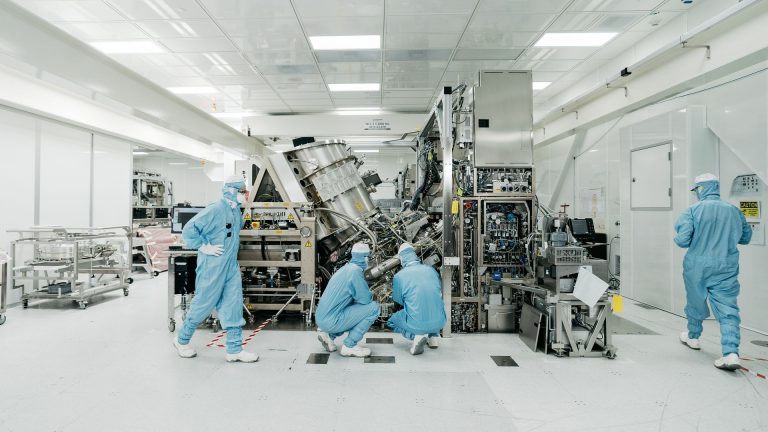
Morningstar senior equity analyst Javier Correonero said ASML has multiple avenues to increase output, including optimizing production space at its Veldhoven headquarters and accelerating deliveries through so-called “fast shipments.” Unlike most technology companies, ASML’s challenge is not finding customers but manufacturing enough highly complex machines to satisfy demand. Each EUV system contains more than 100,000 components and can cost well over $200 million, making production expansion a lengthy and technically demanding process.
The results add to growing evidence that spending on AI infrastructure remains resilient despite recent market volatility surrounding AI-related stocks.
Earlier this week, TSMC, one of ASML’s largest customers, reported a 68% jump in June revenue, highlighting continued strength in demand for AI chips. The Taiwanese foundry is also expanding its advanced chip packaging footprint by adding two more packaging plants at Chiayi Science Park, reflecting another bottleneck in AI semiconductor production.
The combination of expanding wafer fabrication capacity and advanced packaging investments suggests that semiconductor manufacturers continue to prepare for sustained AI demand rather than a short-term spending cycle.
UBS analysts recently said continued construction of semiconductor fabrication plants and robust demand for leading-edge chips should support stronger business conditions for ASML during the second half of the year.
China Remains An Important But Constrained Market
Although AI demand continues to drive growth, ASML remains caught in the center of U.S.-China technology tensions.
Washington has steadily tightened export controls on advanced semiconductor equipment destined for China. Earlier this year, bipartisan U.S. lawmakers proposed legislation that would prohibit ASML from selling even certain DUV lithography systems to Chinese chipmakers, extending restrictions beyond the company’s most advanced EUV tools, which are already banned from export to China.
The proposal has not yet become law, but it highlights growing geopolitical risks surrounding semiconductor equipment exports.
Even so, ASML said it still expects China to account for roughly 20% of total net sales this year, demonstrating the continued importance of the Chinese market despite increasingly restrictive export controls.
Chief Financial Officer Roger Dassen noted that Chinese demand remains broadly consistent with global industry trends.
“The Chinese market is moving in sync with the overall behavior that we see globally,” Dassen said.
Industry analysts have observed that previous rounds of export restrictions often prompted Chinese manufacturers to accelerate equipment purchases before tighter rules took effect, temporarily boosting ASML’s sales.
While ASML’s operating performance continues to exceed expectations, some analysts caution that much of the optimism may already be reflected in its share price.
Morningstar estimates the stock trades at roughly 50 times forward earnings, close to valuation levels reached during the pandemic-era semiconductor boom. Correonero believes a multiple closer to 35-40 times forward earnings would better reflect the company’s long-term fundamentals.
That valuation debate mirrors broader concerns across the semiconductor sector. Investors have become increasingly focused on whether hyperscale cloud providers, AI startups, and governments can sustain today’s extraordinary pace of capital spending over the coming years.
However, ASML’s latest guidance suggests its customers remain committed to expanding manufacturing capacity. Unlike many companies exposed to AI through software or services, ASML benefits from long-term investment cycles. Semiconductor fabrication plants require years to build, and chipmakers typically place equipment orders well before production begins, giving the company unusually strong visibility into future demand.
Looking ahead, investors will closely watch ASML’s Capital Markets Day next June, when the company is expected to provide updated long-term growth targets and additional insight into how it plans to support the next phase of global AI-driven semiconductor expansion.