

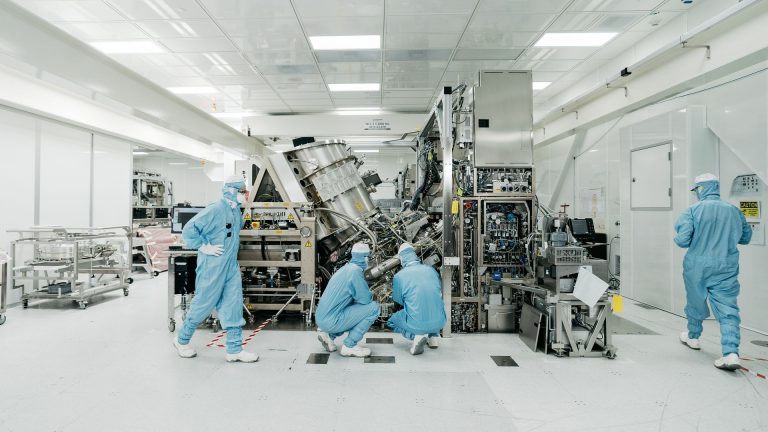
ASML has warned that demand for its advanced chipmaking equipment is outstripping its ability to supply customers, with semiconductor manufacturers seeking production capacity through 2030 as the artificial intelligence boom accelerates investment in data centers and advanced chips.
The Dutch company said on Wednesday that customers were already discussing orders beyond 2027, with some expressing strong interest in securing equipment for 2029 and 2030. Demand is expected to exceed available supply next year and through 2028, raising concerns that constraints in semiconductor manufacturing equipment could limit how quickly the industry expands production to meet AI-related demand.
The warning points to a growing challenge in the global AI investment cycle. While technology companies are committing billions of dollars to data centers and computing infrastructure, expanding semiconductor production depends on specialized equipment that cannot be supplied immediately. ASML, the world’s leading supplier of equipment used to manufacture the most advanced semiconductors, occupies a critical position in that process.
Register for the next Tekedia Mini-MBA.
Register for Tekedia AI in Business Masterclass.
Join Tekedia Capital Syndicate and co-invest in great global startups.
Its customers include Taiwan Semiconductor Manufacturing Company (TSMC), which manufactures chips for Nvidia, as well as Samsung Electronics, Intel, SK Hynix and Micron. These companies are investing heavily in additional capacity to serve demand for AI processors, high-bandwidth memory and other semiconductor products.
ASML Chief Executive Christophe Fouquet said the company was seeing strong demand extending well beyond its immediate production planning horizon.
“We see a lot of order intake for 2028. But also some strong interest to already place orders for 2029 and sometimes even 2030,” Fouquet said.

The company is examining additional ways to expand production capacity after previously announcing plans to increase capacity by 30% in 2027 and another 30% in 2028. Fouquet said those increases would not be sufficient to meet the demand now emerging from customers.
ASML’s shares have risen nearly 70% this year, giving the company a market value of approximately €586 billion, or $657 billion. The stock gained nearly 3% in early Amsterdam trading on Wednesday after the company reported quarterly results and raised the lower end of its full-year sales forecast.
ASML expects fourth-quarter sales of between €14.2 billion and €15.2 billion, equivalent to approximately $15.9 billion to $17 billion, with a gross margin of around 57%. The forecast exceeded analyst expectations and prompted the company to raise its full-year sales outlook to between €44 billion and €45 billion.

For the third quarter, ASML reported net profit of €4.96 billion on net sales of €11.7 billion. Profit exceeded the €4.05 billion expected by analysts polled by LSEG, while revenue was broadly in line with expectations.
The improved outlook suggests that strong demand for semiconductor manufacturing equipment is translating into revenue growth, although the supply constraints mean ASML cannot necessarily fulfil every customer’s preferred delivery schedule.
The contrast between demand and deliverable capacity is deemed crucial to the company’s outlook. Customers can plan new semiconductor plants and commit investment budgets, but the timing of production increases ultimately depends on when equipment becomes available and can be installed. ASML’s order visibility into the end of the decade therefore points to sustained demand, while its capacity limitations indicate that some of that demand may take years to fulfil.
The company is responding through several measures. It broke ground last month on a major expansion in Eindhoven, the Netherlands, but the first phase of that project is not expected to be completed until 2029. ASML will therefore need to increase output through existing facilities and equipment improvements before the new expansion comes fully online.
Chief Financial Officer Roger Dassen said the company would upgrade existing tools and offer newer versions of its machines capable of processing more wafers. Together, the measures would provide “a significant enhancement to our customers’ capacity”, he said.
ASML also plans to increase prices starting in 2027, with the full effect expected to become visible in 2028. The combination of higher prices and improved equipment throughput could support revenue growth, although the ultimate benefit will depend on delivery volumes, product mix and customer investment plans.
ING analyst Marc Hesselink said ASML’s results had exceeded expectations and anticipated upward revisions to consensus earnings forecasts through 2028.
“Management’s commentary on demand visibility and capacity … was again very constructive,” he said.
AI Infrastructure Spending Extends the Semiconductor Equipment Boom
ASML’s order outlook reflects the scale of investment taking place across the semiconductor industry as technology companies seek more computing power for AI training and inference. Data centers require advanced processors, memory, and increasingly sophisticated semiconductor manufacturing processes, creating demand for equipment used to produce those components.
TSMC’s manufacturing role for Nvidia places it at the center of the AI chip supply chain, while Samsung, SK Hynix and Micron are expanding their positions in memory production. Intel is also pursuing additional manufacturing capacity. Their combined investment plans are increasing competition for ASML’s specialized tools.
The company is also assessing a potential opportunity linked to TeraFab, the semiconductor manufacturing initiative associated with Elon Musk. Dassen said ASML was “still kicking the tyres on the exact size of that (TeraFab) opportunity”, indicating that the potential contribution to future demand remains uncertain.
But customers’ plans do not automatically translate into completed orders or realized sales. New semiconductor facilities require substantial capital, and companies must coordinate equipment purchases with construction, installation, financing, and expected demand for their products. If AI infrastructure investment slows or planned facilities are delayed, orders could be deferred even where long-term interest remains strong.
That risk is one reason ASML’s expansion strategy involves balancing additional capacity against the possibility of future downturns. More equipment production could allow the company to capture demand during the current investment cycle, but excessive expansion could leave it with underutilized capacity if customers reduce orders after completing new factories.
Nick Rossolillo of Chip Stock Investor, which holds ASML shares, said he was satisfied with the pace of capacity expansion provided the company continued to increase output to meet customer demand.
“Staying capacity constrained protects the business and gives a bit of cushion for when there are inevitable years of soft customer order activity,” he said, pointing to the 2028-to-2029 period after several new customer plants are completed.
His assessment highlights the tension facing ASML: expanding quickly enough to benefit from the AI investment boom without building so much capacity that a subsequent slowdown damages profitability.
ASML’s warning indicates that semiconductor equipment availability will remain an important consideration for chipmakers planning production increases over the next several years. Even as manufacturers commit to new factories, the specialized machinery needed to produce advanced chips can become a bottleneck if suppliers cannot expand output at the same pace.
The company’s planned factory expansion, equipment upgrades, and higher-throughput machines are intended to ease that pressure. However, the Eindhoven project’s 2029 timeline means that near-term relief must come largely from improvements to existing operations and incremental increases in production.
Pricing will also become a more important part of ASML’s growth strategy. Higher prices from 2027 could improve revenue per machine, with the full impact expected in 2028, but they will also increase equipment costs for customers already committing substantial sums to semiconductor expansion.
For investors, the outlook combines strong order visibility with execution risks. Demand extending into 2030 gives ASML a longer planning horizon, while its latest results and improved sales forecast support expectations for continued growth. Yet the gap between customer requirements and available supply could constrain near-term sales and complicate the timing of industry-wide capacity additions.
However, the question remains: is the AI-related investment going to remain strong enough to justify the manufacturing expansion now being planned?