

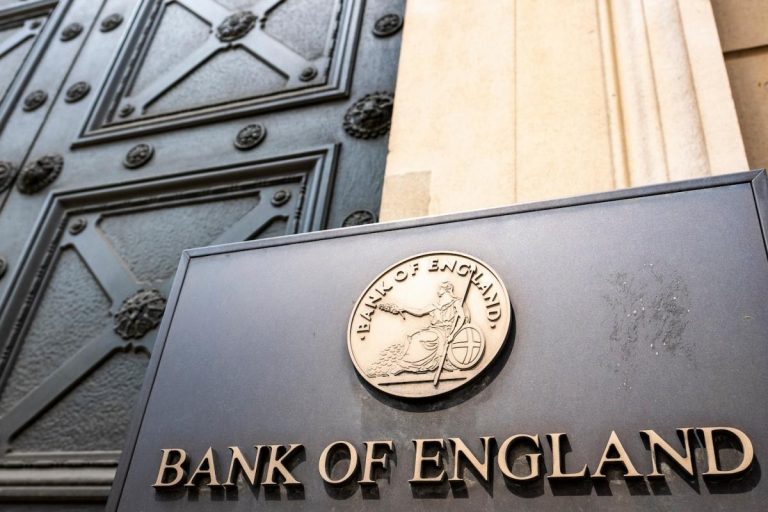
The Bank of England has raised interest rates for the first time in more than three years, warning that another increase could follow if the US-Iran conflict continues to drive up energy prices and feed inflation across the British economy.
The Monetary Policy Committee voted 8-1 on Thursday to increase the benchmark rate from 3.75% to 4%, marking the first hike since August 2023. The decision brings the Bank of England into line with other major central banks that have tightened monetary policy in response to inflation risks linked to the conflict.
The central bank now expects British inflation to reach 4.8% in the second quarter of next year, more than twice its 2% target. It said inflation would have exceeded 5% without measures announced in Finance Minister John Healey’s recent budget.
Register for the next Tekedia Mini-MBA.
Register for Tekedia AI in Business Masterclass.
Join Tekedia Capital Syndicate and co-invest in great global startups.
The increase presents a challenge for Prime Minister Andy Burnham’s government, which has sought to ease the cost-of-living burden on households. Higher interest rates could make mortgages, business loans and other forms of borrowing more expensive at a time when household purchasing power is already under pressure from rising prices.
Governor Andrew Bailey said the decision was intended to address inflationary pressures building in the economy, rather than signal the beginning of an extended tightening cycle.
“Today’s increase should not be seen as the first in an inevitable long sequence of hikes. That is not inevitable. But unless the conflict in the Middle East is resolved, neither does it seem likely to be the last increase,” Bailey said at a press conference.

The Bank said it had found limited evidence of faster inflation spreading beyond sectors directly affected by higher energy costs. However, policymakers concluded that the inflationary impact of months of elevated energy prices was still working its way through the economy, making an early response necessary.
The decision reveals the difficult position facing the central bank. Delaying action could allow energy-related price increases to become embedded in wages, services and other costs. Raising rates, however, adds to borrowing expenses and could weaken consumption and investment.
Sterling strengthened against the US dollar following the announcement, while yields on two-year British government bonds rose. The movement contrasted with declines in bond yields elsewhere, as investors increased their expectations of another rate increase as soon as next month.

Andrew Goodwin, chief UK economist at Oxford Economics, said December’s policy meeting had become uncertain, with the direction of oil and natural gas prices likely to determine the outcome.
“December’s meeting now looks like a coin flip, with the path of oil and natural gas prices set to be the decisive factor,” he said.
Bailey acknowledged that oil prices had fallen sharply over the previous 48 hours, partly following the results of the US midterm elections. He described the decline as encouraging but warned that previous periods of easing energy prices and reduced tensions in the Middle East had not lasted.
He also said another rate increase could be necessary even if oil prices remained around current levels because substantial inflationary pressure was already moving through the economy.
British household energy bills are regulated through a formula that follows wholesale prices with a lag of approximately three months. This means that changes in energy markets do not immediately translate into lower or higher bills for consumers. Even if oil and gas prices stabilize, households may continue to experience the effects of earlier increases.
The committee’s vote also revealed disagreement over the scale of the response. Catherine Mann was the only member to vote against the 25-basis-point increase, but she did so because she wanted a larger, half-percentage-point increase that would have taken the rate to 4.25%.
Mann had warned in September that the central bank was slow to reassure financial markets that it had inflation under control. In the minutes of the November decision, she expressed concern about “non-linear inflation risks”, arguing that consumer price inflation of 3.5% in September could trigger a loss of confidence in the Bank’s ability to contain price pressures.
Other policymakers also signaled that further tightening could be necessary. Deputy Governor Clare Lombardelli and Chief Economist Huw Pill indicated that another increase was likely in the near term. External committee member Megan Greene also discussed the need for “additional hikes”.
However, Swati Dhingra and Alan Taylor, who had previously been reluctant to support higher rates, said they would require stronger evidence that energy-driven inflation was spreading into other parts of the economy before backing further increases.
This division matters because the next phase of monetary policy will depend not only on energy prices but also on how businesses and households respond. If companies pass higher costs on to consumers and workers seek larger wage increases to compensate for lost purchasing power, inflation could persist after the initial energy shock fades.
Growth Outlook Improves, But Household Incomes Face Pressure
The Bank of England revised its economic growth forecasts upwards, projecting expansion of 1.6% this year and 1.3% next year. Both estimates are stronger than the projections published by the government’s Office for Budget Responsibility the previous week.
The central bank attributed part of the improved outlook to stronger-than-expected official economic data, spending on artificial intelligence and a temporary boost from Healey’s annual budget.
However, stronger headline growth does not necessarily translate into improved household finances. The Bank expects average household income from employment, after accounting for inflation and taxes, to decline this year and next.
That expectation results in a difficult combination for consumers. Economic activity may continue expanding, but households could have less purchasing power while facing higher borrowing costs and elevated energy bills.
The inflation outlook remains particularly concerning. Under the Bank’s central scenario, consumer price inflation will not return to its 2% target until the third quarter of 2028, six months later than projected in July. The earlier forecast followed a period of reduced tensions in the US-Iran conflict that had helped lower energy costs.
The Bank also outlined a more adverse scenario in which oil prices approach $130 a barrel, compared with approximately $100 currently. Under that scenario, inflation would reach 6.2% in the third quarter of 2027.
Although that would remain below the peak recorded in 2022 following Russia’s full-scale invasion of Ukraine, it would represent a substantial setback for efforts to restore price stability.
The central bank’s projections expose the limits of monetary policy when inflation is driven by an external supply shock. Higher interest rates cannot increase oil production, reopen disrupted supply routes, or directly reduce international energy prices. They can, however, restrain domestic demand and reduce the risk that higher energy costs spread into wages and prices across the economy.
That response comes with economic costs. Businesses face more expensive financing, households with variable-rate mortgages could see repayments rise, and companies may delay investment as borrowing becomes less attractive.
The Bank of England now faces the challenge of preventing an external energy shock from becoming a prolonged domestic inflation problem without imposing unnecessary damage on economic growth. The latest rate increase signals that policymakers consider the risk of persistent inflation serious enough to act before its full impact appears in consumer prices.