

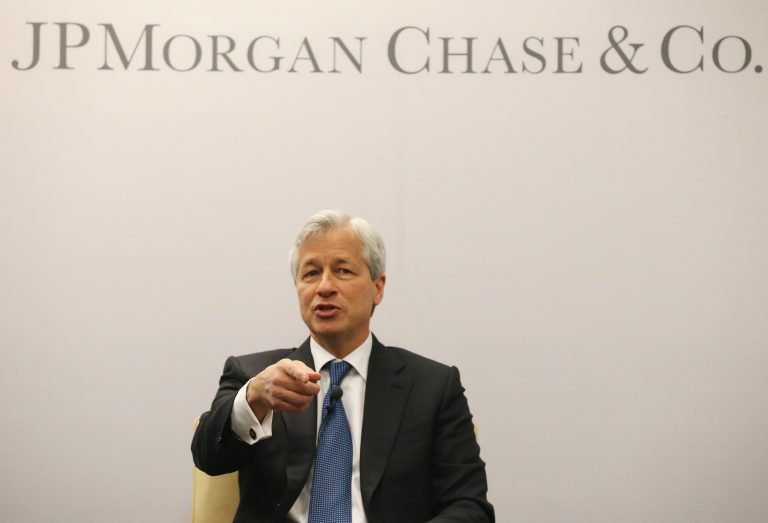
JPMorgan CEO Jamie Dimon has publicly criticized Coinbase CEO Brian Armstrong’s support for the proposed Crypto Clarity Act, arguing that mainstream banks are unlikely to embrace the legislation in its current form.
Dimon during a Friday interview on Fox Business, when asked if he was happy with the current direction of the bill, he said,“No.”
He argued that the legislation would allow crypto firms to offer interest or yield on stablecoins and deposits without the same regulatory safeguards required of traditional banks.
Register for the next Tekedia Mini-MBA.
Register for Tekedia AI in Business Masterclass.
Join Tekedia Capital Syndicate and co-invest in great global startups.
“The banks will not accept it that way,” Dimon said. He specifically criticized what he sees as insufficient provisions on anti-money laundering (AML), Bank Secrecy Act (BSA), and customer protections, calling the approach regulatory arbitrage that gives crypto platforms an unfair edge.
He went further, directly targeting Armstrong, who has been a leading voice in crypto industry lobbying efforts in Washington. “He’s the only one and he’s spending hundreds of millions of dollars in Washington on this thing,” Dimon stated. “He’s full of shit.”
He added that no one in banking would simply bow down to Armstrong or Coinbase, emphasizing that if crypto companies want to act like banks, they should face the full regulatory requirements of banks.

Coinbase CEO Brian Armstrong Strong Support For The CLARITY Act
Coinbase CEO Brian Armstrong has been one of the most vocal supporters of the Crypto Clarity Act, viewing the proposed legislation as a critical step toward establishing clear rules for the digital asset industry in the United States.
Armstrong has consistently argued that regulatory uncertainty has hindered innovation, driven crypto companies offshore, and created confusion for both businesses and consumers.
Through public statements, policy advocacy, and direct engagement with lawmakers, Armstrong has urged Congress to pass legislation that clearly defines the roles of regulators overseeing digital assets.

He believes the bill would provide the legal certainty needed for crypto firms to operate, invest, and expand within the United States while maintaining consumer protections.
Armstrong has also emphasized that a comprehensive regulatory framework could strengthen America’s position as a global leader in financial innovation.
According to him, the Crypto Clarity Act would encourage responsible growth in the sector, attract investment, and prevent emerging blockchain technologies from migrating to jurisdictions with more favorable regulatory environments.
The Clarity Act
The U.S. CLARITY Act, formally known as the Digital Asset Market Clarity Act, is a proposed piece of legislation designed to create a comprehensive regulatory framework for cryptocurrencies and other digital assets in the United States.
The bill emerged in response to years of uncertainty over how digital assets should be regulated and which federal agencies should oversee the rapidly growing sector
The Clarity Act aims to establish a clearer federal framework for digital assets, including rules for stablecoins and market structure. It recently advanced out of the Senate Banking Committee and is moving toward a potential full Senate vote.
However, a key point of contention has been provisions that could allow stablecoin issuers to pay yield on customer balances.
The strong pushback from one of Wall Street’s most influential figures underscores how high the stakes are for both sides as the bill progresses.
This public feud comes amid broader industry efforts to secure regulatory clarity in the United States, with crypto advocates arguing the legislation levels the playing field and promotes innovation. Banks, meanwhile, insist on equivalent oversight to protect the financial system.
In response to Dimon’s remarks several users on X have opposed his view.
@bravosatya wrote,
“Jamie Dimon opposing the Clarity Act tells you everything. The moment crypto gets real regulatory clarity, the monopoly of legacy banks starts to crack. Self-custody, stablecoins, tokenized assets, and open financial rails threaten the old system that profited for decades from gatekeeping and control. This isn’t about protecting consumers — it’s about protecting the farm. Wall Street sees what’s coming: a financial system where people move value without needing permission from giant banks. The Clarity Act isn’t just crypto legislation… it’s a challenge to the old empire.”
@RyanMJeffreys wrote,
“Ha, this is the exact reason crypto will succeed. When was the last time the banks gave you interest on your checking account money? Of course, they are terrified. This effectively will cause customers to keep funds in stable coins that earn them interest with instant access.”
@The20DeltaGuy wrote,
“Yeah, lol. Stablecoins could become a huge problem…for bankers like Jamie Dimon. How dare the customer make some return on his cash!”.
Jamie Dimon’s remarks highlight the deep tensions between traditional banking giants and the crypto sector as lawmakers work to finalize digital asset rules.
Outlook
The battle over the CLARITY Act is likely to intensify as lawmakers move closer to a final vote, with both the banking industry and crypto sector ramping up lobbying efforts to shape the outcome.
If the legislation is passed in a form favorable to the crypto industry, it could mark one of the most significant regulatory victories for digital assets in the United States, providing clearer rules for exchanges, stablecoin issuers, and blockchain companies.
However, opposition from influential banking leaders like Jamie Dimon, suggests that traditional financial institutions will continue to push for stricter oversight, particularly around stablecoins, anti-money laundering requirements, and consumer protection standards.
Banks remain concerned that crypto firms could gain access to banking-like activities without being subject to the same regulatory burdens.