

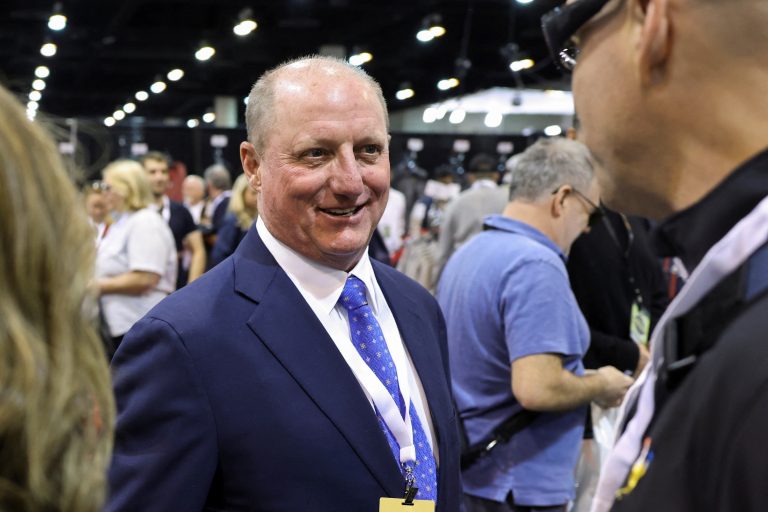
Berkshire Hathaway has sharply increased its share repurchases under chief executive Greg Abel, signaling a more active approach to deploying its enormous cash reserves as the conglomerate adjusts to life after Warren Buffett.
The Omaha-based company repurchased $9.6 billion of its own shares between July and September, followed by approximately $2 billion in October. The purchases came on top of $4.8 billion spent on buybacks earlier in the year, bringing repurchases to about $16.4 billion.
The pace marks a notable shift from the final years of Buffett’s leadership, when Berkshire struggled to find acquisitions large enough to absorb its growing cash pile. Abel, 64, is now demonstrating a greater willingness to return capital to shareholders when the company sees value in its own stock.
Register for the next Tekedia Mini-MBA.
Register for Tekedia AI in Business Masterclass.
Join Tekedia Capital Syndicate and co-invest in great global startups.
The purchases have reduced Berkshire’s cash and cash equivalents to $356.9 billion at the end of September, from $380.2 billion six months earlier. The balance remains substantial, however, giving the company considerable financial flexibility to pursue acquisitions, invest in public companies or continue buying back shares.
Berkshire’s largest annual share repurchase programme was in 2021, when it bought back $27 billion of its stock. The latest activity suggests Abel is prepared to use the buyback option more aggressively, although the company has not indicated that the recent pace will become a fixed policy.
The third quarter was Abel’s third since taking over as chief executive. Buffett, 96, remains chairman emeritus, while his son Howard Buffett replaced him as chairman in September.

The leadership transition is happening amid a challenging operating environment. Berkshire reported that third-quarter operating earnings fell 6% to $12.71 billion, while net earnings declined 28% to $22.11 billion, reflecting weaker insurance results and lower gains on its equity investments.
Berkshire’s operating profit fell from $13.49 billion in the corresponding period last year to $12.71 billion, equivalent to approximately $8,954 per Class A share. Insurance was a major source of the decline, with pretax profit from the segment falling 26% and underwriting earnings dropping 43%.
Net income was also affected by changes in the market value of Berkshire’s stock portfolio. The $22.11 billion reported for the quarter includes unrealized gains and losses on investments the company has not sold. Berkshire has repeatedly cautioned investors against treating these fluctuations as a direct measure of its underlying operating performance.

Revenue, however, increased 11% to $105.65 billion, marking the second consecutive quarter of double-digit growth. The expansion came even as some consumer-facing businesses, including Fruit of the Loom and Forest River, experienced weaker results.
Berkshire’s portfolio includes insurance and reinsurance companies, BNSF railroad, utilities, industrial manufacturers and retail businesses such as Brooks running shoes, Fruit of the Loom and See’s Candies. It also held $335.5 billion in publicly traded equities as of September 30, including investments in Alphabet, Apple and American Express.
The conglomerate’s size and broad exposure to different parts of the economy have made its performance an important indicator for investors assessing corporate conditions in the United States. That position has helped support its shares during a period of market uncertainty. Berkshire stock reached record highs this week even as broader markets came under pressure from concerns about artificial intelligence valuations and debt-funded spending by technology companies.
Since the end of September, Berkshire’s shares have outperformed the S&P 500 by more than 18 percentage points. The company had lagged the broader index significantly after Buffett announced in May 2025 that he would step down as chief executive. For 2026 as a whole, Berkshire has outperformed the benchmark by more than five percentage points.
Cathy Seifert, an analyst at CFRA Research who rates the shares “hold”, attributed the company’s appeal to its strong balance sheet, diversified operations and increased repurchases.
“Investors may be rotating into less volatile, high-quality names such as Berkshire,” Seifert said.
She added that investors would have to decide how much short-term earnings weakness they were prepared to accept in exchange for owning a company with substantial financial resources and a successful leadership transition.
The economic backdrop remains uncertain. Although the US economy expanded at an annualized rate of 3.4% in the third quarter, according to the Commerce Department’s advance estimate, inflation and higher gasoline prices continue to weigh on household purchasing power.
Berkshire said considerable uncertainty remains around economic and geopolitical developments, including tariffs and ongoing wars. It also reported sluggish demand in several retail businesses, which it linked to weaker consumer confidence.
Insurance Weakness Contrasts with Stronger Industrial Performance
Geico was among the weakest performers during the quarter. Its pretax profit fell 45% as the insurer reduced premiums to recover customers lost during a multiyear effort to improve underwriting standards and lower operating costs.
The strategy has come with pressure on underwriting performance. Geico’s loss ratio, which measures the proportion of premiums used to pay claims, increased to 76.6% from 71.5% a year earlier. Claims also rose across other Berkshire insurance and reinsurance operations.
Seifert described Geico’s performance as weak compared with competitors Allstate and Progressive. She also raised concerns about Berkshire’s limited financial disclosures, which can make it difficult for investors to identify the causes of underperformance within individual businesses.
“Limited disclosures are fine when everything goes in the right direction, but become a point of vulnerability” when they do not, she said.
Other parts of Berkshire’s portfolio delivered stronger results. BNSF’s profit increased 19%, supported by fuel surcharges and higher volumes of consumer goods, agricultural products and energy shipments.
Berkshire Hathaway Energy recorded an 8% increase in profit. The business operates utilities and natural gas pipelines, alongside the company’s real estate brokerage operations.
Industrial businesses also performed well. Precision Castparts, which supplies aerospace and industrial components, increased pretax profit by 30%, supported by stronger sales of aerospace products and industrial gas turbines.
Consumer products businesses were weaker, mainly because of lower tax credits at Duracell. Higher gasoline prices, however, benefited Pilot, Berkshire’s truck-stop chain.
Berkshire’s investment activity also shows that the company remains willing to commit substantial capital to selected opportunities. It acquired Occidental Petroleum’s chemicals business for $9.4 billion and homebuilder Taylor Morrison for $6.8 billion this year.
The conglomerate has also invested billions of dollars in Alphabet, Google’s parent company, as the technology group expands its artificial intelligence operations. Alphabet shares have since fallen below the discounted prices Berkshire paid. Berkshire additionally acquired a 4% stake in Italian software technology company Bending Spoons.
These investments demonstrate that Abel’s approach is not limited to share repurchases. Berkshire continues to deploy capital across operating businesses and publicly traded companies, although the size of its cash reserves indicates that finding sufficiently attractive opportunities remains a major challenge.
The latest results therefore present two competing signals. Berkshire’s insurance operations are facing pressure, and its overall operating profit has declined. At the same time, revenue growth, stronger performance in several industrial businesses and an accelerating buyback programme point to a company with substantial financial capacity.