


Half the writers you know already lean on artificial intelligence. Nearly 50 percent of professional authors now weave at least one AI tool into their daily workflow, according to an Automateed industry survey. That rise tracks reality: drafting a novel is demanding, and even veterans face plot knots, flat description, or scenes that stall. Traditional chatbots pitch ideas fast but lose the thread once your manuscript outgrows their memory. Fiction-savvy assistants fix that by tracking lore, echoing your voice, and dropping fresh lines on demand. Below, we rank the 11 best options for 2026 and show you how to pair machine speed with full creative control.
Why novelists are turning to AI
Writing a novel can feel like steering a ship through fog. You know the destination, yet the compass sometimes spins and every direction looks the same.
That is where a well-trained algorithm steps in. An AI assistant never yawns at 3 a.m., never shrugs when you ask for five more plot twists, and never forgets the villain’s eye color. It sits beside us, ready to replace silence with fresh possibilities.
First, speed. A scene that used to take a weekend to draft now pours out in minutes. Instead of wrestling with every verb, you spend your energy shaping tone and tension.
Second, stamina. Advanced models track thousands of words of story context in real time. They remember that the hero fears open water and keep that detail alive later, so readers stay immersed.
Third, style support. Highlight a flat sentence and the AI paints it with sensory detail: salt on the air, gravel underfoot, a heartbeat racing just out of rhythm. Your voice stays in charge while the machine handles the heavy lifting.
Finally, momentum. Because draft pages appear faster, motivation soars. The blank page loses its power, replaced by a living manuscript that grows each time you sit down.
Used wisely, these tools do not replace creativity; they amplify it. You remain the captain, charting the course, while the AI clears the fog so the story can sail forward.
How we evaluated the tools
Ranking creative software is tricky. Every novelist values different things: one prizes lyrical prose, another craves airtight plot logic, a third watches the budget.
To keep our verdict fair, we built a scoring rubric first. Six factors guided every click, prompt, and generated paragraph.
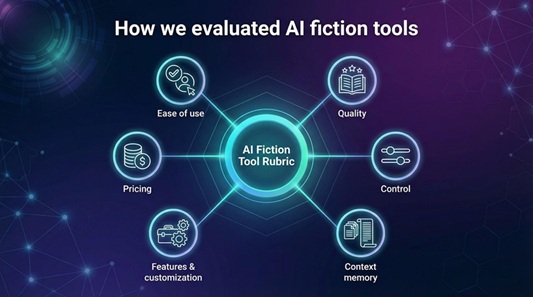
Quality carried the most weight. We asked each AI to draft scenes, mimic voices, and juggle multiple viewpoints. If the writing flowed and characters stayed believable, the score climbed.
Control came next. We measured how precisely you can steer the output: adjust tone, set genre limits, or push into edgier territory without refusals.
Context memory matters in long fiction, so we recorded how many words the tool can hold in its active window and how well side features like lore books keep details straight.
Features and customization covered the extras: outline planners, role-play chat, multi-model support, export options. A richer toolbox earned a higher mark.
Pricing was straightforward. We calculated cost per thousand words and looked for transparent tiers and meaningful free trials.
Ease of use rounded out the list. A clean interface, clear onboarding, and an active community can shave hours off a learning curve.
Each category sat on a hundred-point spreadsheet weighted by real impact on daily writing. The final tally revealed clear leaders, close calls, and a few surprise standouts waiting in the next section.
1. DreamGen: deep customization for serious storytellers
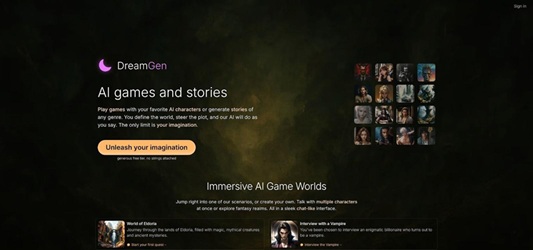
DreamGen AI story platform interface screenshot
On the DreamGen platform, you build entire worlds, not just characters. The scenario codex lets you define plot, setting, writing style, and multiple characters, each with their own personality, goals, and relationships. Sketch a detective mystery where your villain has a secret motive, then watch two side characters banter while you take notes. You can even steer scenes with inline instructions like “make the next exchange tense and under 50 words.”
What surprised us most was the message control. You can edit, delete, or add any message in the conversation, including messages from other characters and the narrator. Most platforms we tested lock you out of NPC dialogue once it’s generated. DreamGen also offers a dedicated story-writing mode with a text editor interface, separate from its chat-based role-play mode, so novelists get a workspace that feels like writing rather than chatting.
The Scenario Wizard helps you go from a rough idea (“1920s noir with a psychic detective”) to a fleshed-out world in minutes by generating plot hooks, character profiles, and setting details that you can refine. Free-tier users get about 2,000 role-play messages per month with daily credits that refill, and Pro plans push the context window to 30,000 tokens, enough for the AI to track threads across long chapters. We did not run into filter-related narrative interruptions during testing, which kept sessions flowing.
2. Sudowrite: on-demand line editor
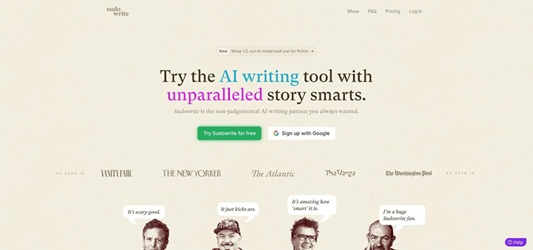
Sudowrite AI fiction line editor interface screenshot
Sudowrite takes a different tack. Instead of drafting whole chapters in one pass, it polishes the pages you already have.
Open its editor, highlight a dull sentence, and click Describe. Sudowrite layers in taste, texture, and emotion so naturally you might forget which words are yours. Need a surprise? The Twist feature drops an unexpected turn that still respects your plot.
Under the hood, the Muse model is tuned for fiction, so metaphors land and dialogue snaps. The interface feels like a friendly word processor; nothing to install and no jargon. The Hobby plan supplies about 225,000 credits (roughly 45,000 AI words) for $19 per month. Heavy drafting can exhaust credits quickly, and filters remain, so explicit scenes may stall.
For writers who want a tireless developmental editor, Sudowrite is an easy yes. Use it to enrich, expand, and refine, then watch your prose sparkle.
3. NovelCrafter: the story architect
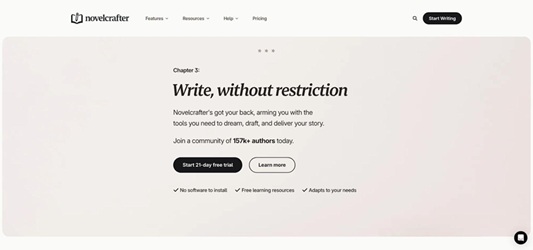
NovelCrafter story architecture and Codex dashboard screenshot
Some authors outline every beat before writing a single line. NovelCrafter is built for that mindset.
Open a project and you step into a command console: acts, chapters, and scenes stack on a virtual corkboard. Drop character bios into the Codex once, and the AI checks every new paragraph against that canon like a vigilant continuity editor.
The payoff is consistency. Tangled subplots align, invented languages keep their grammar, and foreshadowing stays intact. You can even swap underlying models, drafting with one engine and line-editing with another without changing tabs.
The setup takes time. Expect to spend a morning feeding the Codex. Pricing starts at $4 per month for the Scribe tier and tops out at $20 for Worldbuilder, with “bring-your-own-key” AI costs of roughly $0.50–2.00 per chapter depending on the model you connect. Plotters say that front-loading the work saves weeks of rewrites later. If your stories sprawl across kingdoms and generations, NovelCrafter keeps every thread tied tight.
4. Claude 2: the memory champion
Claude 2 shines when sheer context matters. Paste an entire manuscript, up to 100,000 tokens, and the model reads it as a single conversation. Plot threads you lost weeks ago resurface, continuity errors glow, and themes you only hinted at suddenly look deliberate.
Writers lean on Claude as a hyper-attentive beta reader. Ask it to flag scenes where your protagonist’s courage wavers or to list every loose end before the finale. Feedback arrives in seconds, calm and precise.
Prose generation is steady, though a bit restrained. Think thoughtful mentor rather than flamboyant ghostwriter. That composure suits edits and summaries, and you can pair Claude with a livelier tool if you want extra sparkle.
The web interface stays simple, and the $20 monthly plan offers roughly 5 million tokens of combined input and output before rate limits kick in (no word credits to track). For authors juggling sprawling casts and timelines, Claude delivers diligent continuity checking at a reasonable cost.
5. ChatGPT (GPT-4): the universal brainstormer
ChatGPT works like a pocket studio assistant. Type a question and it fires back with crisp suggestions—character names, plot twists, even a three-line lesson on medieval siege engines if your fantasy army needs one.
Versatility is the headline. Ask for ten ways to reveal a secret and you get ten unique angles. Request sharper banter and it rewrites in seconds, offering alternates for comparison.
Memory remains the constraint. Feed it more than 8,000 tokens and early chapters slip from view. Careful summaries help, but they require discipline. Filters are strict, so explicit scenes or graphic violence may stall.
ChatGPT Plus costs $20 per month and never runs out of ideas. Pair it with Claude for long-range continuity or with Sudowrite for polish and you cover every stage of the drafting cycle.
6. SidekickWriter: draft an entire book before lunch

SidekickWriter AI novel drafting workflow screenshot
SidekickWriter is built for authors who crave speed. Hand it a chapter outline at breakfast, and by the time the coffee pot cools you can skim a complete 50,000-word draft.
The workflow is front-loaded. You answer a brief questionnaire (genre, voice, target length), and the system locks those guardrails in place. Click Generate to watch chapters appear one after another, each hitting the beats you sketched.
Is the prose perfect? No. Some passages read like a diligent intern worked overnight. Yet the structure holds, which saves weeks. Instead of staring at a blank page, you spend your time revising, trimming, and adding nuance.
Pricing works on credits. A small pack costs about $16 and covers a single novel of this length, with larger bundles bringing the per-book cost closer to $10. For serial romance or LitRPG authors who publish monthly, the math adds up. Slower writers can lean on the free trial to see whether rapid drafting sparks creativity or sparks headaches.
7. Raptor Write: power to the tinkerers
Raptor Write proves you do not need a big budget to tap premium AI models. The open-source interface lives in your browser and connects to whatever API keys you supply—GPT-4, Claude, or even a local model running on your own GPU.
That DIY flexibility is the draw. Tech-savvy authors script custom prompts, wire in personal databases, and swap engines mid-scene to balance cost against quality. The only filters are those enforced by the model you choose, so content limits stay in your hands.
Setup takes elbow grease. You fetch keys, tweak settings, and accept the occasional bug without a help desk. Once configured, Raptor Write feels like a private writer’s lab. Costs depend on the model: GPT-4 averages about $0.03 per 1,000 tokens, while Claude-Instant hovers near $0.008 per 1,000 tokens. Many novelists finish a chapter for well under a dollar.
For hobbyists on a budget or pros who like fine-tuning every knob, Raptor Write offers rare control at a near-zero software price.
8. Jasper: a marketer’s pen that moonlights in fiction
Jasper earned its reputation in ad copy, and that polish shows. The interface feels clean, onboarding is quick, and built-in Grammarly keeps stray commas at bay. Switch to Story Mode and the same engine spins scenes instead of slogans.
Templates power the workflow. Community “recipes” can build a Hero’s-Journey outline or a full character profile in under a minute. If you juggle novels with newsletters, Jasper lets you draft a chapter, then pivot to a launch email without changing tabs.
The catch is cost. The Boss Mode plan starts at $59 per month for about 50,000 AI words; higher tiers expand the limit or add team features. Because the underlying model favors brand-safe language, darker or explicit fiction may feel muted.
Jasper suits author-preneurs who need marketing prose as much as narrative prose. One subscription covers blurbs, ads, and the book itself, though pure novelists may find cheaper, sharper tools elsewhere.
9. NovelAI: sandbox for unfettered imagination
NovelAI has built a loyal fan base by staying out of the author’s way. Launch a fresh story and the cursor waits until you type a line; tap Generate and the AI continues in the same breath, with no corporate guardrails steering toward family-friendly content.
Want gothic horror packed with gore or a romance scene that blushes? The model complies without protest. A side panel called the Lorebook lets you pin character facts and world rules, and NovelAI weaves those snippets back into the text to keep continuity alive despite a 2,048-token context limit.
The trade-off for that freedom is guidance. Without a solid outline, the narrative can drift into cliché or outright nonsense, so many users run several redo cycles before the prose sings.
Plans range from $10 to $25 per month, all offering unlimited text generation; higher tiers unlock larger image generation budgets and extended context. If you crave experimental storytelling and enjoy shaping raw ideas into polished scenes, NovelAI hands you the keys.
10. Gemini: research muscle meets creative flair
Google’s Gemini is still rolling out, yet early testers already tap it as a go-to brain for fact-packed fiction. Feed the model a photo of a 16th-century map and a paragraph of notes, and it cross-references both to draft a scene that feels museum-ready.
Its multimodal reach sets it apart. Historical novelists verify period slang, architects stress-test sci-fi skylines, and hard-science authors lean on Gemini’s current-events knowledge when inventing tech that skirts today’s physics without breaking it.
Access is the catch. You need the Gemini Advanced tier or an enterprise key, and Google’s content filters stay cautious. According to Google, Gemini Advanced costs $19.99 per month and grants a 1 million-token context window for Pro users, with an even larger 2-million-token option in private preview. Long-form storytelling chops still need more public mileage before we crown it a narrative heavyweight.
If accuracy underpins your story world, keep Gemini on your radar. As access widens, the blend of deep research and solid prose could shift it into the top tier.
11. AI Dungeon: play your way past writer’s block
AI Dungeon began as a choose-your-own-adventure game, and that playful DNA still drives every line it generates. You type an action, the AI responds, and the story races ahead with surprising twists.
For novelists the value is spark. Drop your protagonist into an unscripted scenario and watch them improvise. The session transcript becomes a trove of raw dialogue, quirky side characters, and unexpected conflicts you can refine inside your main manuscript.
Filters stay light, so sword-and-sorcery epics or steamy romance scenes rarely trigger refusals. Multiplayer mode even lets co-authors or beta readers join the same narrative sandbox in real time.
The flip side is chaos. Without firm nudges, plots can drift—aliens might crash a Regency ball or a dragon quote TikTok memes. Treat AI Dungeon as a brainstorming arcade: mine the gems, skip the noise.
Pricing is tiered. A Wanderer account is free with up to 4,000 tokens of context. The Champion plan costs $14.99 per month and lifts the window to 8,000 tokens; Legend ($29.99) and Mythic ($49.99) raise it to 16,000 and 32,000 tokens respectively, while adding credits for ultra-long sessions and images.
Key trends shaping AI-assisted fiction
- Context windows now fit whole novels. When Anthropic opened Claude’s doors to a 100,000-token context window, authors finally pasted an entire manuscript and received coherent feedback in one pass, according to Kindlepreneur. Rival models are racing to match or exceed that capacity, so continuity slips should soon be rare.
- Multimodal models blur media lines. Early Gemini demos let writers drop a Renaissance map or a character sketch into the prompt, then weave prose that stays historically or visually consistent. Imagine feeding a soundtrack snippet and having the AI suggest scene beats that rise and fall with the music; storytelling becomes a sensory collaboration.
- Personalization moves from perk to standard. Sudowrite’s Muse and home-brew fine-tunes on open-source backbones hint at a future where you train an assistant on your past books and watch it draft pages that echo your mature voice. Privacy-minded authors may even keep those custom models local.
- Regulation tightens around attribution. Copyright proposals in the United States and the EU would require clearer disclosure of AI-generated text. Expect 2026 contracts to spell out how and when you must credit machine assistance.

Together, these shifts point to a year when writers wield tools as individual as their stories, while watchdogs make sure credit and compensation land in the right place.
Conclusion
Start with your pain point. If blank pages haunt you, a speed-drafting tool like SidekickWriter hands you a full manuscript to reshape. If world lore keeps slipping through the cracks, NovelCrafter or Claude guard continuity so you can focus on pacing. Need richer prose? Keep Sudowrite open beside your draft and let it polish each paragraph.
Budget matters, too. Raptor Write is open source and costs only the API fees you burn, often pennies per thousand tokens, while NovelAI’s unlimited plans run between $10 and $25 per month. Credit systems in Sudowrite or SidekickWriter reward rapid, high-volume output but can feel costly during slow months.
Finally, consider your content boundaries. DreamGen and NovelAI give you full creative control over your stories, while ChatGPT and Jasper keep stricter content boundaries. Match the tool’s temperament to your genre, run a free trial, and trust your judgment. The assistant that keeps you writing is the one that belongs in your toolbox.