

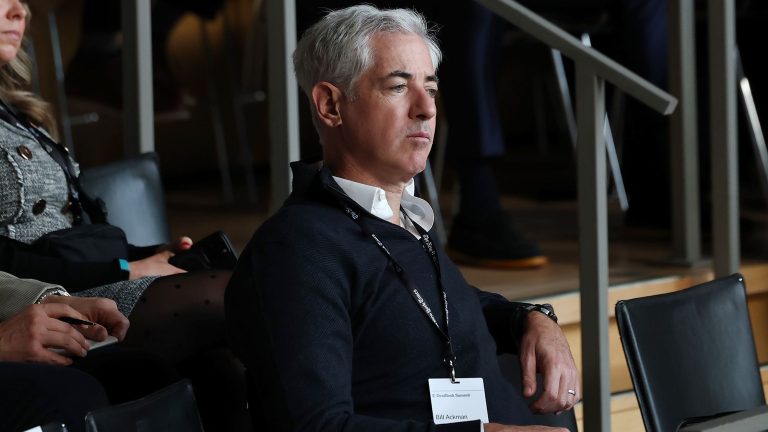
Billionaire investor Bill Ackman has warned that rising speculative trading and the growing use of leverage are creating sharp and unpredictable movements in stock prices, raising concerns about the stability of financial markets and the risks facing retail investors.
The founder of Pershing Square Capital Management said prices in some stocks increasingly appeared disconnected from their underlying business fundamentals, with short-term trading activity producing valuations that make little sense to long-term investors.
“Every number of days, I feel like markets are broken,” Ackman told CNBC’s Squawk Box on Tuesday. “Stocks trade at prices that make no sense to me. Yes, it’s good if you’re a long-term investor and you can buy at a stupid price. I don’t think it’s good for the country generally.”
Register for the next Tekedia Mini-MBA.
Register for Tekedia AI in Business Masterclass.
Join Tekedia Capital Syndicate and co-invest in great global startups.
Ackman compared current market conditions with periods when investors relied heavily on borrowed money to speculate on asset prices, arguing that excessive leverage was contributing to unusually large movements in individual stocks.
“We’re back to the casino type markets when there was 95% leverage,” he said. “I don’t think that’s inherently good for the economy, for society, and it’s leading to these massive moves in stocks.”
His comments come amid growing participation in financial markets through products that allow investors to take leveraged positions or speculate on price movements over short periods. These include one-day leveraged exchange-traded products, perpetual futures and the expansion of sports betting and prediction-style trading.

Ackman’s concern is that such products can encourage investors to treat equities as vehicles for rapid financial gains rather than as ownership stakes in businesses. The resulting trading activity can amplify price movements, particularly when leveraged positions are forced to unwind during sudden declines.
The same market dislocations Ackman criticized have also created opportunities for Pershing Square to acquire shares in major companies at prices he considers attractive.
He cited the hedge fund’s purchases of Microsoft, Amazon and Alphabet during periods when their shares experienced significant declines.

Pershing Square bought Microsoft when the software company was caught in the market sell-off dubbed the “SaaSpocalypse” earlier this year, as investors reassessed the outlook for traditional software businesses amid the expansion of artificial intelligence.
The fund also purchased Amazon after its shares fell following President Donald Trump’s tariff announcements. Ackman said Pershing Square bought Alphabet when its stock moved sharply after the launch of ChatGPT, which triggered concerns about the competitive threat generative AI posed to Google’s search business.
These investments illustrate the distinction between short-term market pricing and the longer-term value Ackman believes established companies can deliver. For an investor with sufficient capital and a long investment horizon, sharp sell-offs can provide opportunities to acquire shares in businesses at lower valuations.
However, Ackman said the advantages for long-term investors do not eliminate the broader economic risks associated with increasingly speculative markets.
“It’s good for us long term, us being Pershing Square,” he said. “I don’t think it’s good for the country.”
The concern extends beyond individual share-price movements. Heavy leverage can magnify losses when prices move against investors, potentially triggering forced selling and further declines. In markets where leveraged products are widely used, these dynamics can accelerate volatility and spread pressure across assets.
One-day leveraged products are particularly exposed to rapid price changes because they seek to deliver multiples of an asset’s daily performance. Their returns over longer holding periods can differ substantially from the stated daily multiple because of compounding and market volatility.
Perpetual futures, meanwhile, allow traders to maintain leveraged exposure to assets without a fixed expiry date. Although such instruments are widely used in cryptocurrency markets, their expansion into other trading environments has increased access to speculative positions.
Ackman did not provide specific estimates of how much leverage is currently driving stock-market volatility. His comments nevertheless point to a broader debate over whether financial innovation is improving market access or encouraging trading behavior that increases risks for investors.
Ackman Favors Visa, Mastercard and Netflix
Despite his concerns about speculative trading, Ackman remains bullish on several established businesses, especially companies with durable market positions and recurring sources of revenue.
He singled out Visa and Mastercard, describing both as among the world’s “greatest” businesses. The two payment networks benefit from the expansion of electronic transactions and operate large global networks connecting consumers, merchants and financial institutions.
Their business models also provide exposure to long-term changes in consumer payments without requiring them to take the same credit risks as banks that issue loans directly to customers.
Ackman is also positive on Netflix, the streaming company in which he disclosed an investment position in August. Netflix has built a global subscription business and expanded its revenue opportunities through advertising, pricing changes, and a broader entertainment offering.
His preference for these companies is consistent with Pershing Square’s investment approach, which focuses on acquiring significant positions in businesses it believes have strong competitive advantages and long-term earnings potential.
The contrast in Ackman’s remarks is that volatility can benefit investors who have the capital and discipline to buy when prices fall, but can damage participants who use borrowed money or treat short-term market movements as a route to quick profits.