

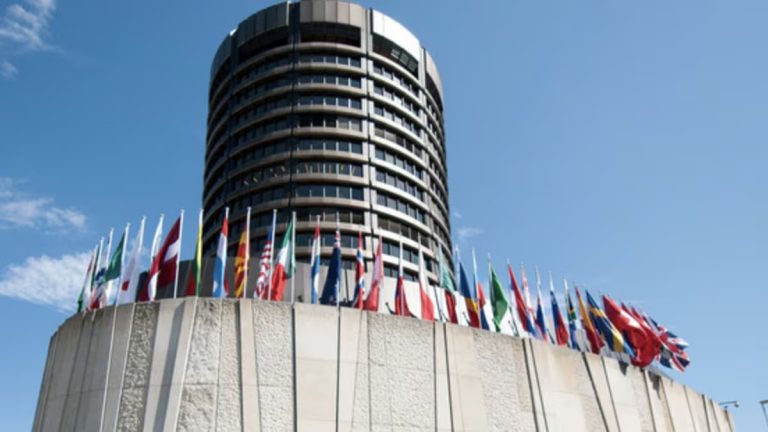
The global financial system faces significant new stability challenges as massive public debt levels collide with the increasing reliance on highly leveraged non-bank financial institutions (NBFIs), according to Pablo Hernández de Cos, the new General Manager of the Bank for International Settlements (BIS).
De Cos, who took over in July, has issued a dire warning, stating that curbing hedge funds’ ability to make highly leveraged bets in government bond markets must be a “key policy priority” for policymakers worldwide.
The central source of risk, according to the BIS chief, is the explosive growth of cash-futures basis trades, a form of “relative value” arbitrage that underpins much of the high-frequency trading in the world’s largest government bond markets, including U.S. Treasuries.
Register for Tekedia Mini-MBA edition 20 (June 8 – Sept 5, 2026).
Register for Tekedia AI in Business Masterclass.
Join Tekedia Capital Syndicate and co-invest in great global startups.
Register for Tekedia AI Lab.
This strategy seeks to exploit tiny, temporary price differences—the “basis”—between a cash government bond (the underlying security) and its corresponding futures contract. Since arbitrage dictates that the prices of the two instruments must converge as the futures contract approaches expiration, hedge funds execute the trade by simultaneously buying the relatively cheaper security and selling the relatively more expensive one.
A typical trade involves three highly interconnected steps:
- The Position: The hedge fund buys the physical bond in the cash market (a long position) while simultaneously selling the corresponding futures contract (a short position). The aim is to lock in the small price differential.
- The Leverage: Because the profit margin on the basis is minuscule, hedge funds must employ massive leverage—often 30- to 60-times capital—to make the trade worthwhile. The cash purchase of the bond is financed by borrowing funds in the repurchase agreement (repo) market, using the purchased Treasury as collateral.
- The Margin: The short position in the futures market requires the posting of margin (collateral) with a central clearing counterparty. This leverage is synthetic but exposes the fund to futures market volatility.
The Systemic Risk: When Convergence Fails
While basis trades are essential for market efficiency and ensuring accurate price discovery, their highly leveraged nature transforms them into a critical source of systemic fragility during periods of market stress.

The peril lies in the dependence on the repo market and the constant possibility of margin calls. If bond prices drop sharply or volatility spikes, the central counterparty (clearinghouse) requires the hedge fund to post immediate additional cash (margin call) to cover potential losses. Simultaneously, the counterparty lending cash in the repo market may demand a larger haircut, effectively increasing the cost of financing and constricting liquidity.
This precise mechanism was highlighted after margin calls on U.S. Treasury future trades in 2021 fueled a bout of turmoil in the world’s biggest government bond market. When volatility spiked, many hedge funds were forced into a disorderly, rapid unwinding of their massive, leveraged positions.
To meet the margin calls, they had to quickly sell the underlying cash bonds, flooding the market and exacerbating the price decline, which, in turn, triggered more margin calls in a dangerous feedback loop known as a margin spiral. The selling pressure distorted prices and severely impaired market liquidity.

De Cos provided striking evidence of the unrestrained leverage currently employed, stating that approximately 70% of bilateral repurchase agreements (repos) taken out by hedge funds in U.S. dollars and 50% of those in euros are offered at zero haircut, meaning creditors are not imposing any meaningful constraint on leverage using sovereign debt as collateral.
Against the backdrop of alarming projections that the debt-to-GDP ratio of advanced economies could soar to 170% by 2050, absent fiscal consolidation, de Cos stated that reining in NBFI leverage was a “key policy priority.” He specifically called for a “carefully selected combination of tools,” prioritizing two measures:
- Central Clearing: Implementing the greater use of central clearing so that government bond market players are treated more equally, reducing counterparty credit risk and increasing market transparency.
- Minimum Haircuts: The application of “minimum haircuts”—or required discounts—to the value of the bonds hedge funds use as collateral, thereby directly limiting the extent of their leveraged plays in a targeted manner.
De Cos concluded with a reiteration of the non-negotiable role of central banks, noting that keeping inflation in check will remain the most effective way to support debt sustainability and that, given the rapidly deteriorating sovereign creditworthiness, the need for credible monetary policy and central bank independence is stronger than ever.