

BUA Foods Plc, one of Nigeria’s leading food manufacturers, has announced its unaudited full-year 2024 financial results, reporting record-breaking revenue and profit growth despite significant economic challenges.
The company achieved a 109.3% increase in revenue, reaching N1.53 trillion, reflecting its robust expansion strategy, volume growth, and strong pricing execution.
BUA Food’s gross profit grew by 107.9% to N541.71 billion, while profit after tax surged by 145.3% to N274.95 billion, demonstrating its resilience in a challenging macroeconomic environment. Earnings per share (EPS) rose by 145.3% to N15.27, further cementing the company’s strong financial position.
Register for Tekedia Mini-MBA edition 20 (June 8 – Sept 5, 2026).
Register for Tekedia AI in Business Masterclass.
Join Tekedia Capital Syndicate and co-invest in great global startups.
Register for Tekedia AI Lab.
BUA Foods’ exceptional performance in 2024 was driven by expansion across all product lines, strategic investments, and effective cost management. The company successfully navigated supply chain disruptions, inflationary pressures, and foreign exchange fluctuations, which affected businesses across Nigeria’s manufacturing sector.
Revenue increased by 109.29% to N1.53 trillion, compared to N729.4 billion in 2023, reflecting higher demand, increased production capacity, and improved distribution efficiency. Gross profit surged to N541.71 billion, from N260.5 billion, indicating strong cost controls and pricing power.
Profit after tax recorded a significant 145.3% growth, rising from N112.1 billion in 2023 to N274.95 billion, reinforcing the company’s market leadership. Additionally, EBITDA increased by 131.5% to N499.4 billion, reflecting improved operating efficiencies.

Despite inflationary pressures, BUA Foods kept operating costs in check, although selling and distribution expenses increased by 27.7% to N60.11 billion, due to higher logistics and supply chain costs.
Strong Growth Across Key Product Segments
BUA Foods experienced significant growth across its major product lines, indicating increasing consumer demand and market expansion.
- Sugar sales rose by 74% to N733.8 billion, reinforcing BUA Foods’ dominant position in the sugar market.
- Flour sales surged 172% to N589.5 billion, driven by increased industrial and retail demand.
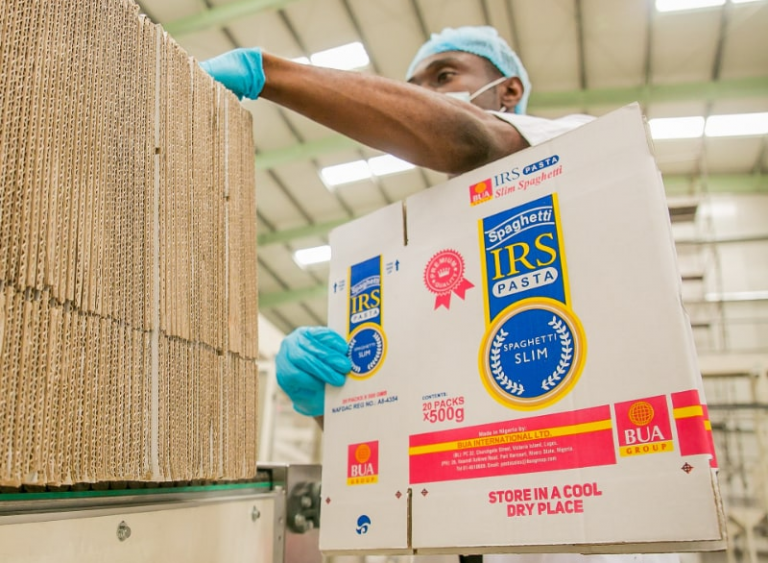
- Pasta sales jumped by 125% to N197.6 billion, benefiting from a growing consumer preference for locally produced pasta.
This broad-based revenue expansion highlights the effectiveness of BUA Foods’ product diversification strategy and investment in production capacity.

Speaking on the company’s performance, Managing Director, Engr. (Dr.) Ayodele Abioye described the results as a testament to BUA Foods’ ability to navigate economic challenges and create sustained value for stakeholders.
“We are delighted to report an exceptional performance in FY 2024. Despite significant macroeconomic challenges, our business effectively managed supply chain costs and foreign exchange losses, ensuring uninterrupted operations.
“The cumulative impact of our expansion strategy has strengthened our ability to meet growing consumer demand while improving internal operational efficiencies. BUA Foods achieved an aggregate volume growth of 18% across our divisions.
“We hit a milestone revenue of N1.53 trillion, reflecting a 109% increase, while profit after tax surged 145% to N274.95 billion. This performance has reinforced our market leadership and competitive position in the industry,” he said.
Looking ahead, Engr. Abioye expressed optimism about future growth, stating that stability in the macroeconomic environment would further enhance the company’s operations.
“With the concerted efforts of our board, management, and frontline associates, we remain focused on addressing food supply challenges in Nigeria and across Africa. Our strategic investments and expansion initiatives will continue to drive strong performance and long-term value creation for all stakeholders,” he added.
BUA Foods has consistently outperformed the industry, leveraging its integrated supply chain, innovative product portfolio, and efficient distribution network.
Food Inflation and Policy Changes Drive BUA Foods’ Growth
While the company’s expansion strategy and operational efficiency have played a major role in this stellar performance, Nigeria’s deepening food insecurity crisis and soaring inflation have significantly contributed, making the unprecedented growth entirely not surprising.
The country has been grappling with one of the worst food inflation rates in its history, hitting 39.84% as of December 2024, according to the National Bureau of Statistics (NBS). As food prices continue to skyrocket, food manufacturers and agricultural producers are seeing record earnings, making the sector one of the most lucrative industries in Nigeria today. BUA Foods, being a dominant force in the food production and distribution industry, has directly benefited from this economic reality.
Nigeria’s food crisis is fueled by a combination of supply chain disruptions, insecurity in farming regions, foreign exchange volatility, and policy-driven import bans. The government’s strict restrictions on food imports, aimed at boosting local production, have inadvertently created a protected market for local producers. This policy, while intended to promote self-sufficiency, has also led to higher food prices, as demand outstrips supply.
With limited competition from imported goods, local food manufacturers like BUA Foods have gained a significant advantage, enabling them to set prices that reflect the prevailing market conditions. This pricing power, combined with strong demand for staple foods, has allowed the company to dramatically increase its revenue and profitability.
With ongoing investments in new production facilities, enhanced logistics, and backward integration, BUA Foods is well-positioned for sustained growth.