

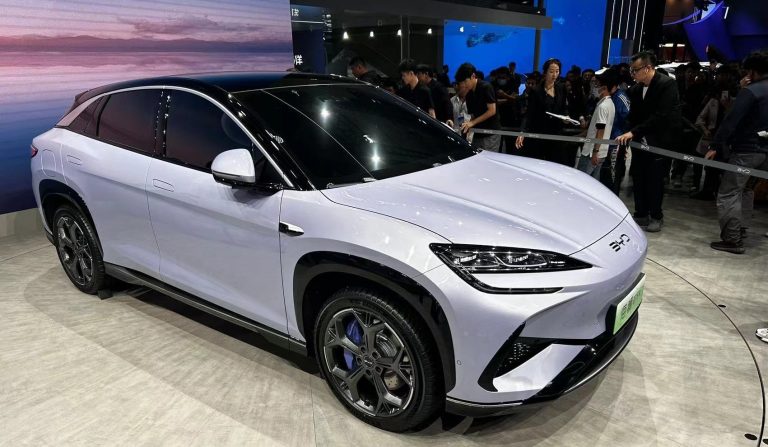
China’s electric vehicle giant BYD is betting that the country’s transition away from gasoline-powered vehicles is far from complete.
The company expects EVs and hybrids to account for nearly 80% of new vehicle sales in China in the coming years, positioning itself on the opposite side of an increasingly heated debate over the future growth trajectory of the world’s largest auto market.
Speaking to CNBC on Monday, BYD Executive Vice President Stella Li projected that continued technological advances would drive another major wave of EV adoption.
Register for the next Tekedia Mini-MBA.
Register for Tekedia AI in Business Masterclass.
Join Tekedia Capital Syndicate and co-invest in great global startups.
“With all the innovation technology introduced to the market, China’s market very quickly will push to … close to 80% in EV penetration,” Li said.
She stands in sharp contrast to the more cautious view recently expressed by executives at Nio, who suggested that the industry’s so-called “golden era” of rapid expansion may be coming to an end as competition intensifies and growth rates moderate.
The disagreement highlights a broader divide emerging within China’s EV sector. While some manufacturers see signs of market maturity after years of explosive growth, others believe technological innovation, falling ownership costs, and changing consumer preferences still leave substantial room for expansion.

China remains the global leader in EV adoption. According to the China Passenger Car Association, electric and hybrid vehicles accounted for more than half of all new passenger vehicle sales in 2024, with penetration reaching a record 62.9% last month. That compares with roughly 25% globally and about 10% in the United States, according to International Energy Agency estimates.
The latest data suggest that China’s transition away from internal combustion engines may be accelerating again. Sales of gasoline-powered vehicles plunged 39% in May from a year earlier, according to industry figures, as higher oil prices linked to tensions in the Middle East made traditional vehicles less attractive to consumers.
For BYD, the world’s largest EV manufacturer by volume, the optimism is underpinned by technology improvements that executives believe could remove one of the industry’s last major barriers: charging times.

Li said domestic demand for BYD vehicles is currently running at roughly twice the level the company can supply. A key factor, she argued, is growing consumer interest in BYD’s next-generation fast-charging systems, which can reportedly replenish batteries to 70% capacity in about five minutes, approaching the convenience of refueling conventional vehicles.
If fast-charging technology becomes widely adopted, it could significantly reduce range anxiety, a concern that has historically slowed EV adoption in many markets. The company is also taking a position for what may become the next major battleground in the industry: intelligent driving systems.
Looking ahead, Li expects the next phase of competition to likely center on driver-assist features.
BYD recently expanded insurance coverage for users of its “L2+” driver-assistance systems, a move Li said could lift utilization rates by five percentage points to at least 95%. The company also unveiled its own driver-assistance chip, underscoring its ambition to control more of the technology stack internally.
Even so, BYD is not abandoning partnerships with global technology leaders. Li said the company will continue relying largely on chips supplied by Nvidia for driver-assistance functions, despite maintaining a semiconductor engineering workforce of approximately 7,000 people. The strategy reveals that automotive competition is shifting beyond battery technology into areas traditionally associated with the technology sector, including artificial intelligence, autonomous driving, and custom silicon.
However, there are still questions about BYD’s growth trajectory.
While the company remains China’s dominant EV manufacturer, analysts note that its sales performance has become less explosive than in previous years. BYD sold nearly three times as many new-energy vehicles as its nearest competitor in May, ending an eight-month streak of declining sales. However, overall sales growth remains relatively modest by the company’s historical standards.
“The question is not only whether BYD can maintain its leadership in China,” said Leon Cheng, head of mobility practice at YCP, “but whether it can defend its position globally as more Chinese EV players compete aggressively in export markets.”
That observation is borne out of a broader challenge confronting Chinese automakers. Domestic competition has intensified into a prolonged price war that has squeezed margins across the sector. As a result, many manufacturers are increasingly relying on international markets to sustain growth.
BYD has been among the most aggressive in pursuing overseas expansion. The company is investing heavily in Europe, Latin America, Southeast Asia, and other emerging markets as it seeks to reduce reliance on China’s increasingly crowded domestic market.
Li said BYD aims to locally manufacture 75% of the vehicles it sells in Europe, a strategy designed to mitigate trade barriers and strengthen its position in one of the world’s most strategically important EV markets. The company is simultaneously navigating growing geopolitical challenges. U.S. tariffs effectively prevent meaningful sales of Chinese-made EVs in the American market, while BYD was recently added to a Pentagon list of companies allegedly linked to China’s military establishment. The automaker did not comment on the designation.
Meanwhile, BYD continues to face scrutiny in Europe. Li rejected allegations raised by a New York-based watchdog group concerning labor conditions during the construction of the company’s factory in Hungary, noting that European authorities had not launched a formal investigation. The European Union has indicated that the matter falls under the jurisdiction of Hungarian labor regulators.
The debate over China’s EV future ultimately centers on whether the industry can sustain growth after already achieving levels of market penetration unmatched anywhere else in the world. BYD believes technological breakthroughs in charging, batteries, and intelligent driving will continue pulling consumers away from gasoline-powered vehicles, even as rivals question whether the sector’s most explosive growth phase has already passed.