

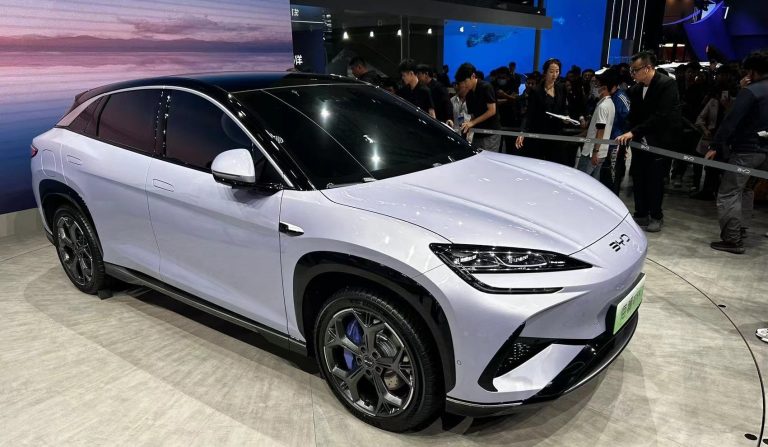
Chinese electric vehicle manufacturer BYD recorded its sixth consecutive month of year-on-year sales growth in October, with overseas markets providing an important source of demand as competition and weak consumer appetite weigh on its domestic business.
The company sold 490,168 vehicles in October, an 11% increase from a year earlier, according to its latest disclosure. However, growth slowed from 17% in September, indicating that the recovery in sales remains uneven.
Overseas shipments provided the strongest contribution. They increased 102.8% year-on-year to 170,194 vehicles, based on Reuters calculations from the company’s disclosure. The figures highlight BYD’s growing reliance on international markets to sustain expansion as China’s automotive industry faces intense price competition and pressure on domestic demand.
Register for the next Tekedia Mini-MBA.
Register for Tekedia AI in Business Masterclass.
Join Tekedia Capital Syndicate and co-invest in great global startups.
The sales performance follows a challenging third quarter, when BYD’s profit growth slowed to 28% year-on-year, missing market forecasts. Competition among Chinese automakers has intensified as manufacturers seek customers at home and accelerate exports to international markets.
The shift towards overseas sales has become crucial for BYD, which has established itself as one of China’s largest electric vehicle manufacturers and a major exporter of hybrid vehicles. However, its expansion in Europe could face additional regulatory challenges as policymakers seek to manage the growth of Chinese vehicle imports.
BYD’s October figures show how international markets are helping the company offset weaker conditions in China. Overseas shipments accounted for approximately 35% of its total vehicle sales during the month, based on the reported figures.

The 102.8% annual increase in overseas shipments substantially outpaced the company’s overall sales growth. This suggests that demand outside China is becoming a more important driver of its business, although the figures alone do not establish how much of the increase came from individual markets or specific vehicle models.
The export push is also taking place as Chinese manufacturers compete more aggressively for customers abroad. Sluggish domestic demand has pushed automakers to seek growth in markets where EV adoption is expanding, and consumers have different purchasing patterns.
However, overseas expansion carries its own risks. Automakers face import tariffs, local manufacturing requirements, regulatory standards, and competition from established vehicle producers. These challenges are significant in Europe, where trade policy has become a major factor in the outlook for Chinese electric and hybrid vehicle exports.

BYD, one of the leading exporters of hybrid vehicles to the European Union, could face new restrictions under a proposed China-EU arrangement aimed at reining in hybrid imports into the region. Any additional curbs could affect the company’s ability to maintain its export momentum in one of the world’s important automotive markets.
The European challenge comes as BYD seeks to build a more geographically diversified business. Strong overseas shipment growth can reduce dependence on China’s domestic market, but it also exposes the company to trade policy changes and the cost of establishing distribution, manufacturing and after-sales networks abroad.
The pressure at home remains high. China’s automotive industry has been caught in an extended price competition, with manufacturers competing through discounts, new model launches and technology upgrades. While lower prices can support sales volumes, they can also compress margins and make it harder for companies to translate revenue growth into stronger profits.
BYD’s third-quarter results underpin that tension. Although profit increased 28% from a year earlier, the growth rate fell short of forecasts, suggesting that higher sales volumes have not fully insulated the company from the industry’s pricing pressure.
China’s domestic car market is expected to record a modest recovery in 2027 after a sharper-than-expected downturn this year. That outlook suggests automakers may have to continue relying on exports and operational efficiency while waiting for domestic demand to improve.
Xiaomi Accelerates Electric Vehicle Production Towards 2026 Target
Meanwhile, Chinese smartphone maker Xiaomi is also expanding its position in the electric vehicle market, reporting more than 50,000 deliveries in October, its highest monthly total this year.
The company has increased monthly deliveries from more than 30,000 vehicles in August to over 40,000 in September, before crossing the 50,000 mark in October.
For the first 10 months of the year, Xiaomi delivered approximately 336,000 electric vehicles. That represents about 61% of its target to deliver 550,000 vehicles in 2026.
The October performance indicates that Xiaomi is increasing production capacity as it seeks to establish a larger presence in China’s competitive electric vehicle market. Its delivery growth also shows how technology companies are expanding into automotive manufacturing, bringing their experience in consumer electronics, software and connected devices into a sector traditionally dominated by established vehicle producers.
However, reaching its annual target will require a substantial acceleration in deliveries over the final two months of the year. Xiaomi would need to deliver approximately 214,000 vehicles in November and December combined, or an average of 107,000 per month, to reach 550,000.
That would be more than double its October delivery volume, making production capacity and supply-chain execution important factors in determining whether it achieves the target.
The contrasting performances of BYD and Xiaomi highlight the scale of competition in China’s electric vehicle industry. BYD is using its established manufacturing base and overseas expansion to sustain growth, while Xiaomi is increasing production as it builds its automotive business.
Both companies face a market in which sales growth alone is no longer sufficient to guarantee stronger profitability. Price competition, production costs, export restrictions, and the ability to build sustainable demand are expected to shape their performance as Chinese automakers expand beyond their home market.