

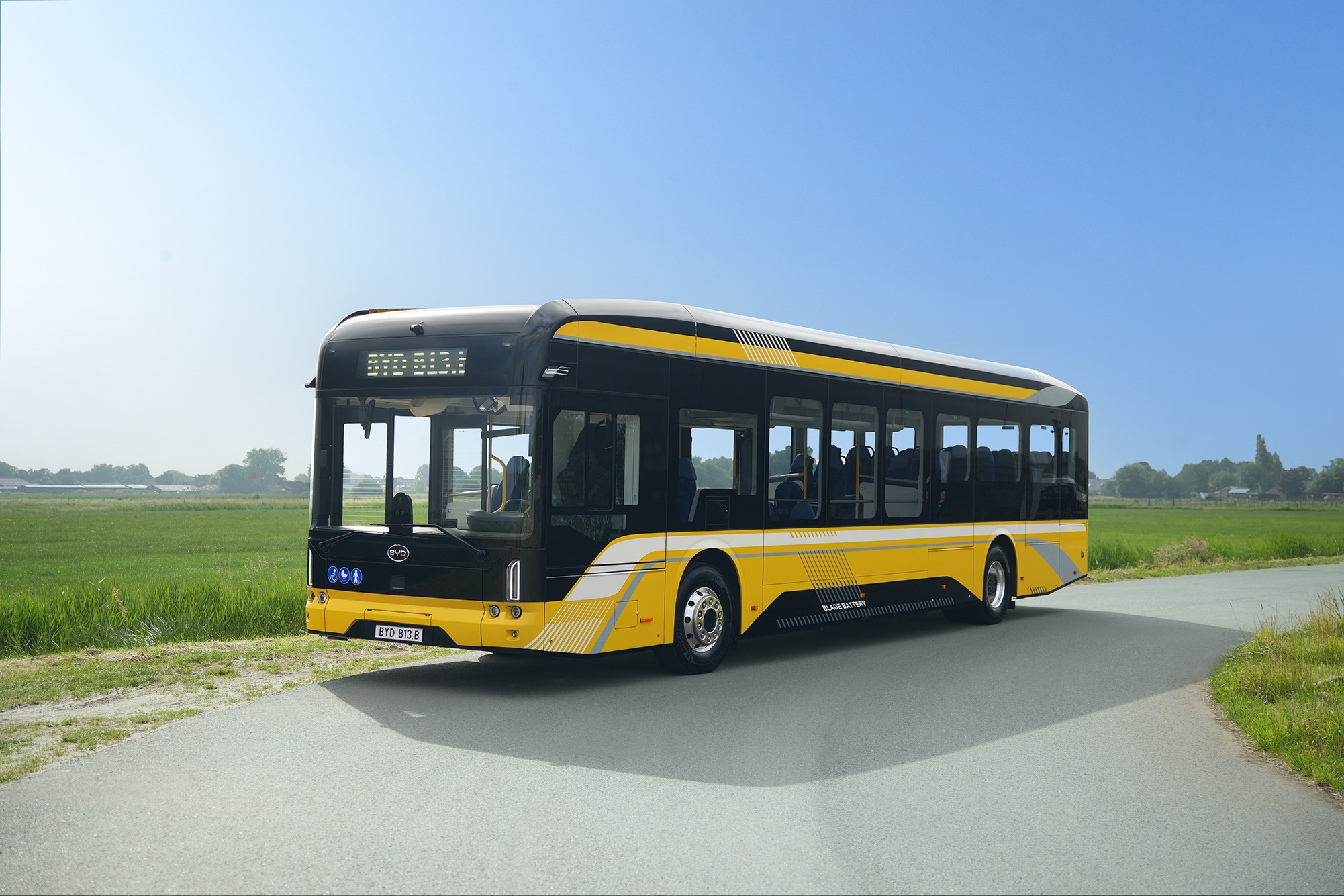
Chinese manufacturer BYD has made a grand European debut of its latest zero-emission bus, the B13.b, at the UITP Global Public Transport Summit in Hamburg.
This 13.2-meter-long intercity electric bus represents a significant leap in efficiency, performance, and range, setting a new benchmark for long-distance electric transportation.
At the heart of the B13.b lies BYD’s proprietary Blade Battery Chassis platform — a cell-to-chassis (CTC) innovation where the lithium-iron-phosphate (LFP) Blade battery is integrated directly into the vehicle’s structure. This design not only conserves space but also increases structural rigidity and lowers the bus’s center of gravity, enhancing ride quality, safety, and handling.
Register for Tekedia Mini-MBA edition 20 (June 8 – Sept 5, 2026).
Register for Tekedia AI in Business Masterclass.
Join Tekedia Capital Syndicate and co-invest in great global startups.
Register for Tekedia AI Lab.
Thanks to this architecture, the B13.b can accommodate a 560 kWh battery — 54 kWh more than its predecessor — delivering a range of up to 700 km on a single charge under the Standardized On-Road Test (SORT) cycle. For operators requiring less distance, a 476 kWh option provides a still impressive 620 km range. Each bus is equipped with two 150 kW hub motors and powered by BYD’s latest 6-in-1 silicon carbide (SiC) controller, balancing performance with high energy efficiency.
The interior seats up to 49 passengers, with total capacity reaching 78, eight more than previous models. Built for intercity service, it’s designed for comfort and functionality.
Charging versatility is a standout feature: operators can choose single or dual 192 kW DC fast charging, or utilize an overhead pantograph delivering up to 500 kW, ensuring rapid turnarounds. Its top speed is capped at 100 km/h, matching intercity route requirements.

BYD’s European Rise
The B13.b follows BYD’s earlier B12 model introduced in 2023 and underscores the company’s rapid rise in the European electric bus market. By mid-2025, BYD had taken over 6,700 e-bus orders across 26 countries and 160 cities, with its fleet logging over 360 million miles and reducing more than 630,000 tonnes of CO? — a tangible contribution to Europe’s green mobility goals.
This sustained growth contrasts sharply with Tesla’s current challenges: slowing demand in key markets, rising price competition from Chinese EV makers, and pressure on its margins amid global economic uncertainty.
Tesla’s downturn has created openings for competitors like BYD to consolidate market share in both consumer and commercial EV segments. While Tesla has struggled to sustain delivery growth in Europe, BYD has steadily introduced buses, passenger cars, and partnerships tailored to the continent’s stricter environmental targets and high public transport electrification goals.

Why It Matters
Few electric buses today match the B13.b’s combination of long charge range, integrated battery technology, and flexible charging systems.
With European cities and national governments investing heavily in green mobility, the B13.b offers transit agencies a long-range, zero-emission option that can compete with — and in some respects surpass — established European brands such as Mercedes and Volvo. Mercedes’ eIntouro, for instance, delivers around 500 km range with a 414 kWh battery, while Volvo’s 8900 Electric offers a high-capacity setup but with a range still below BYD’s new standard.
In summary, the B13.b could redefine expectations for electric intercity buses, offering transit agencies a tool to maintain zero-emission routes without compromising on range or operational flexibility — a critical step forward in the e-mobility transition.