

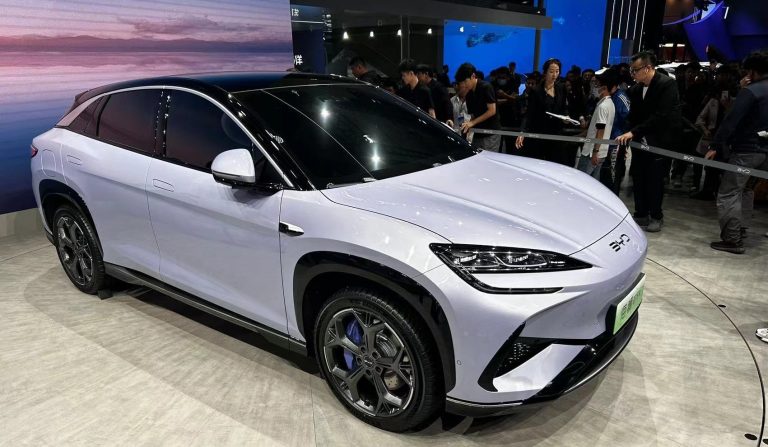
Sales growth at BYD slowed sharply in 2025, underlining mounting pressure on China’s largest electric vehicle maker as intensifying competition at home and signs of a fading technological edge begin to weigh on its dominance.
The sharp deceleration in sales is more than a China-only story. It marks a turning point with implications for the global electric vehicle market, where competition is intensifying, margins are thinning, and the long-simmering rivalry between BYD and Tesla is taking on a more complex, global character.
The Chinese automaker said full-year sales rose 7.73% to 4.6 million vehicles, its weakest growth in five years. December sales fell 18.3% year-on-year, extending a four-month slide and marking the steepest monthly drop in nearly two years. The slowdown followed BYD’s decision to cut its 2025 sales target by 16%, an acknowledgment that domestic demand had weakened sharply from mid-year amid fierce competition from Geely, Leapmotor, and other fast-moving rivals.
Register for Tekedia Mini-MBA edition 20 (June 8 – Sept 5, 2026).
Register for Tekedia AI in Business Masterclass.
Join Tekedia Capital Syndicate and co-invest in great global startups.
Register for Tekedia AI Lab.
At home, the data point to a market that has entered a more mature and unforgiving phase. Price cuts, once a lever to rapidly expand market share, are now yielding diminishing returns. BYD’s decision in May to slash prices across more than 20 models triggered a selloff in Chinese auto stocks and prompted Great Wall Motor’s chairman to warn publicly that China’s auto industry was in an “unhealthy” state. That comment captured a broader concern: China’s EV market, the largest in the world, is becoming oversupplied, with too many players chasing slowing demand.
Chinese media outlet Southern Metropolis Daily reported that BYD chairman Wang Chuanfu told investors in December that the company’s domestic struggles reflected a weakening of its technological leadership. Wang said BYD would roll out major innovations in 2026, a signal that management believes the next phase of competition will hinge less on price and more on differentiated technology.
Over the past year, BYD has already pushed hard on features. It introduced advanced driver-assistance systems on vehicles priced below $10,000 and launched models boasting ultra-fast charging. However, rivals quickly matched or undercut those moves, eroding BYD’s advantage and forcing it into a margin-sapping price war. The pressure has been significant enough that BYD slowed production and delayed capacity expansion in mid-2025, according to Reuters, a notable shift for a company long defined by relentless scaling.

These dynamics matter globally because China has been the engine of EV growth worldwide. A cooling Chinese market increases the incentive for domestic champions like BYD to look outward, exporting both vehicles and competitive pressure to Europe, Southeast Asia, Latin America, and beyond.
That shift is already underway. BYD’s overseas sales surged 150.7% in 2025 to just over 1 million units, becoming the company’s main growth driver. Europe, in particular, has emerged as a key battleground. BYD’s competitively priced models have gained traction as consumers grapple with high inflation and rising interest rates, conditions that favor lower-cost EVs over premium offerings.
This is where the implications for Tesla become most pronounced. In 2025, BYD sold 2.26 million electric vehicles, positioning it to overtake Tesla in annual EV sales for the first time. Tesla was expected to deliver about 1.64 million vehicles, an 8.3% decline from the previous year. The crossover is symbolic, highlighting a shift in the center of gravity of the EV market toward manufacturers that can deliver scale at lower price points.

Tesla’s strategy, however, is diverging sharply from BYD’s. Elon Musk has deprioritized plans for a mass-market $25,000 EV, instead focusing Tesla’s future on artificial intelligence, full self-driving software, and robotaxis. Musk has said these technologies, rather than vehicle volume alone, will define the next era of automotive competition.
BYD, by contrast, remains firmly committed to volume, vertical integration, and aggressive pricing, backed by control over key parts of its supply chain, including batteries. That approach gives BYD resilience in a global market where affordability is becoming more important, particularly as governments scale back EV subsidies and consumers become more price-sensitive.
The rivalry is therefore no longer just about who sells more cars. It reflects two competing visions of the EV future. Tesla is betting that software, autonomy, and AI-driven services will justify higher prices and unlock new revenue streams. BYD is betting that scale, cost control, and steady incremental innovation will win over mass-market buyers across multiple regions.
But BYD’s domestic slowdown now introduces a note of caution into that strategy. Margin pressure at home could limit how aggressively it can price vehicles abroad without hurting profitability. At the same time, intensifying scrutiny in Europe and the United States over Chinese EV imports, including tariffs and trade investigations, could complicate its overseas expansion.
Still, BYD’s ability to offset weakness in China with explosive growth abroad underscores how competitive the global EV market has become. The rise of BYD as a credible global Tesla rival reinforces the reality that competition is no longer coming only from Silicon Valley or Detroit, but from Chinese manufacturers willing to fight on price, scale, and speed.
The EV industry is entering a more demanding phase as 2026 approaches. Growth is slowing in key markets, technology advantages are narrowing, and the battle is shifting from early adoption to mass-market sustainability. BYD’s stalling momentum at home and accelerating push abroad capture that transition — and set the stage for a more intense, globally consequential rivalry with Tesla.