


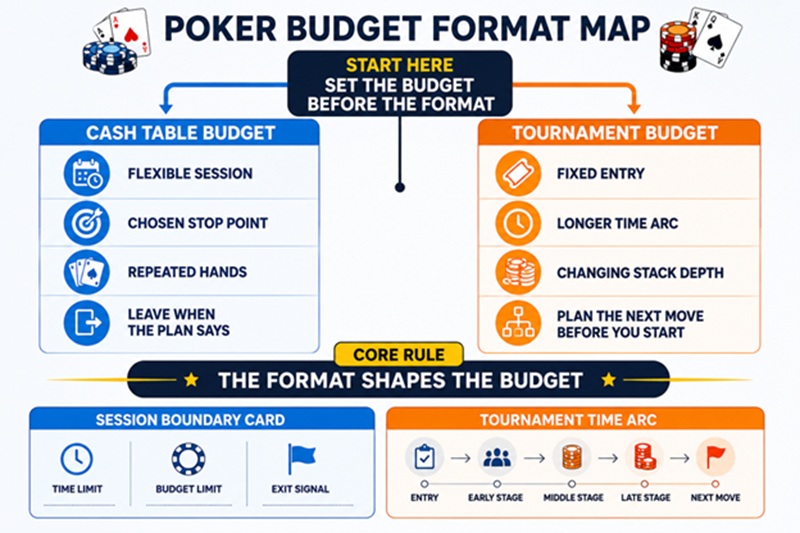
A poker budget works only when it is attached to a format. Cash tables and tournaments both use cards, chips, blinds, and pressure, yet they ask different things from the same set-aside amount. A cash table gives the player more control over session length. A tournament gives a clearer entry point, then adds time, patience, and changing stack depth. Mixing those formats without naming the difference turns figuring out your budget into guesswork.
That is why the first decision is not the table. It is the boundary. A 2024 PLOS One scoping review on money-management behavior separated budgeting, saving, spending, borrowing, and debt settlement as distinct behaviors, which is a useful reminder here. A poker budget is cleaner when it is treated as a specific entertainment choice, with its own limit and stop point.
Match The Budget to the Poker Format
Once the boundary is set, the next question is format. If you’re planning to play real money poker, then start by looking for a site that offers a wide selection of games, such as cash games, Zone Poker, Sit & Go’s, multi-table tournaments, Mystery Knockouts, and Incognito Poker. That means you will have plenty of options so you can choose something that fits both your preferences and your intended budget.
A cash table usually suits someone who wants control over duration and exit timing. A Sit & Go gives a smaller tournament rhythm because the event begins when the table fills. A multi-table tournament asks for a longer attention span because the player may sit through changing blind levels, table moves, and stack swings. The budget should match that shape before the first hand is dealt, especially for casual players who want poker to stay clear, contained, and enjoyable. A player with 45 minutes and a defined stopping point should think differently from someone with an evening available for a tournament path.
A short Xuan Liu poker clip shows that format shift without turning it into theory. She starts inside a WSOP $2K tournament, talks us through her dinner break with a strong stack, later notes that several all-in spots changed the day, then moves toward a cash-game seat after busting in 26th. The useful detail is the change in tempo. The tournament has breaks, field size, and elimination pressure. The cash game scene has a different pace.
Cash Tables Need a Clear Exit
Cash tables can feel easier to plan because the player is not tied to a tournament clock. That flexibility is exactly why the exit point matters. Without one, the session can stretch because there is always another orbit, another playable hand, another chance to see whether the table still feels good.
A cash table budget works best when it answers three ordinary questions. How long is the session meant to last? What amount has been set aside for this session? What signal ends the session? That signal can be time, tiredness, a planned chip boundary, or the feeling that concentration is slipping.
The format also changes how decisions arrive. Cash play gives repeated hands at a steadier rhythm. A player can fold, observe table behavior, choose better spots, and leave when the plan says the session is complete. That can make cash tables easier to contain than a long tournament day. Flexibility should make the budget easier to follow, not easier to forget.
Tournaments Ask for More Than the Entry
A tournament looks simpler at the start because the entry is named upfront. That does not mean your budget only covers money, of course. It also includes time, attention as blinds rise, and patience when the stack moves through different phases.
The same entry can feel different depending on structure. A Sit & Go gives a compact event. A multi-table tournament can run through longer stages where the best decision may be a quiet fold, a patient wait, or a carefully timed hand. The player is choosing a rhythm.
Tournament budgets also need a plan for what happens after the event ends. If the player exits earlier than expected, the next choice should already be defined. That might mean stopping for the day, switching to a smaller cash session that was planned in advance, or saving the remaining time for another day. Decide before the tournament result steers the next move.
Keep The Two Budgets Separate
Cash-table money and tournament money should not be treated as one flexible pile. One amount belongs to cash sessions, where the player controls duration. Another belongs to tournament entries, where the format controls more of the clock.
This separation makes post-session review cleaner. A cash session can be judged by whether the player followed the exit rule and stayed inside the planned boundary. A tournament can be judged by whether the entry fit the available time and whether later decisions matched the player’s stack, position, and patience.
A casual player does not need complex accounting to play with more clarity. Two separate envelopes, even if they are only mental envelopes, can keep the choice honest. Cash tables are about controlled access to repeated decisions. Tournaments are about entering a defined path and accepting its pace. Poker feels cleaner when the format is chosen first and the budget follows that shape, especially because decision-making under uncertainty often demands extra cognitive control, as explained in Frontiers’ review of uncertainty and cognitive control.