

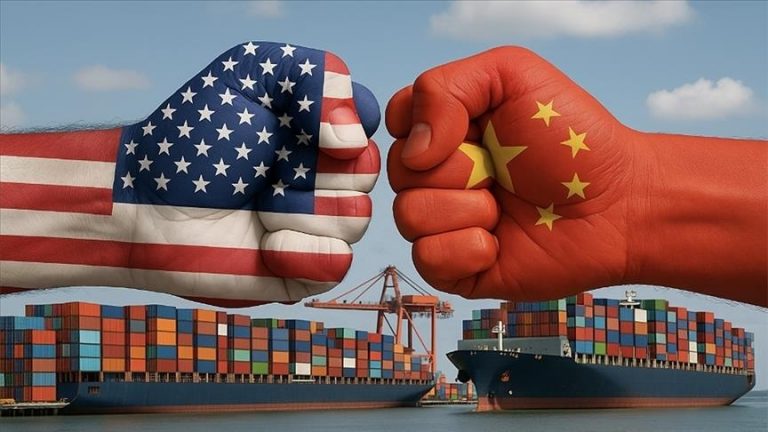
China is closely monitoring the implications of President Donald Trump’s new 15% universal tariff on all imports and will decide “in due course” whether to adjust countermeasures, a commerce ministry official said Tuesday, a day after Trump raised the temporary levy from 10% to 15% under Section 122 of the 1974 Trade Act.
According to Reuters, the official reiterated Beijing’s opposition to unilateral tariffs and urged the United States to “cancel unilateral tariffs and refrain from further imposing such tariffs.” At the same time, the ministry expressed willingness to hold “frank consultations” during the sixth round of U.S.-China economic and trade talks, without specifying timing or location.
Trump’s latest move came in direct response to the U.S. Supreme Court’s 6-3 ruling Friday invalidating his prior use of the International Emergency Economic Powers Act (IEEPA) to impose broad tariffs. That decision dismantled duties of 10–50% on goods from dozens of countries, including a 20% rate on Chinese imports. The court held that IEEPA does not authorize unilateral import taxes absent a specific, imminent foreign threat.
Register for Tekedia Mini-MBA edition 20 (June 8 – Sept 5, 2026).
Register for Tekedia AI in Business Masterclass.
Join Tekedia Capital Syndicate and co-invest in great global startups.
Register for Tekedia AI Lab.
Imports from China had been subject to the 20% IEEPA tariff (10% reciprocal + 10% fentanyl-related). The Supreme Court ruling implies a net reduction of around 5% in effective tariffs on Chinese goods, according to Goldman Sachs analysis. Global Trade Alert estimates China’s trade-weighted average tariff rate drops 7.1 percentage points under the new Section 122 regime — one of the largest relief effects among major U.S. trading partners.
China’s Retaliatory History and Current Posture
Beijing imposed multiple rounds of counter-tariffs on U.S. goods in 2025, targeting agricultural commodities (soybeans, pork, cotton), energy (LNG, crude oil), and industrial products. It also leveraged its dominance in rare earths to restrict exports of critical minerals, causing supply-chain disruptions in U.S. manufacturing.
Most retaliatory measures were suspended in November 2025 after a trade truce negotiated by Presidents Trump and Xi Jinping in South Korea. That agreement included a U.S. pledge to postpone a sweeping rule barring shipments to thousands of Chinese firms and China’s commitment to certain market-access concessions.

The commerce ministry’s measured tone on Tuesday suggests Beijing intends to preserve the truce while preparing contingency options. Analysts see the 5–7 percentage point effective tariff relief as reducing immediate pressure on Chinese exporters, though the new 15% baseline still exceeds pre-2025 levels for many goods.
Upcoming Trump-Xi Summit in Focus
Trump is scheduled to visit Beijing from March 31 to April 2, 2026 — his first trip to China since 2017 — for highly anticipated talks with President Xi. Xi is also expected to make a state visit to Washington later in the year. The Supreme Court ruling weakens Trump’s tariff leverage at a critical moment.
Analysts say China is likely to:

- Push for removal of remaining 10% fentanyl-linked tariffs.
- Seek easing of technology export controls on advanced chips and semiconductor equipment.
- Press for reduced U.S. support for Taiwan, including arms sales and official contacts.
- Demand removal of certain Chinese entities from U.S. sanctions lists.
Xi asserted during a recent phone call that Taiwan is “the most important issue” in U.S.-China relations. Minxin Pei of Claremont McKenna College predicts Xi may offer concessions on U.S. agricultural and energy purchases in exchange for a statement on Taiwan that Beijing could portray as a diplomatic victory.
Scott Kennedy of the Center for Strategic and International Studies noted the ruling has “limited impact” on the overall U.S.-China relationship because “China had already gained the upper hand.” He expects the April summit to yield modest outcomes — perhaps an extension of the truce and increased U.S. product sales — but little progress on structural issues like technology controls or economic rebalancing.
U.S. Contingency Plans and Ongoing Probes
USTR Jamieson Greer defended the continuity of existing trade deals, insisting the ruling affected only IEEPA-based tariffs. The administration has launched new Section 301 investigations covering pharmaceuticals, industrial overcapacity, forced labor, digital services taxes, and discrimination against U.S. tech and digital goods — signaling a shift to more targeted tools.
Trump warned on Truth Social of additional tariffs in the coming months under alternative authorities. The temporary 15% levy expires in 150 days unless Congress approves extensions or new legislation.
The coming weeks will test whether diplomacy can stabilize U.S.-China ties — or whether renewed tariff battles under alternative authorities reignite global trade tensions. With the April summit looming, both sides are maneuvering carefully: Trump seeks commercial wins and leverage on fentanyl and trade deficits, while Xi prioritizes Taiwan and technology access.
The Supreme Court’s intervention has reshaped the negotiating table, giving China a stronger hand on core geopolitical issues while forcing the U.S. to adapt its tariff strategy. The outcome will likely influence not only bilateral trade flows but also the broader trajectory of U.S.-China relations in 2026 and beyond.