

Hua Hong Group has developed advanced chip manufacturing technology capable of producing processors at the 7-nanometre level, according to people familiar with the matter who spoke to Reuters.
The development marks an important step in China’s effort to build a domestic semiconductor ecosystem capable of supporting artificial intelligence and high-performance computing.
The technology is being developed by the group’s contract chipmaking arm, Huali Microelectronics, which is preparing a 7-nanometre (nm) manufacturing process at its facility in Shanghai, the sources said.
Register for Tekedia Mini-MBA edition 20 (June 8 – Sept 5, 2026).
Register for Tekedia AI in Business Masterclass.
Join Tekedia Capital Syndicate and co-invest in great global startups.
Register for Tekedia AI Lab.
If the technology is successfully deployed at scale, Hua Hong would become the second Chinese semiconductor manufacturer capable of producing chips at the 7-nm node, joining Semiconductor Manufacturing International Corporation, or SMIC, the country’s largest contract chipmaker.
The development signals steady progress in Beijing’s attempt to build advanced semiconductor capabilities at home after years of U.S. export restrictions targeting China’s access to cutting-edge chip technologies.
The ability to manufacture chips at 7 nm represents a key technological threshold for modern computing systems. Chips produced at this node are widely used in artificial intelligence accelerators, advanced mobile processors, data center hardware, and high-performance computing systems.

Although global leaders have moved to even smaller manufacturing processes such as 5-nm and 3-nm, the 7-nm node remains highly relevant for AI workloads and advanced computing applications.
Achieving this capability domestically is strategically significant for China because it reduces dependence on overseas semiconductor foundries and strengthens the country’s ability to support its rapidly expanding AI industry.
People familiar with the project said Huawei Technologies has been working with Hua Hong on developing the 7-nm manufacturing technology. The collaboration underlines Huawei’s central role in China’s semiconductor self-sufficiency push after the company was cut off from many Western chip suppliers and manufacturing partners due to U.S. sanctions.

Huawei has since invested heavily in rebuilding a domestic semiconductor supply chain, partnering with chip designers, fabrication plants, and equipment manufacturers across China. Such collaborations have become increasingly important as Beijing attempts to build an integrated technology ecosystem capable of designing, manufacturing, and deploying advanced processors without relying heavily on foreign technology.
Test Production And Early Industry Adoption
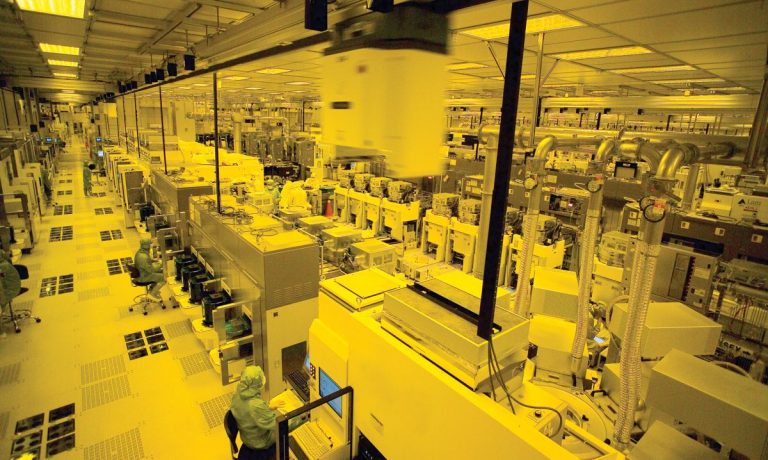
Research and development work on the 7-nm process began last year at Hua Hong Fab 6, the company’s most advanced semiconductor plant located in Shanghai. Sources said the facility is expected to start with relatively modest output, producing a few thousand silicon wafers per month by the end of the year, with capacity expected to scale gradually as manufacturing processes are refined.
Chinese graphics processor developer Biren Technology has reportedly already used the new production line for a tape-out — the stage where a chip design is finalized and turned into a physical prototype before mass manufacturing.
The development is particularly significant for Biren, which lost access to overseas manufacturing services after being placed on a U.S. trade blacklist in 2023. That move forced the company to stop using fabrication services from Taiwan Semiconductor Manufacturing Company, the world’s largest contract chipmaker.
Access to domestic manufacturing capacity, therefore, provides Chinese chip designers with an alternative path to bring advanced processors to market.
The domestic equipment ecosystem is emerging, underpinning progress among China’s semiconductor equipment makers.
Sources said Hua Hong’s work on the 7-nm process involved support from domestic suppliers, including SiCarrier, a Huawei-backed semiconductor equipment company. SiCarrier reportedly tested its manufacturing equipment at a facility in Shenzhen last year as part of efforts to develop indigenous tools for advanced chip production.
The rise of domestic equipment manufacturers is a critical element of China’s semiconductor strategy, as export restrictions have limited access to some of the most advanced machinery used in chip fabrication.
The Challenge of Technology Constraints
China’s semiconductor industry continues to face major technological hurdles despite these advances. The most sophisticated lithography systems required for the world’s most advanced chips are produced by ASML in the Netherlands. These extreme ultraviolet (EUV) machines enable chipmakers to produce processors at cutting-edge nodes such as 5-nm and 3-nm.
Chinese companies do not currently have access to EUV technology due to export controls.
Instead, Chinese foundries have relied on older deep ultraviolet lithography equipment to produce advanced chips using complex multi-patterning techniques. While technically feasible, this method can significantly reduce production efficiency and chip yields.
Analysts have said SMIC has used such techniques to produce 7-nm chips, although yields — the proportion of usable chips produced from each wafer — remain relatively low. However, it remains unclear how Hua Hong achieved its 7-nm capability, what equipment was used, or how efficient the process will be at scale.
Financial Backing And Industrial Consolidation
The push into advanced chip manufacturing is backed by significant investment. In December, Hua Hong Semiconductor announced plans to acquire a controlling stake in Huali Microelectronics and raise 7.56 billion yuan ($1.10 billion) to support research, development, and technological upgrades at the foundry.
The move is part of a broader effort by Chinese semiconductor companies to consolidate resources and accelerate progress toward advanced manufacturing capabilities.
The Hua Hong Group currently operates seven semiconductor fabrication plants. Fab 6 — where the new 7-nm technology is being developed — is its most advanced facility and currently produces logic chips at the 22-nm and 28-nm nodes. Another plant, Fab 5, focuses on mature technologies between 40-nm and 55-nm, which are widely used in automotive electronics, industrial systems, and consumer devices.
Investors reacted strongly to the report of Hua Hong’s technological progress, highlighting its importance. Shares in Hua Hong Semiconductor surged about 12% following the news, reflecting optimism that China’s semiconductor industry may be closing part of the gap with global leaders.
The progress is also another example of how China’s chip sector has continued to advance despite restrictions imposed by the United States. Although Washington has eased some export controls in recent months — allowing companies such as Nvidia to sell certain AI chips to Chinese customers — Beijing has continued encouraging domestic companies to adopt homegrown semiconductor technologies.
Despite the breakthrough, China’s semiconductor industry still faces a long path to matching global leaders. Companies such as TSMC and Samsung produce chips at far smaller process nodes and at vastly larger volumes, supported by decades of technological experience and access to the world’s most advanced equipment.
However, the emergence of a second Chinese manufacturer capable of producing 7-nm chips suggests that China’s semiconductor ecosystem is gradually strengthening.
For Beijing, the strategic goal is not necessarily to surpass global leaders immediately, but to ensure that critical technologies — particularly those needed for artificial intelligence, telecommunications, and national security — can be produced domestically if geopolitical tensions disrupt global supply chains.