

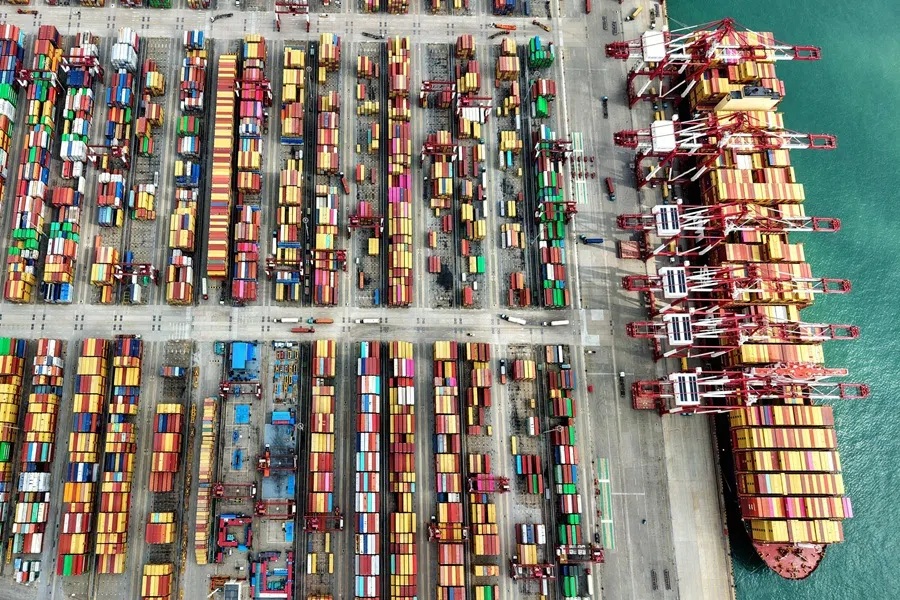
China’s trade performance in May exceeded expectations, with exports accelerating sharply and imports continuing their robust climb, as surging demand for AI-related technology goods and green energy products helped shield the economy from the disruptive effects of the ongoing U.S.-Iran war.
Overall exports rose 19.4% year-on-year in U.S. dollar terms, accelerating from 14.1% growth in April and beating economists’ consensus forecast of 15%, according to customs data released Tuesday. Imports expanded 27.4%, picking up from 25.3% the previous month and surpassing the expected 25% rise. The strong import momentum narrowed the trade surplus to $105.4 billion for the month.
In the first five months of the year, imports have grown faster than exports (24.5% vs 15.5%), a shift that has narrowed the cumulative trade surplus compared to last year. However, economists at Bank of America Global Research cautioned that this is “hardly a sign of rebalancing,” noting that the import surge is narrowly concentrated in categories such as semiconductor chips and gold, driven largely by higher input costs and stockpiling rather than broad-based domestic demand recovery.
Register for the next Tekedia Mini-MBA.
Register for Tekedia AI in Business Masterclass.
Join Tekedia Capital Syndicate and co-invest in great global startups.
AI and Green Tech as Key Buffers
The standout performer was high-tech and AI-related exports. Shipments of integrated circuits soared 110% in value, partly due to rising unit prices, while overall high-tech goods exports jumped 50%. Green energy products, electric vehicles, batteries, and solar panels also posted strong gains, benefiting from global stockpiling ahead of potential further energy price spikes caused by the Iran conflict.
“The war is boosting demand for green exports, such as electric vehicles, batteries, solar products, and AI-related technology goods. We expect the outperformance in high-tech product export growth to persist,” Sheana Yue, senior economist at Oxford Economics, noted.
This resilience comes despite the effective blockade of the Strait of Hormuz, which has disrupted global energy flows and raised input costs. Chinese exporters have capitalized on overseas buyers rushing to secure supplies before prices climb further. However, analysts warn that this tailwind may prove temporary. Once stockpiling momentum fades, sluggish domestic consumption is unlikely to fill the gap.

“We expect the AI boom to support production and trade, as higher prices for tech and semiconductor goods boost headline growth. Domestic demand could show continued weakness,” Xiangrong Yu, chief China economist at Citi, said.
Yu anticipates retail sales growth, a key gauge of consumption, could fall to zero in May, down from the already weak 0.2% in April, as the impact of earlier trade-in subsidies fades.
Shipments to the United States surged 35.4% in May, the strongest growth since March 2021, extending a rebound after prolonged declines last year under pressure from Trump-era tariffs. This performance reflects front-loading by U.S. buyers and a narrowing tariff disadvantage for Chinese goods compared to Southeast Asian competitors.

“China’s tariff disadvantage vis-à-vis Southeast Asia nations has also narrowed, providing a tailwind for exports. Any additional tariffs imposed on Chinese goods under Trump’s Section 301 review will likely be smaller than those facing rival exporters, giving Chinese manufacturers a further competitive edge,” Tianchen Xu, senior economist at the Economist Intelligence Unit, pointed out.
Domestic Weakness and Policy Implications
The strong external performance stands in contrast to softening domestic activity. China’s economy has shown clear signs of faltering after a solid first quarter. Growth slowed across the board in April, with industrial production and retail sales posting their weakest gains in years. The official manufacturing PMI slipped to 50 in May — the threshold separating expansion from contraction.
Bank of America economists noted that the export boom has reduced Beijing’s urgency for aggressive policy stimulus, even as domestic demand remains weak and domestic substitution efforts continue. This dynamic complicates rebalancing efforts away from investment and exports toward consumption-led growth.
The Iran war has compounded these challenges. As the world’s third-largest oil importer, India and China are among the most exposed major economies. Higher energy costs, disrupted fertilizer supplies, and potential El Niño-related drought risks are weighing on India’s agricultural sector and broader growth prospects, with similar ripple effects felt in China.
For now, China’s trade engine continues to fire on high-tech and green cylinders, providing a crucial buffer against external shocks and weak internal demand. The surge in AI-related and green exports is seen as a sign of the success of Beijing’s industrial policy push toward self-sufficiency and strategic sectors.
However, some analysts believe the reliance on front-loading, stockpiling, and elevated global prices makes this growth fragile. This is because a resolution to the Middle East conflict that normalizes energy flows could quickly shift the balance from shortage fears to surplus concerns, potentially pressuring Chinese exporters.
Meanwhile, persistent domestic weakness, evident in slowing retail sales and manufacturing momentum, is said to reveal the need for more targeted stimulus to support consumption.