

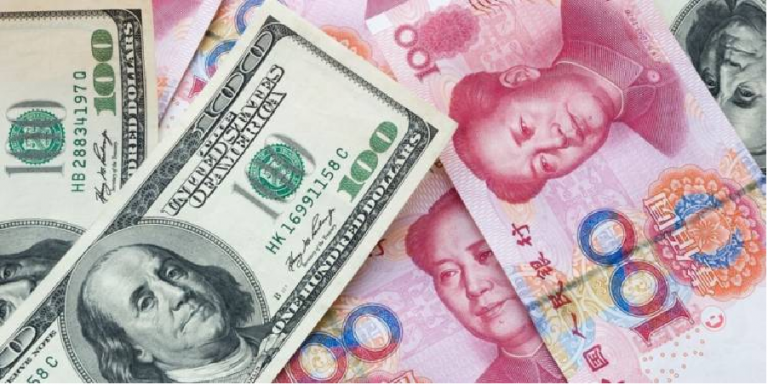
The Chinese Yuan has weakened significantly, reaching its lowest level against the U.S. Dollar in over two years. This decline is largely attributed to a combination of factors, including escalating trade tensions with the United States, particularly following tariff threats, and a deliberate move by China’s central bank, the People’s Bank of China (PBOC), to set the yuan’s midpoint rate at its weakest since September 2023. For instance, on April 8, 2025, the PBOC set the reference rate at 7.2038 per dollar, allowing the onshore yuan to drop to around 7.33 and the offshore yuan to hit levels as low as 7.3677 before stabilizing slightly.
This marks a notable depreciation, with the currency losing about 1% against the dollar in April alone, reflecting pressures from U.S. trade policies and a strengthening dollar amid rising U.S. bond yields. Analysts suggest this could be a strategic move by China to bolster exports in response to economic challenges, though it raises concerns about potential capital flight and inflation. The Chinese yuan hitting its lowest level in two years carries several significant implications across economic, political, and global trade dimensions.
A weaker yuan makes Chinese goods cheaper on the global market, potentially increasing export competitiveness. This could help offset the impact of U.S. tariffs, which have been a pressure point amid ongoing trade disputes. However, this advantage might be limited if other countries retaliate with their own trade measures. Imports, particularly commodities like oil and food, become more expensive with a weaker yuan. Given China’s reliance on imported raw materials, this could drive up domestic inflation, squeezing consumers and businesses already grappling with economic slowdown.
Register for Tekedia Mini-MBA edition 20 (June 8 – Sept 5, 2026).
Register for Tekedia AI in Business Masterclass.
Join Tekedia Capital Syndicate and co-invest in great global startups.
Register for Tekedia AI Lab.
A depreciating currency might spook investors, leading to capital flight as they seek safer assets elsewhere. This could force the PBOC to tighten capital controls or burn through foreign reserves to stabilize the yuan, both of which have costs—either to financial openness or to reserve buffers. Chinese companies with U.S. dollar-denominated debt (a significant amount exists) will face higher repayment costs as the yuan weakens, potentially straining corporate balance sheets and increasing default risks.
The yuan’s slide could escalate trade frictions, especially if the U.S. perceives it as deliberate currency manipulation to undercut American tariffs. This might trigger stronger rhetoric or policy responses from Washington, like labeling China a currency manipulator again, reigniting a cycle of retaliation. A weaker yuan, if it fuels inflation or erodes purchasing power, could stoke public discontent in China, challenging the Communist Party’s narrative of economic competence. The PBOC’s balancing act—letting the yuan weaken but not too much—will be under scrutiny.
A weaker yuan often pressures other emerging market currencies, as investors pull back from riskier assets. Countries in Southeast Asia or those competing with China in exports e.g., Vietnam, India might see their currencies weaken too, sparking a regional and global depreciation trend. Since China is a major consumer of commodities, a weaker yuan could dampen demand due to higher import costs, potentially softening global prices for oil, metals, and grains. This might benefit commodity importers but hurt exporters like Russia or Australia.

The yuan’s decline reinforces the U.S. dollar’s dominance, especially as U.S. bond yields rise. This dynamic could complicate monetary policy for other central banks, particularly those trying to avoid imported inflation from a strong dollar. The PBOC’s willingness to let the yuan weaken—evidenced by the midpoint rate dropping to 7.2038 and the currency hitting 7.33 onshore—suggests a calculated gamble. It’s a response to external pressures (tariffs, dollar strength) and internal needs (export support), but it risks amplifying volatility if markets lose confidence.
Historically, sharp yuan depreciations—like in 2015—have rattled global markets, and while controls are tighter now, the interconnectedness of trade and finance means the effects won’t stay contained to China. In short, this yuan slump could juice China’s exports short-term but at the cost of heightened domestic and international strain—economically destabilizing if mishandled and politically charged given the U.S.-China rivalry.