

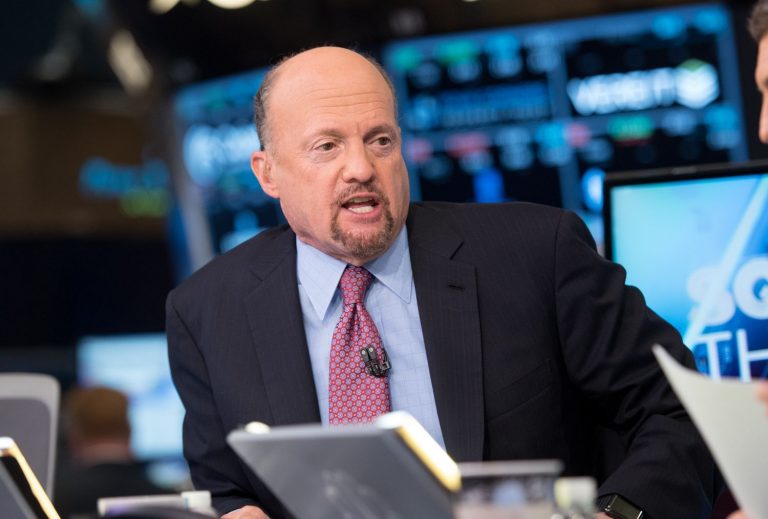
CNBC’s Jim Cramer has delivered a blunt warning to investors eager to declare that Wall Street has found its floor: the market’s fate is not being decided by war headlines or oil shocks, but by interest rates and, more specifically, the bond market’s reading of the Federal Reserve.
Speaking on Mad Money, Cramer argued that if the S&P 500 did indeed bottom on March 30, the turning point had little to do with corporate fundamentals or even the escalating conflict in the Middle East.
Instead, he traced the reversal to remarks from Jerome Powell at Harvard University, where the Fed chair signaled that the central bank was not preparing to raise rates immediately, even as oil prices surged.
Register for Tekedia Mini-MBA edition 20 (June 8 – Sept 5, 2026).
Register for Tekedia AI in Business Masterclass.
Join Tekedia Capital Syndicate and co-invest in great global startups.
Register for Tekedia AI Lab.
“That’s how important Powell’s comments were,” Cramer said, noting their impact on bonds, oil, and most importantly, stocks.
That comment, Cramer suggested, was the real catalyst behind last week’s rebound. The point is more consequential than it first appears. In periods of geopolitical stress, investors typically look first to safe-haven flows, oil markets, and defense stocks. Cramer’s thesis is that this cycle is different: the bond market is acting as the primary transmission mechanism through which the war affects equities.
This is because the real fear on Wall Street is not the conflict itself, but what the conflict does to inflation expectations and, by extension, Fed policy. Put simply, the market can absorb bad geopolitical news more easily than it can absorb higher rates.

That is why Powell’s tone mattered. By signaling patience, the Fed effectively calmed fears that the recent oil spike would immediately translate into another round of monetary tightening. That reassurance helped Treasury yields pull back from recent highs, offering relief to equities, particularly the most rate-sensitive sectors.
Higher yields increase the discount rate used to value future earnings, which disproportionately hurts growth stocks, technology names, and sectors trading on long-duration cash flows. Cramer singled out housing, banks, and utilities as particularly vulnerable for this reason.
“If rates were set to go up,” he warned, “we would have begun a bear market of pretty substantial proportions,” pointing to the vulnerability of rate-sensitive sectors like housing, banks, and utilities.

Mortgage-sensitive housing stocks suffer when long-term Treasury yields rise because borrowing costs move higher. Banks face pressure if funding costs climb faster than lending margins. Utilities, often treated as bond proxies because of their dividend profile, lose appeal when yields on Treasuries become more competitive.
In other words, what Powell did was not merely calm the bond market. He stabilized the valuation framework for equities. That is the deeper insight behind Cramer’s warning that investors should not become too comfortable calling a bottom.
A market low driven by a temporary retreat in yields is fundamentally different from a bottom built on stronger earnings visibility, improved economic data, or broad risk appetite.
The former can be fragile. Cramer’s caution is especially relevant because the next major test is earnings season. This week may be light on results, but over the coming weeks, investors will begin to see whether higher energy costs and geopolitical uncertainty are starting to weigh on corporate guidance.
Analysts believe that is where the market’s resilience will be tested. If companies begin to cut outlooks, cite margin compression from fuel costs, or warn about weakening consumer demand, then last week’s bounce could begin to look more like a rates-driven relief rally than a durable bottom.
This is particularly true for sectors exposed to energy and transport costs. Airlines, logistics firms, industrial manufacturers, and consumer-facing companies may offer the first concrete evidence of whether the oil shock is feeding into profitability.
However, there is also a macro layer that makes Cramer’s point even more compelling. Treasury yields have increasingly become the market’s real-time barometer of whether the Iran war evolves into a stagflation risk. Recent moves in the 10-year yield show how quickly markets are repricing inflation fears tied to oil and shipping disruptions.
What Cramer is effectively saying is that stocks are now downstream from bonds. The equity market is not leading. It is reacting. As long as the bond market believes the Fed can remain on hold, stocks can continue to stabilize even in a time of war.
But if yields reverse sharply higher, especially on signs that inflation is becoming embedded, the rally could quickly unravel. This means the bond market, not the headlines from Tehran or Washington, remains in charge.
“The bond market is in charge of the stock market, even in a time of war,” Cramer said,