

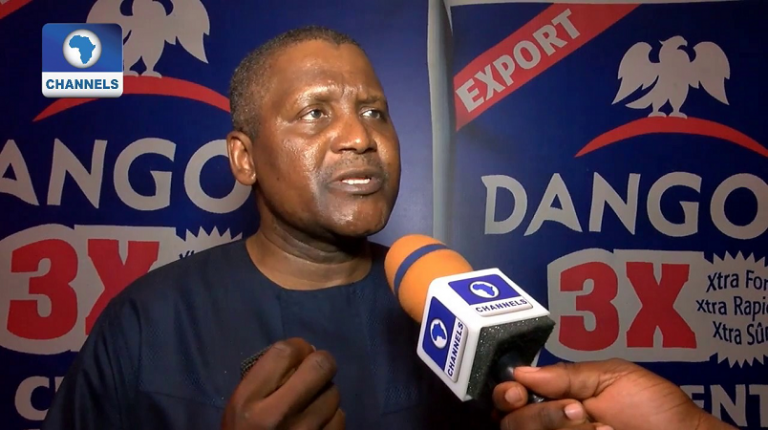
Nigerian billionaire industrialist Aliko Dangote has offered a detailed explanation for why cement produced in Nigeria often sells for less abroad than it does at home, explaining that the country’s heavy tax burden and regulatory structure, rather than production inefficiencies, are the primary drivers of high domestic prices.
In an exclusive interview with Business Insider Africa, Dangote said Nigeria’s fiscal framework places multiple layers of taxes and levies on locally sold cement, sharply inflating prices for domestic consumers. By contrast, cement exported from Nigeria enjoys extensive exemptions, allowing it to compete favorably with products from global manufacturing hubs such as Turkey, Russia, and China.
The issue has become increasingly contentious as Nigerians struggle with rising construction costs and the government pushes large-scale infrastructure and housing projects. Public debate has intensified around why a commodity produced locally, using largely domestic raw materials, remains priced beyond the reach of many Nigerians while being sold more cheaply overseas.
Register for Tekedia Mini-MBA edition 20 (June 8 – Sept 5, 2026).
Register for Tekedia AI in Business Masterclass.
Join Tekedia Capital Syndicate and co-invest in great global startups.
Register for Tekedia AI Lab.
Dangote said the discrepancy becomes clear when one looks at the cost structure behind each bag of cement.
“When you look at my invoice, the cement I export is cheaper than the one I’m selling domestically, because that’s how exports work,” he said. “In export I’m saving a lot of money. I’m not paying 30% income tax, I’m not paying 2% education, I’m not paying 1% health, I’m not paying 7.5% VAT, and I’m not paying 10% withholding tax.”
According to him, these exemptions significantly reduce production costs for export markets, while domestic sales must absorb income tax, value-added tax, sector-specific levies, and other statutory charges. The cumulative effect, he said, is that Nigerian consumers end up paying more to compensate for structural inefficiencies embedded in the tax system.

Dangote stressed that expanding local manufacturing capacity alone is not enough to bring down prices if the operating environment remains unchanged. He noted that without reforms to taxation and regulation, manufacturers have limited room to reduce prices sustainably, regardless of scale or efficiency gains.
His comments come amid mounting pressure from policymakers who have repeatedly called on cement producers to lower prices, citing improved macroeconomic conditions. In February 2025, Nigeria’s Minister of Works, Senator Dave Umahi, urged manufacturers to cut prices to about N7,000 per 50kg bag. Umahi pointed to a stabilizing naira, trading around N1,400 to the dollar at the time, and falling petrol prices as evidence that cost pressures had eased.
Umahi criticized cement prices that were hovering around N9,500, noting that manufacturers had raised prices sharply when the naira weakened to nearly N2,000 per dollar but had not adjusted them downward as the currency recovered. He warned that persistently high cement prices were undermining the government’s infrastructure plans, particularly road construction projects that rely on concrete pavements for durability.

He also cautioned that some contractors were already considering reverting to asphalt, which is cheaper upfront but less durable over time, because of the high cost of cement. Such a shift, he said, could increase long-term maintenance costs for the government.
Umahi isn’t the only government official to publicly criticize cement manufacturers. In February 2024, the Minister of Housing and Urban Development, Musa Dangiwa, accused cement manufacturers of exploiting foreign exchange volatility to justify steep price increases. At the time, cement prices had jumped from about N5,500 to nearly N10,000 per bag, raising alarms about affordability and the viability of government-backed housing programmes.
Dangiwa warned that rising cement costs threatened the ministry’s housing delivery targets, particularly for low- and middle-income earners, and urged manufacturers to innovate and cut inefficiencies instead of passing rising costs directly to consumers.
Despite these calls, cement prices have remained elevated. Market surveys show that a 50kg bag currently sells for between N9,500 and N10,200, depending on location. The high prices have had ripple effects across the economy, pushing up the cost of housing, private construction, and public infrastructure projects.
Dangote’s intervention reframes the debate by shifting focus from manufacturers’ pricing decisions to Nigeria’s broader policy environment. While critics continue to argue that dominant players in the cement market wield significant pricing power, his remarks highlight a deeper challenge facing Nigeria’s industrial sector: how overlapping taxes, levies, and regulatory costs often erode the benefits of local production, leaving consumers to bear the burden.
Amid the government’s need for revenue and its goal to boost industrial output and affordability, Dangote’s comments add urgency to calls for a review of fiscal policies that may be undermining domestic competitiveness and worsening the cost-of-living pressures faced by Nigerians.