

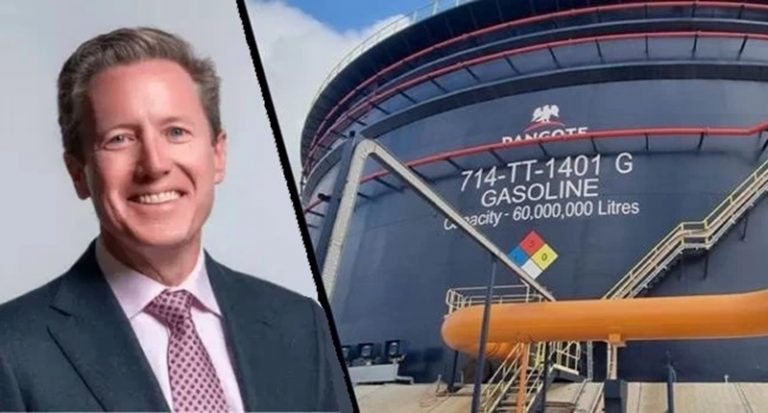
The Dangote Petroleum Refinery and Petrochemicals has appointed David Bird as Chief Executive Officer of its petroleum and petrochemicals division, a move that not only marks a critical leadership shift for Africa’s largest privately-owned refinery but has also stirred conversation over the capacity of Nigerians for the top leadership roles.
Bird, a seasoned British oil executive, assumed the role in July 2025, bringing decades of high-level global industry experience. He spent nearly 20 years with Shell, overseeing some of its most complex operations, including the landmark Prelude Floating LNG facility in Australia — the first of its kind in the world. He later took on senior positions at Oman’s Duqm Refinery and Australian energy giant Santos Ltd, where he led production operations and supply chain efforts.
With degrees from Imperial College London and Stanford University, Bird has now been tasked with steering the Dangote Refinery through its critical growth phase — a time when Nigeria is banking on the refinery to finally ease its chronic fuel import dependence, stabilize local supply, and position itself as a fuel-exporting nation.
Register for Tekedia Mini-MBA edition 20 (June 8 – Sept 5, 2026).
Register for Tekedia AI in Business Masterclass.
Join Tekedia Capital Syndicate and co-invest in great global startups.
Register for Tekedia AI Lab.
In a LinkedIn post cited by S&P Global, Bird pledged to focus on “maximizing operational output and commercial competitiveness,” while also eyeing expansion into other African markets.
But Bird’s appointment has also reopened an uncomfortable conversation about why, after over 60 years of being Africa’s top oil producer, Nigeria appears unable to produce leadership for its most strategic downstream project. There appears to be deep-rooted concerns over the dominance of foreign professionals in Nigeria’s most ambitious industrial venture and the broader implications for indigenous capacity in the oil and gas sector.
Industry chatter quickly turned to questions of competence — or the lack—with critics saying that the refinery’s leadership structure, now firmly in the hands of expatriates, signals a damning indictment of Nigeria’s oil industry training, management, and oversight capabilities. Many pointed to the decades-long failure of state-owned refineries — in Warri, Port Harcourt, and Kaduna — as proof that the country lacks the expertise to run a complex facility of Dangote’s scale.

These state-run facilities have swallowed billions of dollars in failed turnaround maintenance projects since the 1990s, with little to no output to show. None has produced refined fuel at scale in more than two decades.
Against this backdrop, Bird’s appointment is based on operational credibility and the competence required to run a $19 billion project.
Foreigners have been at the helm of Dangote’s oil ambitions from the outset. Edwin Devakumar, an Indian national, has served as Vice President of Oil and Gas at Dangote Group since March 1, 2024, overseeing strategic direction and the buildout of refining operations. Devakumar, who has worked with the group for over two decades, is one of Aliko Dangote’s most trusted lieutenants and played a central role in the engineering, design, and planning of the refinery.

The refinery itself — located in the Lekki Free Trade Zone, Lagos — is the largest single-train refinery in the world, with a processing capacity of 650,000 barrels per day. Its complex houses 435 MW of power generation capacity, a fertilizer plant, petrochemical units, and an integrated export terminal. It began producing diesel and aviation fuel in 2024, with petrol production commencing in September of the same year.
With its aim to dominate the Nigerian oil market and significantly curtail petrol imports, the Dangote Group announced that it will deploy 4,000 compressed natural gas (CNG)-powered trucks to move fuel across Nigeria starting August 15.
Meanwhile, Aliko Dangote continues to pursue international deals, including a partnership with U.S.-based Premier Product Marketing LLC to export petrochemicals and a joint venture with Emirati firm G42 to construct a major data center in Abu Dhabi, further highlighting the group’s increasing global footprint and internationalization strategy.
While the optics of having a non-Nigerian leadership team steering the country’s flagship refinery project have not sat well with many, the bigger question is whether Nigeria is ready for the recalibration that will produce competent indigenous hands in its oil sector.