

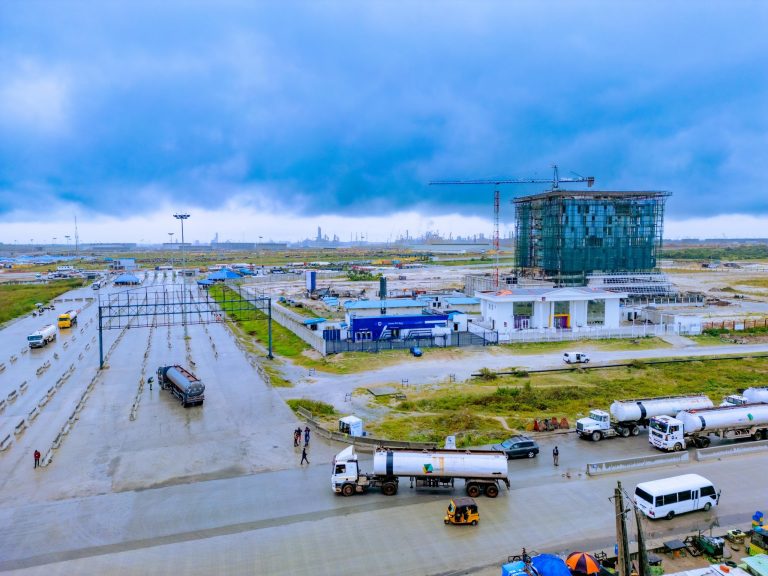
The Dangote Petroleum Refinery has announced that it will commence nationwide distribution of Premium Motor Spirit (PMS) and diesel starting August 15, 2025, marking a major shift in Nigeria’s downstream petroleum market.
In what industry experts are calling a bold intervention, the company has committed to providing free logistics support to registered petrol dealers, fuel marketers, manufacturers, telecom firms, aviation companies, and other large fuel consumers nationwide.
The announcement, made via the company’s official X (formerly Twitter) account on Sunday, includes the deployment of 4,000 brand-new Compressed Natural Gas (CNG)-powered tankers and the rollout of daughter booster stations and distribution hubs nationwide. These facilities will be supported by more than 100 additional CNG-powered trucks to ensure last-mile delivery, particularly in rural and underserved regions.
Register for Tekedia Mini-MBA edition 20 (June 8 – Sept 5, 2026).
Register for Tekedia AI in Business Masterclass.
Join Tekedia Capital Syndicate and co-invest in great global startups.
Register for Tekedia AI Lab.
“The Dangote Petroleum Refinery is pleased to announce the commencement of a significant national initiative designed to transform Nigeria’s fuel distribution landscape,” the company said. “Effective August 15, 2025, we will begin the distribution of PMS and diesel to major users with free logistics to boost the nationwide distribution network.”
Dangote Is Filling the Vacuum Left by Petroleum Equalization Fund
Energy analyst Kelvin Emmanuel has hailed the initiative as “fantastic,” describing it as a strategic step that will create price uniformity across the country.
“Dangote is now assuming the role of the Petroleum Equalization Fund that was established in 1975 by General Yakubu Gowon with Decree number 9 and amended in 1989 by General Ibrahim Babangida through Decree number 32,” Emmanuel explained. “It was eventually collapsed into the Petroleum Industry Act (PIA) as bridging allowances when PEF was merged with PPPRA and DPR to form the Nigerian Midstream and Downstream Petroleum Regulatory Authority (NMDPRA).”

He said that for years, the NMDPRA has failed to publish bridging allowances, largely because it cannot reconcile the disparity between reported fuel consumption and the volume of fuel actually lifted.
“For you to publish bridging costs, there has to be alignment between the revenues generated from actual consumption and the total amount of product lifted. The mismatch is proof that Nigeria doesn’t consume the 60 to 70 million liters per day that’s often claimed,” Emmanuel said.
According to him, this initiative could help the government establish a more accurate picture of Nigeria’s actual fuel consumption, which he estimates does not exceed 30 million liters daily.

The Dangote Refinery is offering petrol station owners a two-month window to register directly with the company to receive products on CIF (Cost, Insurance & Freight) terms. By doing so, Dangote is effectively cutting out the dominance of depot owners and fuel import lobbyists, who have long wielded disproportionate influence in the fuel distribution value chain.
“This move will help station owners boycott the middleman monopoly,” Emmanuel said. “Depot owners can no longer layer on arbitrary ‘system costs’, hoard products to create artificial scarcity, or distribute off-spec petrol that falls short of approved sulphur limits or has anti-knocking issues — all of which have plagued the market in the name of ‘Africa spec’.”
He added that this direct-to-station delivery model will enhance product quality, stabilize nationwide pricing, and limit inflationary pressures — especially considering that energy accounts for approximately 20% of Nigeria’s Consumer Price Index (CPI) basket.
Also, the refinery’s free delivery plan will reduce logistics costs for retailers and manufacturers, helping to revive dormant petrol stations and increase access to energy in rural areas. The refinery aims to support small and medium-sized enterprises (SMEs), create jobs, and improve price stability across sectors dependent on fuel by lowering fuel distribution costs.
In addition to supporting industrial production, the move is also expected to strengthen investor confidence in Nigeria’s downstream sector by eliminating long-standing inefficiencies and bringing more transparency to pricing and supply.
Bulk buyers who purchase a minimum of 500,000 liters will be eligible for an additional 500,000 liters on credit, repayable within two weeks and backed by a valid bank guarantee — a liquidity cushion likely to support smaller operators seeking to scale their distribution capacity.
The Obstacles that Fueled The Initiative
The decision is believed to have been fueled by operational inconsistencies hampering the distribution of petroleum products. For instance, the Independent Petroleum Marketers Association of Nigeria (IPMAN), South-West Zone, has already directed its transporters to withdraw from the Lekki-Epe corridor starting June 16, 2025, in protest against a new N12,500 E-Call-up fee imposed by the Lagos State Government.
The association says that the levy is arbitrary and could result in harassment of its members, with the potential to disrupt loading and delivery operations from key depots.
The Dangote Refinery’s initiative is poised to offer a timely alternative to such bottlenecks, creating a new model of distribution that is less vulnerable to regulatory friction and more focused on efficiency.
In addition to the short-term benefits, analysts say the Dangote distribution programme could signal the beginning of a structural shift in Nigeria’s fuel logistics. Dangote is believed to be effectively building a private-sector-led framework that may pressure regulators and policymakers to either reform or get out of the way, by assuming roles traditionally left to public agencies, from supply chain management to price equalization.
The refinery’s nationwide rollout is also expected to help authorities crack down on fuel diversion, smuggling, and subsidy-related fraud by providing a more transparent and traceable distribution process.