

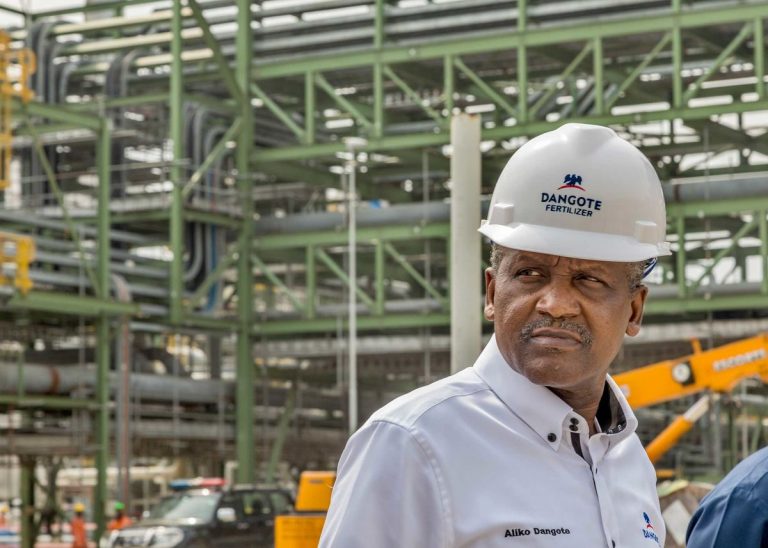
Africa’s richest man, Aliko Dangote, has projected that his vast business empire is on track to hit $30 billion in annual revenue by 2026. But that forecast, delivered at a venture capital forum in Lagos on Thursday, is already colliding with growing global economic instability—most notably, the disruptive trade policies of U.S. President Donald Trump and the resulting slump in oil prices.
Dangote, whose conglomerate spans cement, fertilizer, sugar, and now oil refining, said the group is expected to hit $25 billion in revenue next year, before adding another $5 billion by 2026, driven primarily by his new 650,000 barrels-per-day refinery in Lagos. That refinery, he stressed, would be a major foreign exchange earner, helping Nigeria reduce reliance on fuel imports and becoming a dominant force in petroleum exports.
But there’s a hitch. Trump’s renewed tariff wars are already rippling through global supply chains, and the oil market has begun to feel the strain. Last month, the international benchmark Brent crude slipped below $60 per barrel, its lowest point in nearly a year, reflecting a sharp drop in global demand amid rising geopolitical tensions and trade friction triggered by Washington’s aggressive economic nationalism.
Register for Tekedia Mini-MBA edition 20 (June 8 – Sept 5, 2026).
Register for Tekedia AI in Business Masterclass.
Join Tekedia Capital Syndicate and co-invest in great global startups.
Register for Tekedia AI Lab.
This drop in oil prices casts a shadow over the very asset Dangote expects to power the group’s next growth chapter.
While the U.S. administration has so far excluded oil and gas from its latest wave of tariffs, the indirect damage is already evident. China, Europe, and other major markets have reduced energy purchases as they brace for a slowdown while manufacturing output has declined in key economies—two symptoms of a contracting global trading environment. All this means fewer buyers, lower prices, and increased competition.
Dangote did not ignore the turbulence entirely. He admitted that his fertilizer business, another crucial export arm, was briefly at risk due to U.S. tariff adjustments.

“I was worried about the U.S. tariff because 37% of our urea goes to the U.S.,” he said. “Luckily for us, Algeria was slapped with 30% tariffs.”
That stroke of fortune gave Nigerian urea a price advantage, but analysts warn that advantage could be fleeting, given how easily Washington’s policy shifts.
Meanwhile, Nigeria’s broader trade relationship with the U.S. hangs in the balance. A report by Strategy&, the consulting arm of PwC, warns that Nigeria could soon lose key trade privileges under the African Growth and Opportunity Act (AGOA), which allows duty-free exports to the U.S. The Trump administration has floated a review of AGOA, citing a need to protect American industries and reduce deficits. Nigeria, which exported $1.76 billion worth of goods under AGOA in 2024, mostly crude oil and agricultural produce, would be hard hit by any withdrawal.

Dangote told investors that the group’s cement production would rise to 62 million metric tons by next year, up from the current 53 million, putting his company ahead of Egyptian rivals and making it Africa’s largest cement producer. With total group assets now valued at $27.5 billion, according to the Bloomberg Billionaires Index, the business remains formidable in size and scope.
“We will be number one,” he said, referring to the group’s cement expansion. “We are building for the long term.”
However, questions persist about whether that scale is sufficient to weather a global downturn. Analysts are particularly skeptical about revenue targets tied to oil exports at a time when the market is growing more volatile.
The situation is particularly concerning for Nigeria, which is relying on Dangote’s refinery to ease pressure on its currency and reduce its crude-for-fuel swap bills, the stakes are even higher. The refinery is expected to curb the outflow of foreign exchange by replacing imported fuel with locally refined products, while simultaneously earning dollars from exports. But if global oil demand shrinks, or if U.S. protectionism intensifies, the expected gains may not materialize.
Nigeria’s policymakers are watching closely. According to the Strategy& report, titled Global Economic Policy Changes and Implications for Nigeria, the country must now develop contingency plans for a world where U.S. markets are less accessible. That could mean strengthening regional trade within Africa, speeding up refinery product standardization to meet European export requirements, and exploring non-oil exports.