

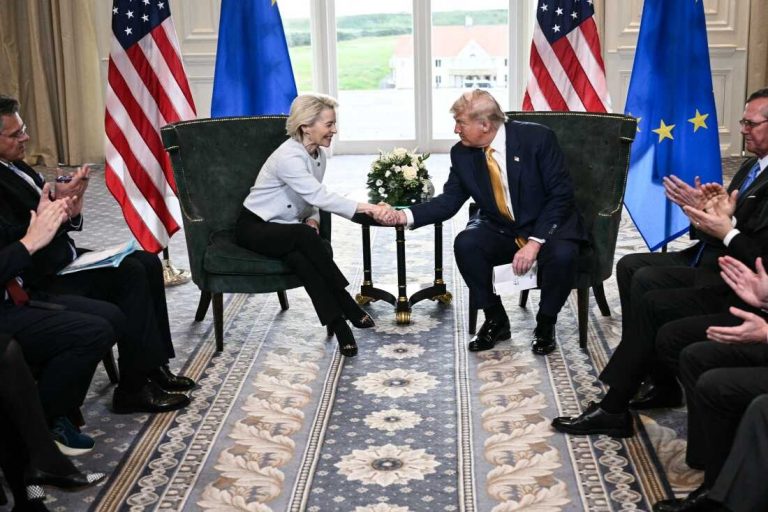
The European Parliament has suspended ratification of the 2025 EU-U.S. trade agreement after Washington imposed new universal tariffs, with Bernd Lange warning the bloc is prepared to act if the deal is undermined.
Transatlantic trade relations have entered a renewed phase of uncertainty after the European Parliament paused ratification of the 2025 EU-U.S. trade agreement, citing concerns that Washington’s latest tariff actions breach the spirit and letter of the deal.
Bernd Lange, chair of the European Parliament’s international trade committee, told CNBC that the United States has altered agreed tariff commitments multiple times since the deal was concluded last summer.
Register for Tekedia Mini-MBA edition 20 (June 8 – Sept 5, 2026).
Register for Tekedia AI in Business Masterclass.
Join Tekedia Capital Syndicate and co-invest in great global startups.
Register for Tekedia AI Lab.
“We wanted to have really stability and predictability. And unfortunately, the government, the president of the United States, has really made a breach of this deal several times,” Lange said.
The immediate trigger was the imposition of a universal 10% levy on all imports, announced by President Donald Trump after the Supreme Court of the United States struck down his earlier “reciprocal” tariffs. Trump has since indicated the rate will rise to 15%, although no formal timeline has been provided.
What the 2025 Agreement Was Meant to Deliver
The 2025 trade accord was framed as a stabilizing reset after years of tariff disputes. It set a baseline 15% tariff on most EU goods entering the U.S., while carving out exemptions for selected sectors. Steel and aluminum, along with certain derivative products, were subject to a higher 50% levy.

The architecture of the deal aimed to lock in predictability for exporters, manufacturers, and investors on both sides of the Atlantic. For the EU, it was intended to protect small and medium-sized enterprises that are particularly sensitive to tariff volatility.
Lange argues that weeks after the agreement was finalized, Washington raised tariffs on roughly 400 derivative products from 15% to 50%, creating what he described as material harm to European SMEs.
“We are sticking to the deal. A deal is a deal,” he said. “But on the U.S. side, there was a breaking [of the agreement] some weeks after the deal was concluded.”

From Brussels’ perspective, the introduction of a universal tariff layered on top of sector-specific rates effectively restructures the trade environment that negotiators had sought to stabilize.
The Supreme Court’s intervention complicates the legal terrain. While the ruling curtailed the administration’s earlier tariff mechanism, the White House responded with a new structure rather than retreating from its broader trade posture.
U.S. Trade Representative Jamieson Greer suggested over the weekend that the administration’s policy orientation remains intact and that previously negotiated trade arrangements are still operative. European officials, however, are seeking written assurances clarifying whether the new tariff regime overrides or coexists with the 2025 agreement.
This uncertainty has direct commercial implications. Companies that structured contracts and supply chains around agreed tariff levels now face shifting cost assumptions. For industries such as automotive manufacturing, pharmaceuticals, chemicals, and aerospace — all heavily integrated across the Atlantic — even marginal tariff changes can alter investment decisions and pricing models.
The Anti-Coercion Instrument: A Dormant but Potent Tool
Within the EU, debate has turned to the possible activation of the bloc’s Anti-Coercion Instrument (ACI), a legislative mechanism designed to counter economic pressure from third countries.
The ACI would allow Brussels to restrict access to EU public procurement markets, impose export or import controls, and potentially limit foreign direct investment flows. Although often described as a “nuclear” trade measure, it has never been deployed.
Lange indicated that while the instrument remains available, its use is not imminent.
“I would not call it bazooka … It’s a normal legislation for a specific case,” he said. “At the moment, I see the case is not given [to use it], but we have it on the table. If necessary, we will use it.”
Member states are divided. Export-driven economies such as Germany and Italy are cautious about escalation, given the scale of transatlantic trade and the exposure of their industrial sectors to U.S. demand. France has been more vocal about maintaining leverage.
Economic Stakes on Both Sides
The U.S. and EU together account for one of the largest bilateral trade relationships globally, spanning goods, services, and investment flows. The integration is particularly dense in high-value sectors where components cross borders multiple times before final assembly.
A universal 10% — potentially 15% — tariff alters the cost calculus across that network. European exporters face higher entry costs into the U.S. market, while American importers may pass increased costs to consumers or absorb them through margin compression.
President Trump warned Monday that countries that “want to play games” could face higher duties in the coming months, reinforcing the prospect of additional measures.
The core issue is not solely the level of tariffs for Brussels but the predictability of policy. The 2025 agreement was designed to anchor expectations over a multi-year horizon. Lange has called for formal assurances that no further tariff changes will be introduced for at least three years.
“We need clarity,” he said.
The pause in ratification places the dispute squarely within the EU’s institutional framework. Without parliamentary approval, full implementation of the agreement cannot proceed, limiting legal certainty for businesses.