

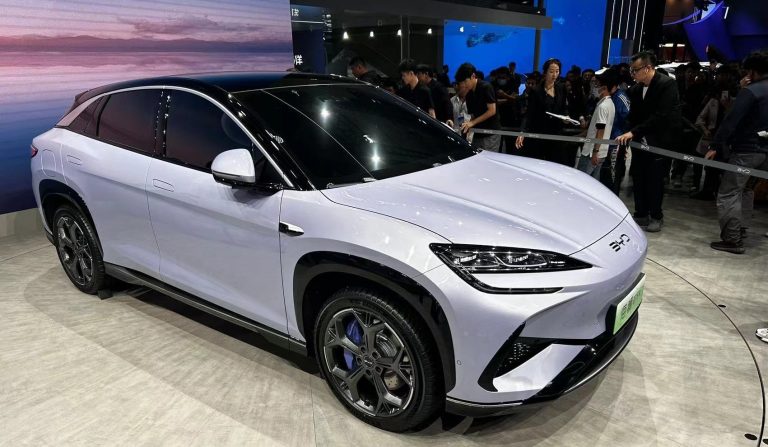
The European Union has asked China to voluntarily restrict exports of hybrid vehicles to the bloc as Brussels seeks to contain a widening trade imbalance with Beijing without triggering a broader trade war, the Financial Times reported on Thursday.
Under the proposal, China would limit sales of Chinese-made hybrid vehicles to roughly 15% of the European Union market, according to people familiar with the discussions cited by the newspaper.
The request marks a significant shift toward negotiated trade management as the EU confronts a surge in Chinese exports across several industrial sectors. Brussels is becoming more concerned that China’s manufacturing capacity is allowing Chinese companies to expand rapidly in European markets at a time when European manufacturers are struggling with weak demand, high costs and the transition to cleaner technologies.
Register for the next Tekedia Mini-MBA.
Register for Tekedia AI in Business Masterclass.
Join Tekedia Capital Syndicate and co-invest in great global startups.
“If they will not limit their exports to our market then we will,” the FT quoted an EU official as saying. “This is about stopping deindustrialisation. We have to act. It’s about managed trade.”
The proposal reportedly extends beyond automobiles. The EU has also asked China to consider limiting exports of other products, including chemicals, while seeking greater Chinese purchases of European goods as part of efforts to narrow the trade imbalance.
The approach would effectively seek to manage the two-way flow of goods rather than relying exclusively on tariffs or other unilateral trade restrictions.

Brussels Confronts a New “China Shock”
European Commission President Ursula von der Leyen sharpened the bloc’s criticism of China on Wednesday, telling the European Parliament that the EU would use every available tool to address what she described as an “unsustainable” trade deficit with Beijing.
The EU’s goods trade deficit with China reached €360.6 billion ($413.4 billion) last year, according to von der Leyen, and widened by 9% during the first six months of this year.
She described the deterioration as a tipping point and warned that Europe was experiencing a second “China shock” through deindustrialisation.

The language captures the central economic concern behind Brussels’ growing aggressive trade posture. European officials are not simply worried about individual Chinese products gaining market share. They are concerned that sustained import growth in sectors such as electric vehicles, batteries and chemicals could weaken domestic manufacturing capacity, investment and employment in industries considered important to Europe’s industrial base.
The hybrid-car proposal also highlights how quickly the trade dispute is expanding beyond electric vehicles.
China has become a major force in global electric and electrified vehicle manufacturing, supported by a large domestic market, extensive battery production and a dense industrial supply chain. European automakers have been competing with Chinese manufacturers while simultaneously investing heavily in the transition away from conventional internal-combustion vehicles.
The challenge for Brussels is to protect European industrial capacity without making European consumers bear the full cost through higher prices or provoking retaliatory measures from Beijing. That helps explain the attraction of a negotiated export ceiling. A voluntary limit could give European manufacturers more room in their domestic market while allowing China to avoid the escalation associated with unilateral EU restrictions.
But such an arrangement would also signal a departure from the EU’s traditional emphasis on open competition and market access. Managing import volumes through negotiated quotas risks creating a more controlled trading relationship in which governments, rather than market forces alone, determine how much foreign production can enter key industries.
China Rejects Overcapacity Accusations
European officials say the surge in Chinese exports of vehicles, batteries, chemicals and other manufactured products is being driven in part by excess industrial capacity in China.
Beijing rejects that characterization, saying that Western concerns over Chinese overcapacity and economic imbalances are protectionist measures designed to restrict China’s industrial development.
That disagreement is at the heart of the broader EU-China trade dispute.
From China’s perspective, companies that have invested heavily in manufacturing and developed competitive supply chains should be able to sell those products abroad. From the European perspective, the rapid expansion of Chinese exports can become destabilizing when production capacity grows faster than domestic demand and the resulting surplus is directed toward foreign markets.
The dispute has become complicated because Europe’s trade deficit with China is not limited to consumer goods. Chinese companies increasingly compete in industrial technologies that Europe has historically regarded as areas of manufacturing strength.
The EU is therefore seeking a combination of measures. Alongside proposed export restraints, Brussels wants China to purchase more European products, potentially providing European companies with greater access to the Chinese market and helping reduce the imbalance from both sides of the trade equation.
European Trade Commissioner Maros Sefcovic is leading talks with China and has said he wants tangible results by October. He is expected to visit China by early next month. The timetable adds urgency to the negotiations. If talks fail to produce concessions, the EU could move toward more aggressive trade measures, increasing the risk of retaliation from Beijing.
That possibility is sensitive for European companies with substantial exposure to China. A confrontation could affect not only automakers but also industrial machinery, luxury goods, chemicals and other exporters that depend on the Chinese market.
For China, accepting voluntary limits could reduce the immediate threat of additional European restrictions, but it could also establish a precedent for other trading partners seeking similar concessions.
The proposal therefore sits at the intersection of two competing objectives. Brussels wants to prevent the loss of European industrial capacity while avoiding a damaging trade war. Beijing wants to preserve access to overseas markets without accepting the premise that its manufacturing strength is the result of unfair overcapacity.
The outcome could determine whether the EU-China relationship moves toward negotiated trade management or a more confrontational cycle of tariffs, quotas and retaliation.