

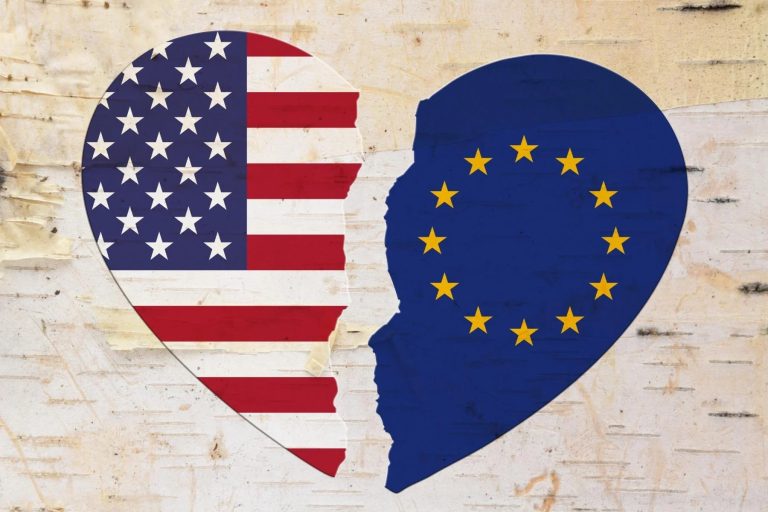
A sharp diplomatic row has erupted between Washington and European capitals after the United States imposed visa bans on five prominent European figures linked to efforts to regulate American technology companies, prompting accusations of “coercion and intimidation” from leaders including French President Emmanuel Macron.
The bans, announced on Tuesday, target Thierry Breton, the former EU commissioner who played a central role in designing the bloc’s Digital Services Act (DSA), alongside four anti-disinformation campaigners based in Germany and the UK. Those affected include Imran Ahmed, chief executive of the US-based Center for Countering Digital Hate; Anna-Lena von Hodenberg and Josephine Ballon of the German non-profit HateAid; and Clare Melford, co-founder of the Global Disinformation Index.
Washington framed the move as a defense of free speech and U.S. interests. Writing on X, U.S. Secretary of State Marco Rubio accused European “ideologues” of leading organized campaigns to pressure American platforms into suppressing viewpoints they oppose.
Register for Tekedia Mini-MBA edition 20 (June 8 – Sept 5, 2026).
Register for Tekedia AI in Business Masterclass.
Join Tekedia Capital Syndicate and co-invest in great global startups.
Register for Tekedia AI Lab.
“The Trump administration will no longer tolerate these egregious acts of extraterritorial censorship,” Rubio said, casting the DSA as a threat to freedom of expression and U.S. tech firms.
The response across Europe was swift and unusually unified. France, Germany, Spain, and the UK joined senior EU officials in condemning the bans, while Brussels warned it could “respond swiftly and decisively” if necessary. The episode has added fuel to an already strained relationship between Donald Trump’s administration and the European Union, with artificial intelligence and digital regulation emerging as a new frontline in broader cultural, political, and economic tensions.
Macron denounced the visa bans in forceful terms, calling them an attempt to undermine Europe’s digital sovereignty. In a statement posted on X, he said the measures amounted to “intimidation and coercion” and stressed that EU digital rules were adopted through a democratic process involving both the European Parliament and member states.

“The rules governing the European Union’s digital space are not meant to be determined outside Europe,” he wrote.
Macron later confirmed he had spoken with Breton, thanking him for his work and vowing that Europe would not retreat.
“We will protect Europe’s independence and the freedom of Europeans,” he said.

France’s foreign minister, Jean-Noël Barrot, echoed that stance, arguing that Europeans could not accept external powers dictating the rules of their digital space. Similar language came from Berlin and Madrid. Germany’s justice ministry described the bans as unacceptable and expressed solidarity with the German campaigners, noting that HateAid supports victims of unlawful online hate speech. German foreign minister Johann Wadephul said the DSA was democratically adopted for use within the EU and had no extraterritorial effect.
The DSA, passed in 2022, requires large digital platforms to demonstrate how they are addressing systemic online risks, including illegal content, hate speech, and the manipulation of elections through disinformation. EU officials argue the law is about enforcing existing legal standards in the digital sphere, not censoring speech. Washington, however, sees it as an attempt to impose European norms on U.S.-based companies and users.
Breton, a former French finance minister who served as EU commissioner for the internal market from 2019 to 2024, responded sharply to the U.S. action.
“Is McCarthy’s witch-hunt back?” he asked, pointing out that the DSA was approved by 90% of the European Parliament and unanimously by all 27 member states. “To our American friends: censorship isn’t where you think it is,” he said.
EU Commission President Ursula von der Leyen also weighed in, emphasizing that freedom of speech underpins European democracy and vowing to protect it. A commission spokesperson reinforced that message, warning that the EU would defend its regulatory autonomy against what it described as unjustified measures.
The dispute comes against the backdrop of increasing enforcement of the DSA. Earlier this month, Elon Musk’s X platform was fined €120 million for multiple violations, largely linked to transparency failures, including misleading users over verification checks and restricting researchers’ access to data. The penalty has become a rallying point for U.S. critics of the EU’s regulatory approach, who argue it is designed to weaken American tech giants under the guise of regulation.
In Washington, officials have insisted the EU’s actions amount to undue restrictions on expression, while European leaders counter that safeguarding democratic discourse requires clear rules for powerful platforms. Stéphane Séjourné, who succeeded Breton as commissioner for the internal market, publicly backed his predecessor, saying no sanction would silence the sovereignty of European peoples.
The row has also drawn in politicians and civil society figures. Dennis Radtke, a German MEP from the ruling CDU, questioned why free speech arguments appear to be deployed selectively. Raphaël Glucksmann, a French socialist MEP, accused Washington of confronting democracies while accommodating authoritarian regimes, telling Rubio that Europe must stand up for its laws and interests.
Beyond the immediate dispute, analysts see the episode as emblematic of a deeper shift in transatlantic relations. Michel Duclos, a former senior French diplomat, compared the treatment of Breton with Washington’s engagement with figures linked to Russia, warning that Europe risks being recast as an adversary rather than an ally in U.S. strategic thinking.
The visa bans also revive memories of earlier confrontations. In August, Washington sanctioned a French judge at the International Criminal Court over investigations involving Israeli leaders and U.S. officials, a move that had already unsettled European governments.
As AI and online platforms grow ever more central to economic influence and political discourse, the clash between Europe’s regulatory ambitions and Washington’s defense of U.S. tech interests looks set to intensify, with broader consequences for the future of transatlantic cooperation.