

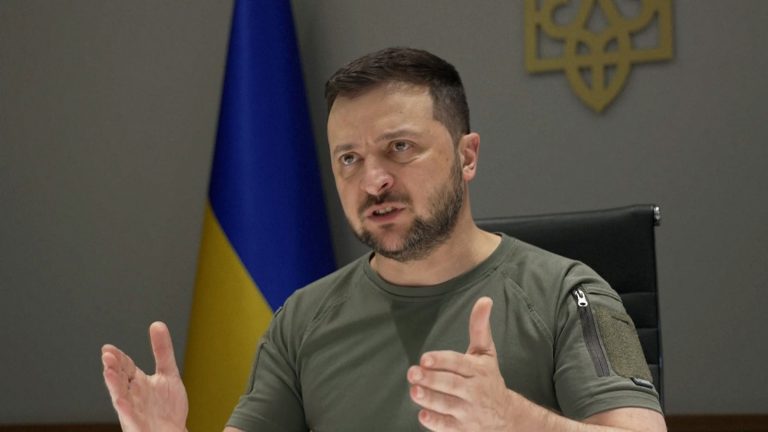
European leaders are heading to Washington to stand beside Volodymyr Zelenskiy as he prepares for another tense meeting with U.S. President Donald Trump, who is pressing Ukraine to accept a swift peace deal with Russia.
The gathering, set for Monday, comes at a critical juncture as Trump, fresh from talks with Vladimir Putin in Alaska, signals a willingness to prioritize a final settlement over a ceasefire — a position that has unnerved many of Kyiv’s allies.
At the heart of the debate is Trump’s push for concessions that could see Ukraine surrender swathes of fortified territory in the east in exchange for limited Russian withdrawals elsewhere, while freezing the existing front lines. According to sources briefed on the Alaska summit, the U.S. and Russia floated proposals for a trade-off that would effectively redraw Ukraine’s borders, raising alarm in European capitals wary of legitimizing Moscow’s territorial gains.
Register for Tekedia Mini-MBA edition 20 (June 8 – Sept 5, 2026).
Register for Tekedia AI in Business Masterclass.
Join Tekedia Capital Syndicate and co-invest in great global startups.
Register for Tekedia AI Lab.
Mikhail Ulyanov, Russia’s envoy to international organizations in Vienna, openly acknowledged that Moscow is open to a peace agreement provided it also secures security guarantees for Russia.
“Many leaders of EU states emphasize that a future peace agreement should provide reliable security assurances or guarantees for Ukraine,” he wrote on social media. “Russia agrees with that. But it has equal right to expect that Moscow will also get efficient security guarantees.”
Trump’s envoy, Steve Witkoff, went further in suggesting that Washington had won a significant concession, saying the U.S. could extend “Article 5-like protection” to Ukraine without full NATO membership — a pledge that could, in theory, deter further Russian aggression. Yet history speaks cautiously. Ukraine was already promised security guarantees under the 1994 Budapest Memorandum when it surrendered its nuclear arsenal, a commitment that failed to prevent Russia’s annexation of Crimea in 2014 and its full-scale invasion eight years later.

For Kyiv, the prospect of trading the Donbas for vague guarantees feels dangerously familiar. Zelenskiy is also under pressure to avoid a repeat of his bruising Oval Office encounter in February, when Trump and Vice President JD Vance accused him of ingratitude in front of cameras. Determined not to be cornered again, Zelenskiy will arrive in Washington with the backing of a united European front.
On Sunday, German Chancellor Friedrich Merz, French President Emmanuel Macron, and British Prime Minister Keir Starmer convened a high-level meeting of allies to rally behind the Ukrainian leader. Their joint communiqué pledged readiness to deploy a reassurance force once hostilities cease, secure Ukraine’s skies and seas, and help rebuild its armed forces. European Commission President Ursula von der Leyen, Italian Prime Minister Giorgia Meloni, and Finnish President Alexander Stubb — who has personally cultivated ties with Trump — will also join the Washington talks, underscoring the symbolic show of unity.
But there are still divisions. Some European leaders argue for an immediate ceasefire, a position Trump initially supported before shifting closer to Moscow’s preference for peace talks without halting the fighting. Poland’s foreign ministry dismissed the idea outright: “You cannot negotiate peace under falling bombs.”

Zelenskiy, for his part, insists that Ukraine’s sovereignty and independence remain non-negotiable. Posting on X, he wrote: “Everyone agrees that borders must not be changed by force. Any prospective security guarantees must really be very practical, delivering protection on land, in the air, and at sea, and must be developed with Europe’s participation.”
Trump, however, continues to frame the conflict in stark terms. “Russia is a very big power, and they’re not,” he told reporters last week, bluntly urging Ukraine to cut a deal. After his Alaska summit, Trump called Zelenskiy to relay that Putin had offered to freeze most front lines if Kyiv ceded all of Donetsk. Zelenskiy flatly rejected the demand, a signal that Monday’s talks could be just as fraught as those before them.
U.S. Secretary of State Marco Rubio has hinted that Washington sees movement in negotiations, though he acknowledged that both sides would have to make painful concessions.
“I’m not saying we’re on the verge of a peace deal,” Rubio told CBS. “But I am saying that we saw enough movement to justify a follow-up meeting with Zelenskiy and the Europeans, enough movement for us to dedicate even more time to this.”
With more than a million casualties since the war began, the stakes in Washington are higher than ever. For Zelenskiy, backed by Europe’s most powerful leaders, the question remains whether Trump’s vision of peace will come at too high a cost for Ukraine’s future.