

As the Osun State governorship election approaches, campaign communication is becoming increasingly emotional. While elections should ideally revolve around competing policy proposals and governance records, a growing pattern has emerged across social media. Political actors and their supporters are attempting to influence voters not only through promises and achievements but also through fear. This strategy, often described as manufactured fear, involves constructing narratives that portray political opponents as threats to communities, democracy and the future of the state.
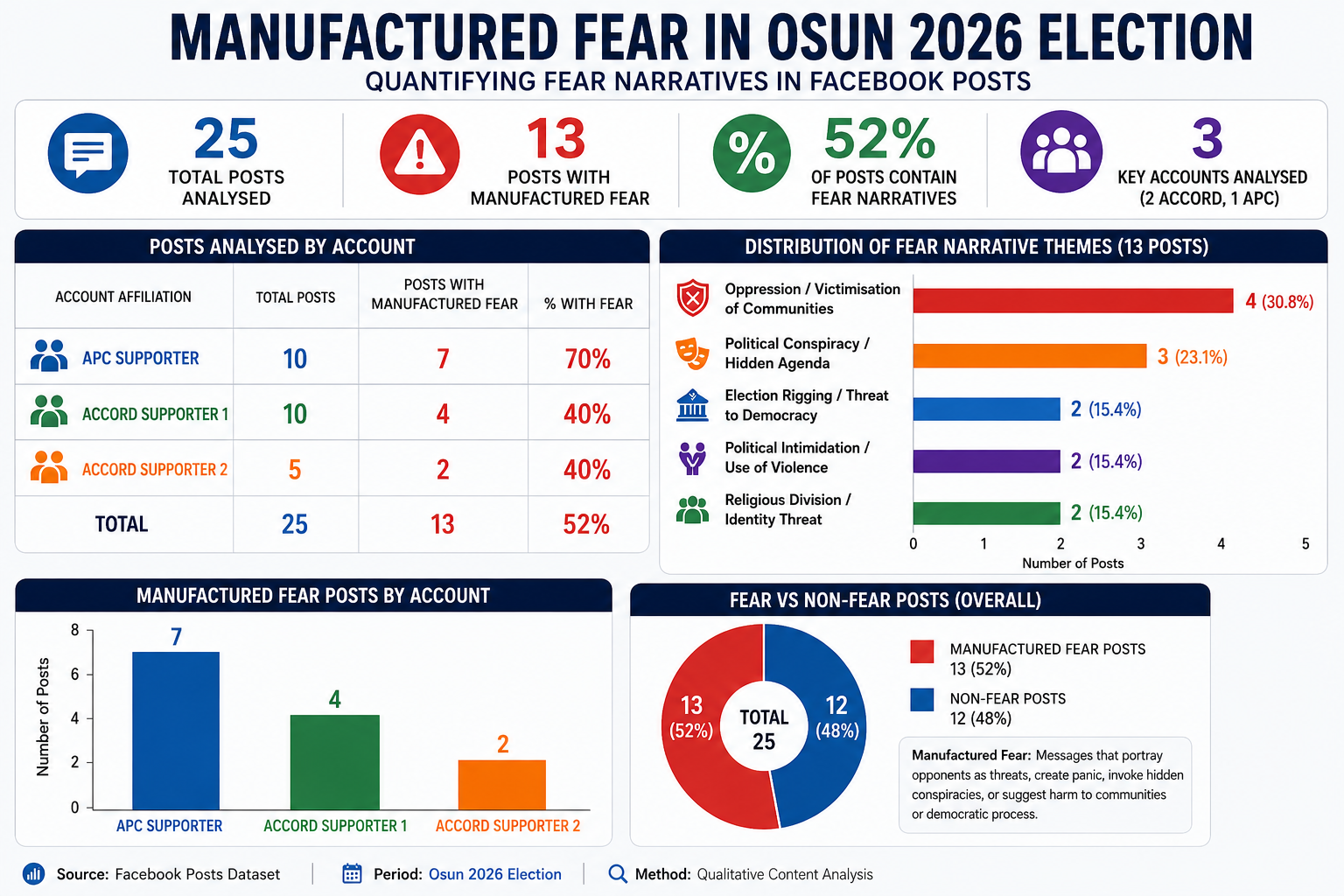
An analysis of Facebook posts from influential supporters of the All Progressives Congress (APC) and the Accord Party shows that manufactured fear has become an important feature of the online campaign. Although many posts focus on endorsements, campaign activities and development achievements, several messages go further by encouraging voters to believe that electing the opposing party would expose them to oppression, instability, deception or intimidation.
One prominent pattern is the portrayal of the incumbent administration as hostile to particular communities. Rather than presenting governance shortcomings as administrative failures, several posts attribute deliberate malice to the government. One message urges voters to support the opposition in order to “rescue the community” from oppression and injustice. Another questions why a particular community has become the target of government “hatred” while alleging deliberate neglect of infrastructure and public services. Such messages transform electoral competition into a struggle for survival by suggesting that communities are being punished because of their political identity. This framing encourages voters to perceive political change not as a democratic choice but as an urgent necessity.
Register for the next Tekedia Mini-MBA.
Register for Tekedia AI in Business Masterclass.
Join Tekedia Capital Syndicate and co-invest in great global startups.
Another recurring strategy is the construction of hidden political conspiracies. Posts alleging that political emissaries offered huge sums of money to induce defections or claiming that senior government officials were preparing to abandon the administration create an impression of widespread instability within government. Whether these allegations are substantiated is less important than their communicative effect. Repeated exposure to such claims encourages citizens to believe that government institutions are collapsing behind the scenes and that the administration is rapidly losing legitimacy.
Supporters of the governing party deploy manufactured fear differently. Rather than portraying the opposition as oppressive, they frame it as a threat to democratic stability and social cohesion. Some posts accuse opposition actors of promoting dangerous religious narratives in an attempt to divide voters. Given Nigeria’s history of religious tensions, such messages invite citizens to associate the opposition with social instability rather than democratic competition. Other posts introduce concerns about electoral manipulation by referring to claims that external political actors could influence the election. Even when such claims are dismissed, their repeated circulation keeps electoral insecurity within public discourse.
Another strand of communication portrays the opposition as increasingly desperate and willing to employ intimidation. Several posts allege the destruction of campaign materials and billboards after unsuccessful political rallies. These messages encourage supporters to interpret political setbacks as evidence that opponents may resort to coercion instead of democratic persuasion. Whether these allegations are ultimately verified is separate from the communication strategy itself. The intended effect is to portray political opponents as willing to undermine peaceful electoral competition.

The analysis also suggests that manufactured fear is not the dominant communication strategy employed by either political camp. Many posts focus on campaign momentum, endorsements by influential individuals, infrastructure projects and criticism of opponents’ performance. However, the fear narratives stand out because they redefine elections as contests between safety and danger rather than between competing policy alternatives. Voters are encouraged to believe that failure to support one candidate could expose their communities to oppression, corruption, violence or social division.
Perhaps the most significant finding is that both political camps construct different versions of fear while pursuing the same objective. Opposition-aligned messages depict the incumbent administration as vindictive, discriminatory and hostile to dissenting communities. Pro-government messages portray the opposition as deceptive, intolerant and prepared to undermine democratic norms through intimidation or divisive identity politics. In both cases, electoral choices are framed less around governance performance than around avoiding perceived threats posed by political opponents.
This communication strategy carries significant implications for democratic consolidation in Osun State. When political actors consistently present rivals as existential threats, public trust in democratic institutions begins to erode. Elections become less about evaluating policies and more about defeating perceived enemies. Such narratives deepen political polarisation, increase suspicion between supporters of rival parties and make post-election reconciliation more difficult.

As campaigning intensifies ahead of the Osun 2026 election, political parties, candidates and their supporters should recognise that every message shared online contributes to the broader democratic environment. Robust criticism and political competition are essential features of democracy, but campaigns that deliberately amplify fear risk weakening the very democratic institutions they seek to control. The long-term health of Osun’s democracy will depend not only on the credibility of the election itself but also on the quality of political communication that shapes citizens’ choices before they cast their votes.