

Benfica Unveils Bold ‘Benfica District’ Plan to Transform Lisbon’s Stadium of Light

Quote from Alex Bobby on September 4, 2025, 8:06 AM
Lisbon's Stadium of Light Set to Become 'Benfica District' in Radical Redesign
For decades, Lisbon’s Estádio da Luz, or Stadium of Light, has been more than just the home of S.L. Benfica—it has stood as a place of gathering, faith, and identity for the club’s millions of supporters. Much like a place of worship, a stadium is a space where rituals are performed, hopes are invested, and memories are created. That is why Benfica’s ambitious plans to redesign their iconic stadium and its surroundings are being framed not just as an architectural upgrade, but as a cultural transformation.
The new project, titled the “Benfica District”, is the brainchild of club president Rui Costa and aims to turn the stadium into a world-class destination for sport, leisure, and community life. If all goes to plan, work will begin in mid-2027 and be completed in time for the 2030 FIFA World Cup, which Portugal will co-host alongside Spain and Morocco.
A Vision Rooted in Comfort and Connectivity
At the heart of the masterplan is the commitment to “comfort and connectivity.” This is not only about increasing the stadium’s capacity but also about reshaping the entire matchday and everyday experience for supporters. The Estádio da Luz, inaugurated in 2004 and already a modern venue by European standards, will be given a bold new look and feel to ensure it remains one of the continent’s premier stadiums for decades to come.
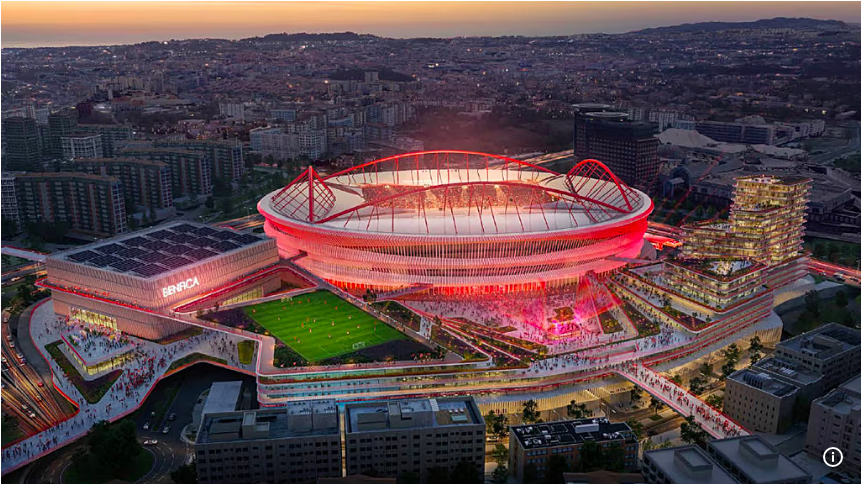
The capacity will be boosted to 70,000 seats, further cementing its reputation as one of the largest stadiums in Europe. A new façade will encircle the arena, designed to provide shade for concourses and enhance the comfort of fans. Additionally, a fourth floor will be added to the structure, offering 6,800 square metres of premium hospitality and office space, reflecting the growing demand for stadiums to double as commercial hubs.
Beyond Football: A True District
The “Benfica District” is about far more than expanding a football ground. The plan includes the construction of three new multi-purpose pavilions, with one set to become a state-of-the-art indoor sports arena seating up to 2,500 people. This space will cater to basketball, volleyball, handball, futsal, roller hockey, and even boxing, underlining Benfica’s commitment to being a multi-sport institution.
The current swimming pool will be replaced with a new community pool, while an outdoor football pitch and running track will be added, encouraging local residents and members to stay active. A new theatre and event space, with capacity for 500 spectators, will also rise within the complex, creating opportunities for cultural and artistic programming alongside sporting events.
A New Square for Fans
Perhaps the most symbolic addition to the “Benfica District” will be the creation of a vast new square adjacent to the stadium. This gathering place, designed to hold more than 10,000 fans, will feature a DJ booth, shops, and restaurants with outdoor terraces.
It will serve as a vibrant meeting point before and after matches, but also as a destination in its own right on non-match days. Here, fans will also encounter the relocated statue of Eusébio, the club’s greatest icon, which will stand proudly at the entrance of this new space, greeting visitors and linking the project to Benfica’s rich history.
Architects of Change
The redesign will be carried out by Populous, the global architecture firm behind many of the world’s most iconic stadiums, including Tottenham Hotspur Stadium and the Emirates in London. Populous also designed the Estádio da Luz’s original incarnation in 2004. Working alongside them will be Portuguese firm Saraiva + Associados, ensuring the project carries both international expertise and local cultural grounding.
Tom Jones, senior principal and project architect at Populous, described the masterplan as a “new benchmark” for how stadiums can serve communities. “Estádio da Luz will not just be a home for Benfica’s proud history, but a catalyst for its vibrant future,” Jones said.
Costs and Concerns
The full financial details of the project have not yet been disclosed, though early estimates suggest a price tag between €200 million and €300 million. This scale of investment reflects Benfica’s ambition to cement its position not only as Portugal’s leading football club but also as a major cultural and sporting institution on the global stage.
Of course, such radical redesigns can be met with caution from supporters. Just as with religious spaces, fans develop deep personal bonds with stadiums—bonds tied to memory, routine, and emotion. Benfica’s leadership will need to carefully manage the balance between modernisation and tradition, ensuring that the essence of Estádio da Luz is preserved even as it is transformed.
A Beacon for 2030 and Beyond
The timing of the project is no coincidence. With the 2030 World Cup on the horizon, Benfica and Lisbon will be under the global spotlight. The “Benfica District” is designed to ensure that the stadium is not only a venue for unforgettable matches but also a showcase of Portuguese innovation, culture, and hospitality.
Rui Costa, unveiling the vision, emphasised that the goal is to project Benfica “even further into the country and the world as Portugal’s great sporting reference.” The project reflects a broader trend in modern football, where stadiums are no longer just grounds for sport, but multi-use districts that bring communities together and generate economic activity year-round.
Looking Forward
The transformation of Estádio da Luz into the “Benfica District” represents more than just a construction project—it is a long-term vision for how football can anchor urban life. As Benfica prepares to embark on this ambitious journey, fans, architects, and city leaders alike will be eager to see how the project unfolds. If completed as planned, the new district will not only elevate Benfica’s global profile but also set a precedent for blending sport, culture, and community in one cohesive space. Looking ahead, Lisbon could find itself at the forefront of a wider movement where stadiums evolve into dynamic, year-round destinations that enrich both the club and the city it calls home.
Final Thoughts
The transformation of Lisbon’s Stadium of Light into the “Benfica District” represents a bold reimagining of what a football stadium can be. Combining sporting excellence with cultural spaces, leisure facilities, and community amenities, the project seeks to create a landmark that transcends sport. If successful, it will not only redefine Benfica’s role in Portuguese society but also set an example for how stadiums can evolve into true cultural beacons.
By 2030, when fans from around the world arrive for the World Cup, they may find in Lisbon not just a football ground but a living, breathing district—one that embodies the passion, pride, and vision of Benfica and its supporters.
Conclusion
Benfica’s vision for the “Benfica District” is more than an architectural facelift—it is a statement of intent. By expanding Estádio da Luz into a multi-faceted hub for sport, culture, and community, the club is positioning itself at the forefront of modern stadium design. While the cost and scope of the project raise inevitable questions, the ambition reflects Benfica’s desire to remain a global football powerhouse while deepening its roots in Lisbon. As the 2030 World Cup approaches, the transformation of the Stadium of Light could shine as both a symbol of Portuguese pride and a model for how football venues can evolve into vibrant community districts.
Meta Description:
Benfica plans a radical redesign of Lisbon’s Estádio da Luz, boosting capacity to 70,000 and adding new sports, cultural, and community facilities in time for the 2030 World Cup.
Lisbon's Stadium of Light Set to Become 'Benfica District' in Radical Redesign
For decades, Lisbon’s Estádio da Luz, or Stadium of Light, has been more than just the home of S.L. Benfica—it has stood as a place of gathering, faith, and identity for the club’s millions of supporters. Much like a place of worship, a stadium is a space where rituals are performed, hopes are invested, and memories are created. That is why Benfica’s ambitious plans to redesign their iconic stadium and its surroundings are being framed not just as an architectural upgrade, but as a cultural transformation.
The new project, titled the “Benfica District”, is the brainchild of club president Rui Costa and aims to turn the stadium into a world-class destination for sport, leisure, and community life. If all goes to plan, work will begin in mid-2027 and be completed in time for the 2030 FIFA World Cup, which Portugal will co-host alongside Spain and Morocco.
Register for Tekedia Mini-MBA edition 20 (June 8 – Sept 5, 2026).
Register for Tekedia AI in Business Masterclass.
Join Tekedia Capital Syndicate and co-invest in great global startups.
Register for Tekedia AI Lab.
A Vision Rooted in Comfort and Connectivity
At the heart of the masterplan is the commitment to “comfort and connectivity.” This is not only about increasing the stadium’s capacity but also about reshaping the entire matchday and everyday experience for supporters. The Estádio da Luz, inaugurated in 2004 and already a modern venue by European standards, will be given a bold new look and feel to ensure it remains one of the continent’s premier stadiums for decades to come.
The capacity will be boosted to 70,000 seats, further cementing its reputation as one of the largest stadiums in Europe. A new façade will encircle the arena, designed to provide shade for concourses and enhance the comfort of fans. Additionally, a fourth floor will be added to the structure, offering 6,800 square metres of premium hospitality and office space, reflecting the growing demand for stadiums to double as commercial hubs.

Beyond Football: A True District
The “Benfica District” is about far more than expanding a football ground. The plan includes the construction of three new multi-purpose pavilions, with one set to become a state-of-the-art indoor sports arena seating up to 2,500 people. This space will cater to basketball, volleyball, handball, futsal, roller hockey, and even boxing, underlining Benfica’s commitment to being a multi-sport institution.
The current swimming pool will be replaced with a new community pool, while an outdoor football pitch and running track will be added, encouraging local residents and members to stay active. A new theatre and event space, with capacity for 500 spectators, will also rise within the complex, creating opportunities for cultural and artistic programming alongside sporting events.

A New Square for Fans
Perhaps the most symbolic addition to the “Benfica District” will be the creation of a vast new square adjacent to the stadium. This gathering place, designed to hold more than 10,000 fans, will feature a DJ booth, shops, and restaurants with outdoor terraces.
It will serve as a vibrant meeting point before and after matches, but also as a destination in its own right on non-match days. Here, fans will also encounter the relocated statue of Eusébio, the club’s greatest icon, which will stand proudly at the entrance of this new space, greeting visitors and linking the project to Benfica’s rich history.
Architects of Change
The redesign will be carried out by Populous, the global architecture firm behind many of the world’s most iconic stadiums, including Tottenham Hotspur Stadium and the Emirates in London. Populous also designed the Estádio da Luz’s original incarnation in 2004. Working alongside them will be Portuguese firm Saraiva + Associados, ensuring the project carries both international expertise and local cultural grounding.
Tom Jones, senior principal and project architect at Populous, described the masterplan as a “new benchmark” for how stadiums can serve communities. “Estádio da Luz will not just be a home for Benfica’s proud history, but a catalyst for its vibrant future,” Jones said.
Costs and Concerns
The full financial details of the project have not yet been disclosed, though early estimates suggest a price tag between €200 million and €300 million. This scale of investment reflects Benfica’s ambition to cement its position not only as Portugal’s leading football club but also as a major cultural and sporting institution on the global stage.
Of course, such radical redesigns can be met with caution from supporters. Just as with religious spaces, fans develop deep personal bonds with stadiums—bonds tied to memory, routine, and emotion. Benfica’s leadership will need to carefully manage the balance between modernisation and tradition, ensuring that the essence of Estádio da Luz is preserved even as it is transformed.
A Beacon for 2030 and Beyond
The timing of the project is no coincidence. With the 2030 World Cup on the horizon, Benfica and Lisbon will be under the global spotlight. The “Benfica District” is designed to ensure that the stadium is not only a venue for unforgettable matches but also a showcase of Portuguese innovation, culture, and hospitality.
Rui Costa, unveiling the vision, emphasised that the goal is to project Benfica “even further into the country and the world as Portugal’s great sporting reference.” The project reflects a broader trend in modern football, where stadiums are no longer just grounds for sport, but multi-use districts that bring communities together and generate economic activity year-round.
Looking Forward
The transformation of Estádio da Luz into the “Benfica District” represents more than just a construction project—it is a long-term vision for how football can anchor urban life. As Benfica prepares to embark on this ambitious journey, fans, architects, and city leaders alike will be eager to see how the project unfolds. If completed as planned, the new district will not only elevate Benfica’s global profile but also set a precedent for blending sport, culture, and community in one cohesive space. Looking ahead, Lisbon could find itself at the forefront of a wider movement where stadiums evolve into dynamic, year-round destinations that enrich both the club and the city it calls home.
Final Thoughts
The transformation of Lisbon’s Stadium of Light into the “Benfica District” represents a bold reimagining of what a football stadium can be. Combining sporting excellence with cultural spaces, leisure facilities, and community amenities, the project seeks to create a landmark that transcends sport. If successful, it will not only redefine Benfica’s role in Portuguese society but also set an example for how stadiums can evolve into true cultural beacons.
By 2030, when fans from around the world arrive for the World Cup, they may find in Lisbon not just a football ground but a living, breathing district—one that embodies the passion, pride, and vision of Benfica and its supporters.
Conclusion
Benfica’s vision for the “Benfica District” is more than an architectural facelift—it is a statement of intent. By expanding Estádio da Luz into a multi-faceted hub for sport, culture, and community, the club is positioning itself at the forefront of modern stadium design. While the cost and scope of the project raise inevitable questions, the ambition reflects Benfica’s desire to remain a global football powerhouse while deepening its roots in Lisbon. As the 2030 World Cup approaches, the transformation of the Stadium of Light could shine as both a symbol of Portuguese pride and a model for how football venues can evolve into vibrant community districts.
Meta Description:
Benfica plans a radical redesign of Lisbon’s Estádio da Luz, boosting capacity to 70,000 and adding new sports, cultural, and community facilities in time for the 2030 World Cup.
Share this:
- Click to share on Facebook (Opens in new window) Facebook
- Click to share on X (Opens in new window) X
- Click to share on WhatsApp (Opens in new window) WhatsApp
- Click to share on LinkedIn (Opens in new window) LinkedIn
- Click to email a link to a friend (Opens in new window) Email
- Click to print (Opens in new window) Print