

Lithuania and Philippines Sign Security Pact to Counter China-Russia 'Authoritarian Axis'

Quote from Alex Bobby on July 1, 2025, 5:19 AM
Lithuania and the Philippines Forge Security Pact to Counter China-Russia ‘Authoritarian Axis’
In a powerful diplomatic move that signals growing global concern over authoritarian expansion, Lithuania and the Philippines have signed a security agreement aimed at countering the increasing influence of what they describe as a rising “authoritarian axis” comprising China, Russia, North Korea, and Iran.
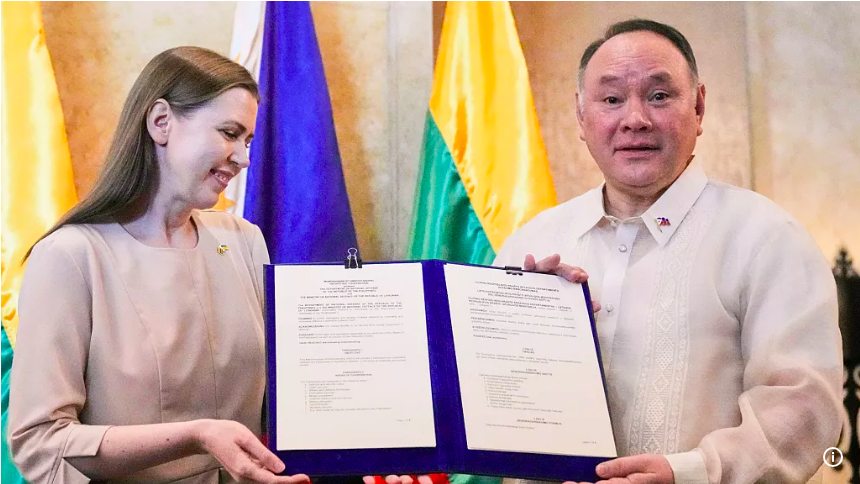
The memorandum of understanding, signed in Manila on Monday by Lithuania’s Defence Minister Dovilė Šakalienė and Philippine Defence Secretary Gilberto Teodoro Jr., lays the groundwork for deeper defence cooperation between the two nations—despite being separated by continents but united by shared security anxieties.
A Pact Born of Common Threats
The agreement focuses on strengthening collaboration in cybersecurity, defence industry development, munitions production, and maritime security—particularly in light of intensifying tensions in the South China Sea, where the Philippines is embroiled in territorial disputes with China.
“What we see now is that authoritarian states are really cooperating very efficiently,” Šakalienė said during a joint press conference with Teodoro. “Their joint actions are threatening the free world… we do not have the luxury to allow this to be annihilated.”
Šakalienė also referenced her remarks made at a defence forum in Singapore, where she warned about the dangerous coordination between authoritarian regimes, citing Russia’s war in Ukraine and China’s aggressive posture toward Taiwan and Southeast Asian waters.
China's Escalating Assertiveness
While China did not immediately respond to the Lithuanian minister’s remarks, the timing of this pact comes amid a significant uptick in Chinese naval and coast guard confrontations with the Philippines in disputed waters. The South China Sea, a vital artery for global trade, has become a flashpoint for regional instability.
Beijing claims nearly the entire sea as its territory—despite a 2016 international arbitration ruling under the UN Convention on the Law of the Sea (UNCLOS) that invalidated China’s sweeping claims. Still, China continues to defy the ruling, using tactics such as water cannon attacks, ship blockades, and high-risk maneuvers against Filipino vessels.
“We see these horrifying materials—videos of how they are threatening Filipino fishermen, how they are treating people who are simply making there living in their own waters,” Šakalienė said.
Maritime Law in the Crosshairs
Defence Secretary Gilberto Teodoro emphasised the pact’s importance not just in addressing physical security threats but also in upholding the rule of law in international waters.
“We must resist any unilateral attempts to reword or re-engineer maritime law and the international order to the benefit of new powers that want to dominate the world to the detriment of smaller nations,” Teodoro stated.
The Philippines has adopted a “name and shame” strategy in recent years, documenting Chinese aggression and releasing footage to the international community. This tactic has helped Manila gain diplomatic support, even from countries that are geographically distant, such as Lithuania—a NATO and EU member with its own long-standing wariness toward Russia and China.
Lithuania’s Global Pivot
Lithuania has emerged as one of the most vocal EU countries in criticising China’s global behaviour, particularly its treatment of Taiwan and its disinformation campaigns. Vilnius opened a Taiwanese representative office in 2021, drawing fierce backlash and economic retaliation from Beijing. Since then, Lithuania has intensified efforts to build alliances with like-minded democracies, particularly those on the frontline of geopolitical hotspots.
By partnering with the Philippines, Lithuania extends its Indo-Pacific engagement and signals its commitment to defending democratic values beyond Europe’s borders.
The Bigger Picture: An Arc of Security
This bilateral pact aligns with Philippine President Ferdinand Marcos Jr.’s strategy of building an “arc of security alliances”—strengthening ties not only with traditional partners like the United States but also with Europe and Asia-Pacific democracies.
As China seeks to assert dominance in the region, smaller states like the Philippines are looking to pool resources and forge new security architectures that can deter authoritarian encroachment.
While the Lithuania-Philippines agreement may not carry the military weight of longstanding alliances, it symbolises a growing network of cooperation aimed at countering coercion and preserving international norms.
Final Thoughts
The signing of this security agreement between Lithuania and the Philippines is more than a symbolic gesture—it’s a reflection of how deeply interconnected global security concerns have become. What happens in the South China Sea matters in Eastern Europe, and vice versa. As authoritarian regimes tighten their grip and collaborate more openly, democracies—no matter their size or geography—are finding strength in solidarity.
“If they work together to threaten us, then we must work together to defend ourselves,” Šakalienė concluded.
As tensions mount across continents, this new partnership is a clear signal: smaller democracies are stepping up to safeguard a rules-based world order.
Conclusion
The new security pact between Lithuania and the Philippines is a striking example of how smaller democracies are banding together in response to a shifting global power dynamic. As authoritarian states like China and Russia deepen their cooperation and challenge international norms, countries that value freedom, sovereignty, and rule of law are building strategic alliances across continents.
This agreement, though not a traditional military treaty, sends a clear message: democracies, regardless of size or proximity, will not stand idle in the face of aggression. By focusing on shared challenges—from cybersecurity to maritime security—the Philippines and Lithuania are laying the groundwork for a broader, more resilient network of cooperation. In an increasingly polarised world, this kind of proactive partnership could prove crucial in defending global stability and democratic values.
Meta Description:
Lithuania and the Philippines sign a security pact to boost defence ties and counter threats from the China-Russia "authoritarian axis." Here's what it means for global security.
Lithuania and the Philippines Forge Security Pact to Counter China-Russia ‘Authoritarian Axis’
In a powerful diplomatic move that signals growing global concern over authoritarian expansion, Lithuania and the Philippines have signed a security agreement aimed at countering the increasing influence of what they describe as a rising “authoritarian axis” comprising China, Russia, North Korea, and Iran.
The memorandum of understanding, signed in Manila on Monday by Lithuania’s Defence Minister Dovilė Šakalienė and Philippine Defence Secretary Gilberto Teodoro Jr., lays the groundwork for deeper defence cooperation between the two nations—despite being separated by continents but united by shared security anxieties.
Register for Tekedia Mini-MBA edition 20 (June 8 – Sept 5, 2026).
Register for Tekedia AI in Business Masterclass.
Join Tekedia Capital Syndicate and co-invest in great global startups.
Register for Tekedia AI Lab.
A Pact Born of Common Threats
The agreement focuses on strengthening collaboration in cybersecurity, defence industry development, munitions production, and maritime security—particularly in light of intensifying tensions in the South China Sea, where the Philippines is embroiled in territorial disputes with China.
“What we see now is that authoritarian states are really cooperating very efficiently,” Šakalienė said during a joint press conference with Teodoro. “Their joint actions are threatening the free world… we do not have the luxury to allow this to be annihilated.”

Šakalienė also referenced her remarks made at a defence forum in Singapore, where she warned about the dangerous coordination between authoritarian regimes, citing Russia’s war in Ukraine and China’s aggressive posture toward Taiwan and Southeast Asian waters.
China's Escalating Assertiveness
While China did not immediately respond to the Lithuanian minister’s remarks, the timing of this pact comes amid a significant uptick in Chinese naval and coast guard confrontations with the Philippines in disputed waters. The South China Sea, a vital artery for global trade, has become a flashpoint for regional instability.

Beijing claims nearly the entire sea as its territory—despite a 2016 international arbitration ruling under the UN Convention on the Law of the Sea (UNCLOS) that invalidated China’s sweeping claims. Still, China continues to defy the ruling, using tactics such as water cannon attacks, ship blockades, and high-risk maneuvers against Filipino vessels.
“We see these horrifying materials—videos of how they are threatening Filipino fishermen, how they are treating people who are simply making there living in their own waters,” Šakalienė said.
Maritime Law in the Crosshairs
Defence Secretary Gilberto Teodoro emphasised the pact’s importance not just in addressing physical security threats but also in upholding the rule of law in international waters.
“We must resist any unilateral attempts to reword or re-engineer maritime law and the international order to the benefit of new powers that want to dominate the world to the detriment of smaller nations,” Teodoro stated.
The Philippines has adopted a “name and shame” strategy in recent years, documenting Chinese aggression and releasing footage to the international community. This tactic has helped Manila gain diplomatic support, even from countries that are geographically distant, such as Lithuania—a NATO and EU member with its own long-standing wariness toward Russia and China.
Lithuania’s Global Pivot
Lithuania has emerged as one of the most vocal EU countries in criticising China’s global behaviour, particularly its treatment of Taiwan and its disinformation campaigns. Vilnius opened a Taiwanese representative office in 2021, drawing fierce backlash and economic retaliation from Beijing. Since then, Lithuania has intensified efforts to build alliances with like-minded democracies, particularly those on the frontline of geopolitical hotspots.
By partnering with the Philippines, Lithuania extends its Indo-Pacific engagement and signals its commitment to defending democratic values beyond Europe’s borders.
The Bigger Picture: An Arc of Security
This bilateral pact aligns with Philippine President Ferdinand Marcos Jr.’s strategy of building an “arc of security alliances”—strengthening ties not only with traditional partners like the United States but also with Europe and Asia-Pacific democracies.
As China seeks to assert dominance in the region, smaller states like the Philippines are looking to pool resources and forge new security architectures that can deter authoritarian encroachment.
While the Lithuania-Philippines agreement may not carry the military weight of longstanding alliances, it symbolises a growing network of cooperation aimed at countering coercion and preserving international norms.
Final Thoughts
The signing of this security agreement between Lithuania and the Philippines is more than a symbolic gesture—it’s a reflection of how deeply interconnected global security concerns have become. What happens in the South China Sea matters in Eastern Europe, and vice versa. As authoritarian regimes tighten their grip and collaborate more openly, democracies—no matter their size or geography—are finding strength in solidarity.
“If they work together to threaten us, then we must work together to defend ourselves,” Šakalienė concluded.
As tensions mount across continents, this new partnership is a clear signal: smaller democracies are stepping up to safeguard a rules-based world order.
Conclusion
The new security pact between Lithuania and the Philippines is a striking example of how smaller democracies are banding together in response to a shifting global power dynamic. As authoritarian states like China and Russia deepen their cooperation and challenge international norms, countries that value freedom, sovereignty, and rule of law are building strategic alliances across continents.
This agreement, though not a traditional military treaty, sends a clear message: democracies, regardless of size or proximity, will not stand idle in the face of aggression. By focusing on shared challenges—from cybersecurity to maritime security—the Philippines and Lithuania are laying the groundwork for a broader, more resilient network of cooperation. In an increasingly polarised world, this kind of proactive partnership could prove crucial in defending global stability and democratic values.
Meta Description:
Lithuania and the Philippines sign a security pact to boost defence ties and counter threats from the China-Russia "authoritarian axis." Here's what it means for global security.
Share this:
- Click to share on Facebook (Opens in new window) Facebook
- Click to share on X (Opens in new window) X
- Click to share on WhatsApp (Opens in new window) WhatsApp
- Click to share on LinkedIn (Opens in new window) LinkedIn
- Click to email a link to a friend (Opens in new window) Email
- Click to print (Opens in new window) Print