

Mürren: Switzerland’s Medieval Alpine Village Reaches New Heights with World’s Steepest Cable Car

Quote from Alex Bobby on December 15, 2025, 7:13 AM
Discover Mürren, the medieval Swiss hamlet now connected by the world’s steepest cable car. Explore its car-free streets, Alpine beauty, and close-knit community perched high in the Bernese Oberland.
Mürren: The Medieval Swiss Hamlet Reaches New Heights
Nestled in the heart of the Bernese Oberland, Mürren has remained, for centuries, a quiet Alpine hamlet largely untouched by modern life. With a population of just 430 residents, the village clings to a natural terrace beneath the Schilthorn summit, 1,638 meters above sea level, surrounded by jagged peaks, snow-covered pines, and the dramatic expanse of the Lauterbrunnen valley. For much of its history, Mürren’s residents lived in relative seclusion, relying on endurance, community, and a few key transport connections to sustain their way of life.
Last year, I made the scenic journey from Geneva to Lauterbrunnen—a three-hour train ride through the breathtaking Swiss Alps—arriving at the gateway to Mürren, a car-free village that has long resisted modern encroachment. For centuries, life in Mürren required perseverance. Residents would lead mules three hours down into the valley to gather essentials before trekking back up the steep mountain paths. In the late 19th century, narrow-gauge railways and funiculars began to make the journey slightly easier. In 1891, a railway connected Mürren to Grütschalp, while a funicular reached down to Lauterbrunnen. Later, in 1965, a single-track cableway linked the hamlet to the neighboring car-free village of Gimmelwald.
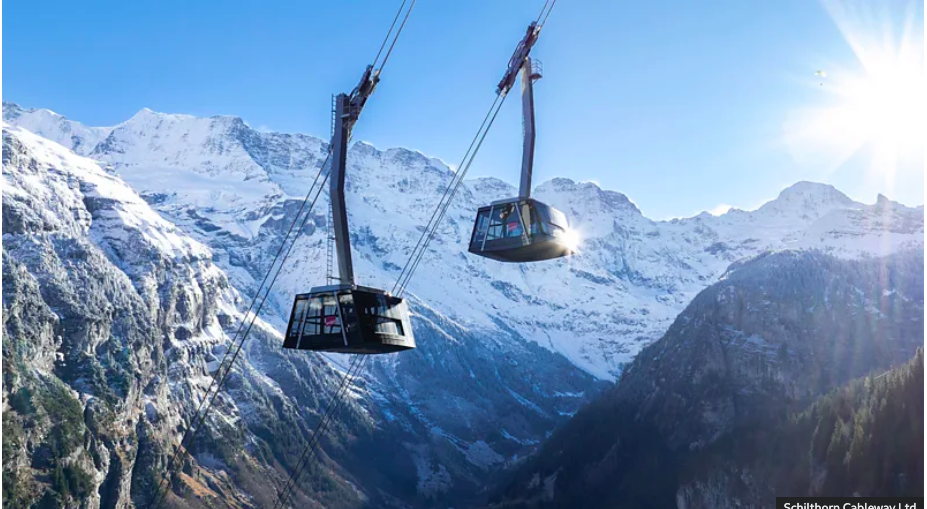
But the latest development has changed the way Mürren interacts with the outside world: the world’s steepest cable car, the Schilthornbahn, now rises 775 meters up the vertical Mürrenfluh rockface in just four minutes. The gradient, a staggering 159.4%, surpasses the previous record-holder, Norway’s Loen Skylift, which climbs at 133%. This engineering marvel brings visitors directly from the valley floor at Stechelberg to the edge of Mürren, offering views that are nothing short of spectacular.
The first time I stepped into the glass-enclosed cabin, I felt a thrill unlike any other. Looking down, the storybook cottages of Mürren appeared to float amidst the jagged crags and snow-dusted evergreens. The ascent was so smooth that I hardly noticed the extreme gradient until my ears popped. Four minutes later, I was perched on the natural terrace at the village’s edge, gazing out over the Lauterbrunnen valley and imagining what life might have been like here centuries ago.
Life in a Secluded Village
Despite Mürren’s breathtaking scenery, everyday life here has historically demanded self-reliance. As native Michael Abegglen explains, even with a small but resilient infrastructure, some necessities require a journey down to the valley. “Most everyday necessities and services are available in Mürren,” he says, “but every time we need a doctor, hairdresser, or dentist, we need to go down to the valley where many of us have our cars parked.”
For Abegglen and other residents, the cable car has long been an integral part of daily life. “Taking the cable car to school might seem unusual to many,” he adds, “but it was an everyday ritual for me.” The vertical journey is embedded in the rhythms of the village: commuting, grocery runs, and even social visits often involve the aerial lift.
Because of its extreme location, Mürren has never been connected to the outside world by road. This isolation has shaped a strong sense of community among the year-round residents. “When you grow up here like I did, you know almost everyone,” Abegglen says. “There’s a close-knit community. Some guests are like locals, as they return to Mürren every single year.”
History Preserved in Stone and Timber
Mürren’s charm is not only in its altitude but in its architecture and history. The village dates back to the 13th century, with traditional stone and timber chalets that appear to cling precariously to the mountainside. Narrow cobbled lanes wind between cottages adorned with wooden balconies and flower boxes, while the backdrop of the Schilthorn summit and the Jungfrau massif provides a constantly changing panorama through the seasons.
The village has retained its medieval character partly because of its seclusion. Without roads, cars, or mass tourism, Mürren has escaped the modernization that often transforms Alpine towns. Instead, it offers visitors a glimpse of historical Swiss life: quiet mornings, neighborly greetings, and a landscape designed to inspire reflection and connection to nature.
The Cable Car: Bridging Past and Present
While the Schilthornbahn is a modern engineering feat, it is deeply in keeping with the rhythms of the village. For residents, it reduces travel time and makes essential services more accessible. For visitors, it opens up Mürren’s dramatic scenery, allowing them to experience a historically secluded village that was once reachable only by long, arduous treks or limited railways.
The cable car also highlights a broader theme: the balance between preserving tradition and embracing accessibility. Mürren remains car-free, its architecture and character intact, but the cable car ensures that the village is no longer entirely cut off from the outside world.
Visitors arriving via the Schilthornbahn can explore Mürren’s quiet lanes, enjoy locally prepared Alpine cuisine, or simply pause and take in the sweeping views. The village’s charm lies in its dual identity: a place steeped in history yet connected to modern life through innovation that respects its natural and cultural heritage.
Final Thought
Mürren is a rare gem where history, community, and breathtaking Alpine scenery converge. The opening of the world’s steepest cable car brings this once-secluded hamlet closer to the world, yet it preserves the village’s timeless charm and close-knit spirit. For travelers, Mürren is more than a destination—it’s an invitation to slow down, immerse in nature, and witness a way of life that has endured for centuries, reminding us that even in a rapidly modernizing world, some places remain beautifully untouched.
Conclusion
Mürren is more than a picturesque Alpine village; it is a living testament to human resilience and community in extreme landscapes. From centuries of mule treks to railways and now the world’s steepest cable car, the village has evolved while maintaining its medieval character and close-knit society. For visitors, Mürren offers a rare opportunity to experience Switzerland’s natural beauty, history, and Alpine culture in one breathtaking package.
Looking Forward
The opening of the Schilthornbahn signals a new chapter for Mürren. While the village retains its seclusion and charm, it is now more accessible than ever. This careful integration of modern infrastructure with traditional life may serve as a model for other mountain communities seeking to balance heritage preservation with tourism and accessibility. For travelers, Mürren promises not only spectacular scenery but a chance to experience a community where centuries of history meet the ingenuity of the present, creating an Alpine escape unlike any other.
Discover Mürren, the medieval Swiss hamlet now connected by the world’s steepest cable car. Explore its car-free streets, Alpine beauty, and close-knit community perched high in the Bernese Oberland.
Mürren: The Medieval Swiss Hamlet Reaches New Heights
Nestled in the heart of the Bernese Oberland, Mürren has remained, for centuries, a quiet Alpine hamlet largely untouched by modern life. With a population of just 430 residents, the village clings to a natural terrace beneath the Schilthorn summit, 1,638 meters above sea level, surrounded by jagged peaks, snow-covered pines, and the dramatic expanse of the Lauterbrunnen valley. For much of its history, Mürren’s residents lived in relative seclusion, relying on endurance, community, and a few key transport connections to sustain their way of life.
Last year, I made the scenic journey from Geneva to Lauterbrunnen—a three-hour train ride through the breathtaking Swiss Alps—arriving at the gateway to Mürren, a car-free village that has long resisted modern encroachment. For centuries, life in Mürren required perseverance. Residents would lead mules three hours down into the valley to gather essentials before trekking back up the steep mountain paths. In the late 19th century, narrow-gauge railways and funiculars began to make the journey slightly easier. In 1891, a railway connected Mürren to Grütschalp, while a funicular reached down to Lauterbrunnen. Later, in 1965, a single-track cableway linked the hamlet to the neighboring car-free village of Gimmelwald.
Register for Tekedia Mini-MBA edition 20 (June 8 – Sept 5, 2026).
Register for Tekedia AI in Business Masterclass.
Join Tekedia Capital Syndicate and co-invest in great global startups.
Register for Tekedia AI Lab.
But the latest development has changed the way Mürren interacts with the outside world: the world’s steepest cable car, the Schilthornbahn, now rises 775 meters up the vertical Mürrenfluh rockface in just four minutes. The gradient, a staggering 159.4%, surpasses the previous record-holder, Norway’s Loen Skylift, which climbs at 133%. This engineering marvel brings visitors directly from the valley floor at Stechelberg to the edge of Mürren, offering views that are nothing short of spectacular.
The first time I stepped into the glass-enclosed cabin, I felt a thrill unlike any other. Looking down, the storybook cottages of Mürren appeared to float amidst the jagged crags and snow-dusted evergreens. The ascent was so smooth that I hardly noticed the extreme gradient until my ears popped. Four minutes later, I was perched on the natural terrace at the village’s edge, gazing out over the Lauterbrunnen valley and imagining what life might have been like here centuries ago.
Life in a Secluded Village

Despite Mürren’s breathtaking scenery, everyday life here has historically demanded self-reliance. As native Michael Abegglen explains, even with a small but resilient infrastructure, some necessities require a journey down to the valley. “Most everyday necessities and services are available in Mürren,” he says, “but every time we need a doctor, hairdresser, or dentist, we need to go down to the valley where many of us have our cars parked.”
For Abegglen and other residents, the cable car has long been an integral part of daily life. “Taking the cable car to school might seem unusual to many,” he adds, “but it was an everyday ritual for me.” The vertical journey is embedded in the rhythms of the village: commuting, grocery runs, and even social visits often involve the aerial lift.
Because of its extreme location, Mürren has never been connected to the outside world by road. This isolation has shaped a strong sense of community among the year-round residents. “When you grow up here like I did, you know almost everyone,” Abegglen says. “There’s a close-knit community. Some guests are like locals, as they return to Mürren every single year.”

History Preserved in Stone and Timber
Mürren’s charm is not only in its altitude but in its architecture and history. The village dates back to the 13th century, with traditional stone and timber chalets that appear to cling precariously to the mountainside. Narrow cobbled lanes wind between cottages adorned with wooden balconies and flower boxes, while the backdrop of the Schilthorn summit and the Jungfrau massif provides a constantly changing panorama through the seasons.
The village has retained its medieval character partly because of its seclusion. Without roads, cars, or mass tourism, Mürren has escaped the modernization that often transforms Alpine towns. Instead, it offers visitors a glimpse of historical Swiss life: quiet mornings, neighborly greetings, and a landscape designed to inspire reflection and connection to nature.
The Cable Car: Bridging Past and Present
While the Schilthornbahn is a modern engineering feat, it is deeply in keeping with the rhythms of the village. For residents, it reduces travel time and makes essential services more accessible. For visitors, it opens up Mürren’s dramatic scenery, allowing them to experience a historically secluded village that was once reachable only by long, arduous treks or limited railways.
The cable car also highlights a broader theme: the balance between preserving tradition and embracing accessibility. Mürren remains car-free, its architecture and character intact, but the cable car ensures that the village is no longer entirely cut off from the outside world.
Visitors arriving via the Schilthornbahn can explore Mürren’s quiet lanes, enjoy locally prepared Alpine cuisine, or simply pause and take in the sweeping views. The village’s charm lies in its dual identity: a place steeped in history yet connected to modern life through innovation that respects its natural and cultural heritage.
Final Thought
Mürren is a rare gem where history, community, and breathtaking Alpine scenery converge. The opening of the world’s steepest cable car brings this once-secluded hamlet closer to the world, yet it preserves the village’s timeless charm and close-knit spirit. For travelers, Mürren is more than a destination—it’s an invitation to slow down, immerse in nature, and witness a way of life that has endured for centuries, reminding us that even in a rapidly modernizing world, some places remain beautifully untouched.
Conclusion
Mürren is more than a picturesque Alpine village; it is a living testament to human resilience and community in extreme landscapes. From centuries of mule treks to railways and now the world’s steepest cable car, the village has evolved while maintaining its medieval character and close-knit society. For visitors, Mürren offers a rare opportunity to experience Switzerland’s natural beauty, history, and Alpine culture in one breathtaking package.
Looking Forward
The opening of the Schilthornbahn signals a new chapter for Mürren. While the village retains its seclusion and charm, it is now more accessible than ever. This careful integration of modern infrastructure with traditional life may serve as a model for other mountain communities seeking to balance heritage preservation with tourism and accessibility. For travelers, Mürren promises not only spectacular scenery but a chance to experience a community where centuries of history meet the ingenuity of the present, creating an Alpine escape unlike any other.
Uploaded files:Share this:
- Click to share on Facebook (Opens in new window) Facebook
- Click to share on X (Opens in new window) X
- Click to share on WhatsApp (Opens in new window) WhatsApp
- Click to share on LinkedIn (Opens in new window) LinkedIn
- Click to email a link to a friend (Opens in new window) Email
- Click to print (Opens in new window) Print