

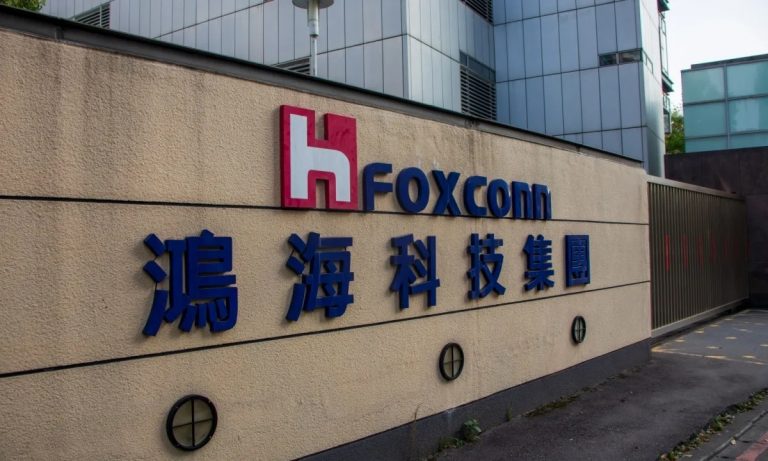
Foxconn is ramping up its push into artificial intelligence infrastructure, announcing on Wednesday that it is taking a 10% stake in TECO Electric & Machinery Co.
The move marks a strategic pivot for the Taiwanese electronics giant—formally known as Hon Hai Precision Industry—as it eyes a dominant role in the global race to build next-generation AI data centers.
The share-swap deal deepens cooperation between the two companies and comes at a moment of massive investment in data infrastructure, with analysts at Counterpoint Research estimating global spending on data centers could top $1 trillion in the coming years. Foxconn, best known for assembling Apple’s iPhones, is now attempting to leverage its manufacturing expertise into new markets, particularly AI, where it also partners with Nvidia to build servers designed for high-performance computing.
Register for Tekedia Mini-MBA edition 20 (June 8 – Sept 5, 2026).
Register for Tekedia AI in Business Masterclass.
Join Tekedia Capital Syndicate and co-invest in great global startups.
Register for Tekedia AI Lab.
The new alliance with TECO is intended to create a “one-stop shop” for AI data centers, ranging from the design and manufacturing of server components to full-scale infrastructure deployment. TECO, which began as a motor manufacturer, now has experience in electric vehicles, energy storage systems, and large-scale industrial construction. The companies say the joint initiative will focus on Taiwan, parts of Asia, the Middle East, and the United States, where both firms already have a manufacturing footprint.
“The strategic partnership extends the two companies’ cooperation in the fields of low-carbon smart factories and energy services, toward being a one-stop solution for data centers going forward,” said TECO Chairman Morris Li in a statement.
Foxconn’s ambitions in this space are driven by the booming demand for AI processing power. The company previously forecast that its AI server revenue would double in the second quarter of 2025, driven by surging global demand for infrastructure supporting large language models and generative AI tools. Its servers are purpose-built for AI workloads, which require enormous amounts of computation and storage, far more than traditional enterprise applications.

Neil Shah, partner at Counterpoint Research, described the TECO-Foxconn alliance as a tightly integrated supply chain play.
“With the AI infrastructure boom, Hon Hai with a strategic alliance with TECO aims to extend and tightly integrate the server components and racks value chain from co-design, manufacturing to engineering and infrastructure construction services,” he said. “Hon Hai aims to become a one-stop shop for all the data center needs.”
Beyond server racks and chips, Foxconn is betting that full-stack offerings will be key to winning major contracts. That includes everything from the physical hardware to the energy-efficient cooling and power systems needed to operate hyperscale data centers. By pairing TECO’s energy and infrastructure engineering capabilities with its own electronics manufacturing capacity, Foxconn believes it can offer a vertically integrated solution that rivals global players like Siemens, ABB, and Mitsubishi Electric.

The partnership also ties into broader geopolitical shifts in supply chains. Both companies indicated their joint project will support U.S. manufacturing and help “reshape the global supply chain,” reflecting the increasing importance of localized production in sensitive technology sectors such as AI, semiconductors, and energy systems.
With tech giants like Microsoft, Amazon, and Google committing tens of billions of dollars to AI infrastructure in 2025 alone, Foxconn is aggressively positioning itself to become a crucial supplier not just of components, but of entire data center ecosystems. The tie-up with TECO underlines its intent to go beyond its legacy role in consumer devices and become a central player in the physical foundation of the AI age.